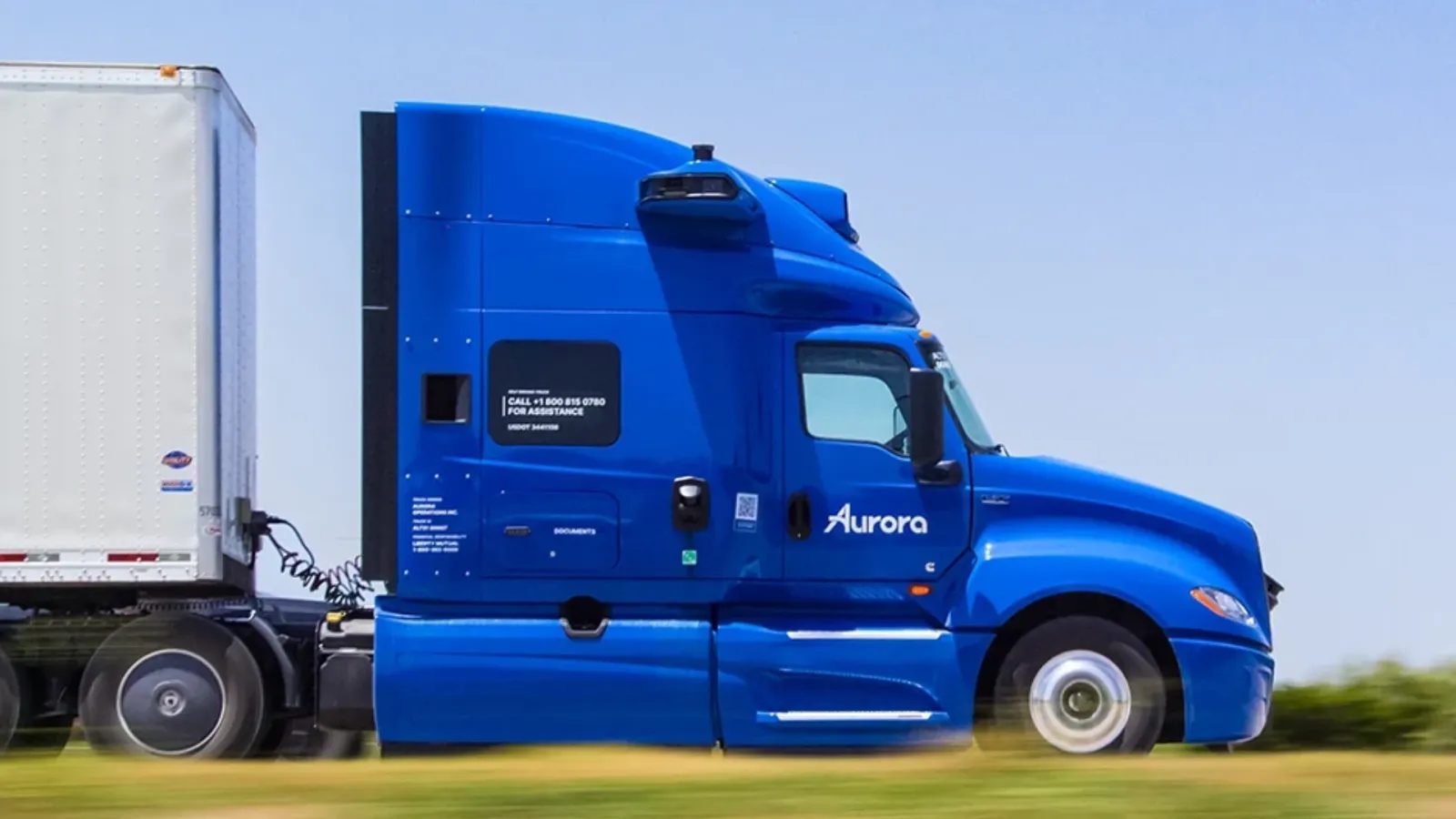

Aurora Innovation targets more than 30,000 driverless trucks in operation by 2030, the company said on Wednesday as it opened its 2026 Analyst and Investor Day in Dallas.
According to the company’s statement, the 2030 fleet would deliver a multi-billion dollar revenue stream and gross margins comparable to software-as-a-service businesses under its Driver as a Service (DaaS) model.
The Pittsburgh-based self-driving firm set no interim fleet targets for 2027 through 2029 in the release, and gave no specific revenue or margin figure for 2030.
“We have emerged from the building phase and are revolutionizing how goods move,” Co-founder and Chief Executive Officer Chris Urmson said.
Attendees at the event were offered rides in Aurora Driver-powered trucks with no one behind the wheel on a segment of the company’s Dallas-to-Houston commercial route.
Aurora described these as industry-first driverless passenger rides.
Chief Financial Officer David Maday said the company’s momentum puts it on the path to profitability.
Fleet and Customers
Aurora said it has nearly doubled its driverless customers in 2026 and is fully allocated to exit the year with 200 driverless trucks operating under Transport as a Service (TaaS) agreements.
Its second-quarter shareholder letter had put that target at “more than 200” trucks.
The shareholder letter projected 20 to 25 second-generation driverless trucks by the end of the third quarter, all built on the International LT Series truck.
Aurora had about 20 driverless trucks on the road this week, CNBC reported, leaving approximately 180 to add in the fourth quarter.
According to the company, a 200-truck exit fleet translates to an annualized TaaS revenue run-rate of about $80 million.
Current revenue remains small.
Aurora reported a second-quarter net loss of $270 million on $2 million in revenue, and ended the quarter with nearly $1.2 billion in cash and short-term investments.
Management guided 2026 revenue to between $14 million and $16 million, with more than half expected in the fourth quarter.
Urmson told CNBC this week that Aurora is targeting positive free cash flow in 2028.
Hirschbach intends to own and operate 500 Aurora-powered trucks through a DaaS agreement, with deliveries slated to begin in 2027, according to the release.
Aurora’s forward-looking statements in the same release describe Hirschbach’s commitment as a non-binding memorandum of understanding. The two companies first announced the plan in May.
Additionally, Aurora said it is negotiating DaaS agreements with a number of additional customers.
Maday has put the TaaS per-mile revenue outlook at over $2, while the DaaS subscription targets over $0.85 per mile.
The Aurora Driver has completed more than 500,000 driverless miles since commercial launch,
At the end of June, the figure stood at nearly 440,000.
Trucks running for McLane, Werner and other customers average an annualized rate of over 225,000 miles a year, more than double a traditional truck, according to Aurora.
The American Transportation Research Institute put the average at 85,991 miles per truck in 2025.
Hardware and Manufacturing
Aurora’s second-generation commercial hardware kit is engineered for a one-million-mile operating life and cuts costs by more than half, which the company called a critical milestone on the path to positive gross profit.
In its fourth-quarter 2025 shareholder letter, Aurora said it was targeting breakeven gross margin on a run-rate basis exiting 2026.
Upfitter Roush has begun volume production and targets a rate of 20 trucks a week in October.
In July, Aurora said Roush was expected to reach an annual run-rate of 1,000 trucks in October.
Aurora upfits its system on the International LT Series and integrates it lineside on the Volvo VNL Autonomous at Volvo’s New River Valley plant in Virginia.
Volvo Autonomous Solutions plans to begin driverless operations on that truck in the first quarter of 2027.
PACCAR and Aurora are defining a path to integrate the third-generation kit on PACCAR’s future autonomy-enabled platform on its assembly lines.
After Aurora’s 2025 driverless launch, PACCAR asked the company to place an observer in the driver’s seat of its trucks.
The second-generation fleet Aurora launched in July on International trucks runs without a person behind the wheel and without a partner-requested observer.
Furthermore, the company has announced no commercial deployment of autonomous electric trucks and relies on diesel Class 8 vehicles.
Uber Trims Its Stake
Uber, Aurora’s largest shareholder, has sold three blocks of Aurora shares since June for about $1.1 billion in total, according to regulatory filings.
The most recent sale, of 29.4 million shares at $6.21 each, took place on September 15, eight days before the investor day. Uber still holds about 157 million shares.
Competing Freight Models
Aurora launched its commercial driverless service between Dallas and Houston in 2025.
Publicly listed rivals include Kodiak AI and Swedish freight technology company Einride.
Einride said on Monday it will build its next-generation autonomous system on Nvidia’s Drive Hyperion platform, working directly with the Nvidia team.
Einride expects its fleet to reach 1,500 to 2,000 vehicles by 2028.
Einride and Lidl last week put Germany’s first cab-less Level 4 truck into daily operations on a public road, a route of about 400 metres capped at 25 kilometres an hour.
Einride also ordered 500 Tesla Semi trucks in August for Amazon freight corridors, including in Texas. Those trucks carry human drivers.
On Tuesday, Tesla was selected as primary manufacturer for a 2,500-unit battery-electric Class 8 order organised by a shippers’ alliance whose founding members include Microsoft and PepsiCo. Houston, Dallas and San Antonio are among the 10 initial deployment hubs.
Volvo and PACCAR’s Kenworth, both Aurora partners, were named secondary suppliers for that order.
Aurora’s partners include FedEx, McLane, Nvidia, PACCAR, Ryder, Schneider, Toyota, Uber, Volvo Trucks and Werner, according to the release.
Aurora will host a Partner Summit on Thursday with several dozen current and prospective customers.