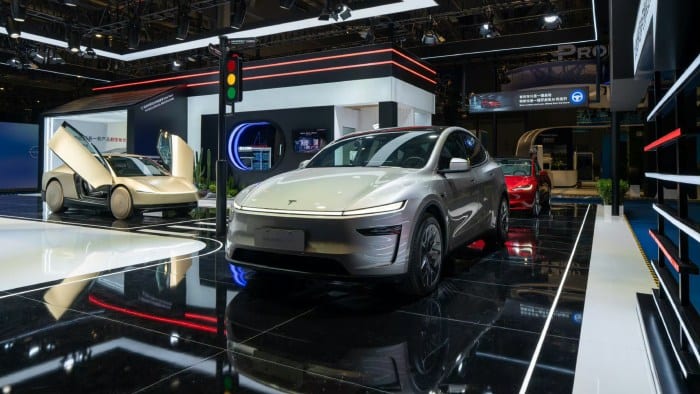

Tesla said on Monday that its Full Self-Driving Supervised system has been approved in the Czech Republic, which would make it the seventh European Union country to clear the software three months after the Czech transport ministry said it would not act ahead of a bloc-wide decision.
“FSD Supervised now approved in Czechia. Rollout will begin soon,” Tesla’s Europe, Middle East and Africa account posted on X, with a short clip of a Tesla driving on city streets.
The post was the only source at the time of writing. The Ministry of Transport had not published a statement, and no Czech outlet had confirmed the approval independently.
In June the ministry said a national route would mean the Czech state taking legal responsibility for an exemption file, which is an administrative act that a manufacturer’s post does not document.
The pattern matches Slovenia two weeks ago, where Tesla posted the approval on September 7 and the infrastructure ministry confirmed it the following day.
What the Ministry Said in June
The Czech position had been the clearest statement of the wait-for-Brussels camp.
On June 10, the day after Denmark became the fourth country to approve, the Ministry of Transport published a lengthy position on X saying the Dutch approval “is temporary, exceptional and valid only on the territory of the Netherlands,” that it “is not an approval automatically valid across the European Union,” and that the Czech Republic would await the European assessment rather than take a national route.
The ministry said the system could react differently from what a driver expects, could briefly exceed speed limits and could perform atypical manoeuvres, that a Level 2 system which changes lanes and takes evasive action without a proper handover risks being misunderstood by drivers, that liability in the event of a crash was unresolved, and that the Dutch file was not a standard manufacturer type-approval request.
It said the matter concerned only a few hundred vehicles in the country. The Czech Tesla community disputed that, pointing to nearly 2,000 new Teslas registered in 2025 alone with FSD-capable hardware.
The ministry also made a point of saying Czechia was not behind on automation.
It has permitted Level 3 conditionally automated systems on its roads since January 2026, the second EU country to do so after Germany, and is preparing legislation for Level 4.
It argued that Tesla’s system, despite being Level 2, differs from other European driver-assistance products in what it does when the driver is not properly engaged. The road safety agency BESIP and the Czech police were both involved in the review.
Whether the ministry has now recognised the Dutch approval, on what conditions, and what changed since June is what its statement, when it comes, will have to answer.
The Seven
If the Czech approval is confirmed, the map reads: Netherlands on April 10, the original RDW type approval under UN Regulation 171 with an Article 39 exemption. Lithuania on May 20 and Estonia on May 29, both recognising the Dutch certificate without their own testing.
Denmark on June 9, after reviewing the file. Belgium on June 10, after 5,000 km of testing in Flanders signed off by Flemish Mobility Minister Annick De Ridder. Slovenia on September 7. Czechia on September 21.
The first six covered about 9.4% of the EU’s population. Czechia’s 10.9 million people add roughly 2.4 percentage points, taking the total to just under 12%.
Every one of the seven is a small or mid-sized state. Germany, France, Italy and Spain, which between them hold enough of the bloc’s population to block a qualified majority, have approved nothing.
The Vote It Precedes
EU-wide recognition requires a qualified majority in the Technical Committee on Motor Vehicles: 55% of member states, meaning at least 15 of the 27, representing 65% of the population.
The committee discussed the Dutch file on June 30 without voting, and Tesla has said the vote could come on October 6.
Tesla published a safety dashboard on September 1 timed to it, claiming 4.1 times fewer collisions than manually driven Teslas across 102 million km in the first five approved countries.
Sweden’s Transport Administration told the committee in an April 30 letter, obtained by Reuters, to vote against unless Tesla removes the speed-offset feature that lets drivers set a margin above the posted limit, and confirmed in June the position had not changed.
Norway has raised the same objection. Finland, which had earlier raised concerns, has since described itself as broadly positive while awaiting Tesla’s answers on driver handover and behaviour on fast curves in poor weather.
France’s transport minister said in July the system was not acceptable in its current form, and France has since begun testing two vehicles. Germany’s KBA has not recognised the Dutch approval.
The Czech ministry’s June objections were the same ones.
Denmark had also voiced doubts at European level before approving in June, but Czechia is the only country to have published a detailed national doctrine of waiting for Brussels. A reversal on the eve of the vote would be the first of that kind.
Tesla ended one-time FSD purchases in Europe from May 21 and sells the system by subscription. It offered two-month trials to owners in approved markets in August, and six approvals had yet to show up in European registration data as of this month.