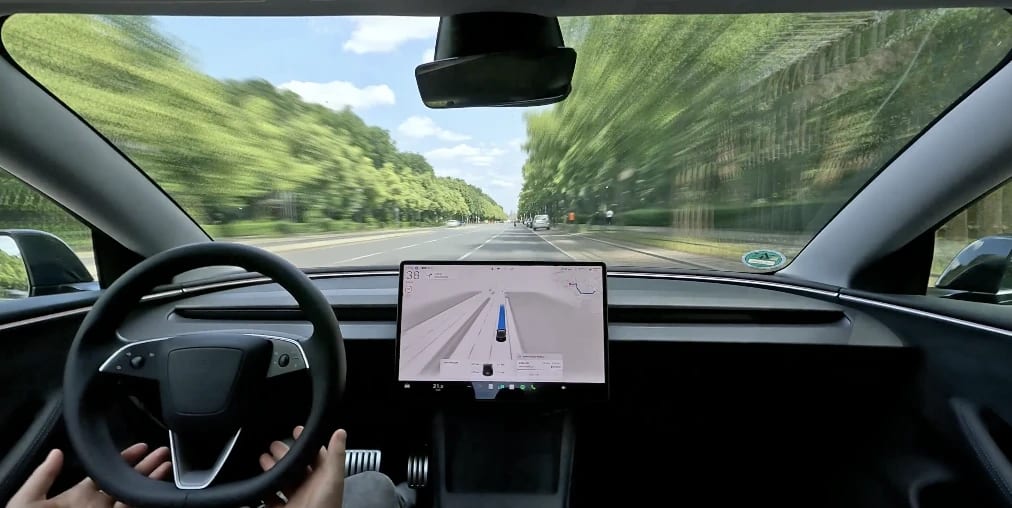

Tesla‘s Full Self-Driving software faces a longer path to European Union-wide approval, after the bloc’s motor-vehicle committee scheduled further discussion of the system, rather than a vote, at its June 30 meeting.
A draft agenda published by the European Commission lists the topic as a continuation of talks, not a decision point.
Item eight on the agenda for the 118th meeting of the Technical Committee on Motor Vehicles reads “Continuation of discussions on request of the Netherlands for an Art. 39 authorisation,” scheduled from 2:40 p.m. to 3:30 p.m. in Brussels.
The document, dated June 4 and signed on June 8, allots the item 50 minutes.
No Vote on the Agenda
The wording is significant.
Two other items on the same agenda were listed for a “final examination and vote,” covering separate rules on in-vehicle battery durability and brake-particle emissions.
The Netherlands request tied to Tesla‘s system was not.
The distinction indicates the committee is not scheduled to decide on EU-wide approval at the June meeting, and will instead continue its review.
June 30’s discussion follows a presentation that the Dutch authority gave at the committee’s previous session on May 5.
The committee, chaired by the European Commission with representatives from all 27 member states, is the body empowered to extend the Dutch approval across the bloc.
First Approved in the Netherlands
Tesla secured its first European clearance on April 10, when the Dutch vehicle authority, the RDW, granted type approval for FSD (Supervised) in the Netherlands.
The approval was issued under UN Regulation 171, the standard governing driver control assistance systems, together with an exemption under Article 39 of EU Regulation 2018/858, the provision for technologies that do not fit existing harmonized rules.
It followed more than 18 months of testing and over 1.6 million kilometers on European roads, along with extensive customer ride-alongs and documentation of compliance requirements.
The system is classified as a Level 2 driver aid rather than autonomous driving.
Drivers remain legally responsible at all times, eye-tracking cameras monitor their attention, and the vehicle issues escalating alerts before disabling the feature and coming to a controlled stop if a driver fails to respond.
The RDW has said the vehicles are not self-driving.
Expansion by Mutual Recognition
The Dutch decision does not automatically apply in other member states, but it established a record that other authorities can recognize.
Under EU mutual recognition, a national authority may accept the Dutch approval without repeating the testing.
Tesla has used that route to expand.
Lithuania became the second country to activate FSD (Supervised) on May 20, recognizing the Dutch certification, and Estonia followed as the third on May 29.
Estonia has recently followed, becoming the third country in the Old Continent to approve it.
Belgium, Greece, Spain, Germany, France and Italy are among the markets still working through national recognition or domestic testing.
The alternative is harmonization across all 27 member states simultaneously, which is the process before the committee on June 30.
The Path to a Bloc-Wide Vote
EU-wide approval requires a qualified-majority vote in the Technical Committee on Motor Vehicles, under the comitology procedure set out in EU Regulation 2018/858.
That threshold requires at least 15 of the 27 member states, representing 65% of the EU population, to vote in favor.
Should the committee approve the Dutch request, the European Commission could adopt an implementing act extending the Article 39 exemption across the bloc, replacing the current patchwork of national recognitions with a single approval.
The RDW notified the Commission of its intention to seek that recognition on April 13 and presented its case on May 5.
“If it is good enough for the Netherlands, it is good enough for Europe,” the RDW’s general manager of type approvals told Reuters after the Dutch decision.
A rejection would not reverse the approvals already granted.
Tesla would retain its Netherlands clearance, and individual countries could still issue their own recognitions.
Objections From Nordic States
The measured pace reflects unease among several member states.
Regulators in Sweden, Finland, Denmark and Norway have raised objections to FSD, according to email correspondence recently reported by Reuters.
Their concerns center on the system’s handling of posted speed limits, its performance on icy roads, and whether the “Full Self-Driving” name overstates the technology’s capabilities.
Those countries’ votes could prove decisive in any qualified-majority count.
Sweden’s transport agency has questioned why the system is permitted to exceed speed limits, and a regional authority in Uppsala declined a Tesla request to test the system on public roads, citing safety and traffic concerns.
Rollout Timeline Slips
Tesla had targeted EU-wide availability by the summer of 2026.
With no vote on the June 30 agenda, the earliest opportunity moves to a later committee session, a body that typically convenes only every few months.
That pushes a bloc-wide decision toward the autumn at the earliest, and some industry trackers now project full EU recognition slipping into the first quarter of 2027.
The company’s projections have preceded the regulator’s timetable before.
Tesla said late last year that the Dutch approval would come in February; the RDW clarified that it had agreed only to a demonstration, and the clearance ultimately arrived in April.
Commercial Stakes
The European rollout bears on a part of Tesla‘s business that increasingly informs its valuation.
FSD (Supervised) is offered in Europe through a subscription priced at 99 euros a month, and the approval so far covers only vehicles fitted with Tesla‘s Hardware 4 computer, leaving owners of older cars without access.
A limited FSD (Supervised) version is being planned for HW3 vehicles at a later stage.