
Tesla appears to be edging closer to regulatory approval for its Full Self-Driving (Supervised) system in Flanders, Belgium.
Flemish Minister of Mobility Annick De Ridder announced on Tuesday that she has asked Tesla to submit its FSD file to the Flemish administration, with instructions to provide clarity on a possible fast-track homologation by the end of the week.
De Ridder wrote on X that the file “is now with my administration, which I have instructed to provide clarity by the end of the week on a possible fast-track homologation.”
The minister framed the move as part of a broader effort to position Flanders as a region open to innovation.
“Because innovation shouldn’t be slowed down, but enabled in a thoughtful and safe way,” she added. “That’s how we keep Flanders at the forefront as a forward-looking region.”
Flanders, Belgium’s Dutch-speaking northern region, shares a border with the Netherlands — the only EU member state where Tesla‘s FSD (Supervised) is currently approved and operational.
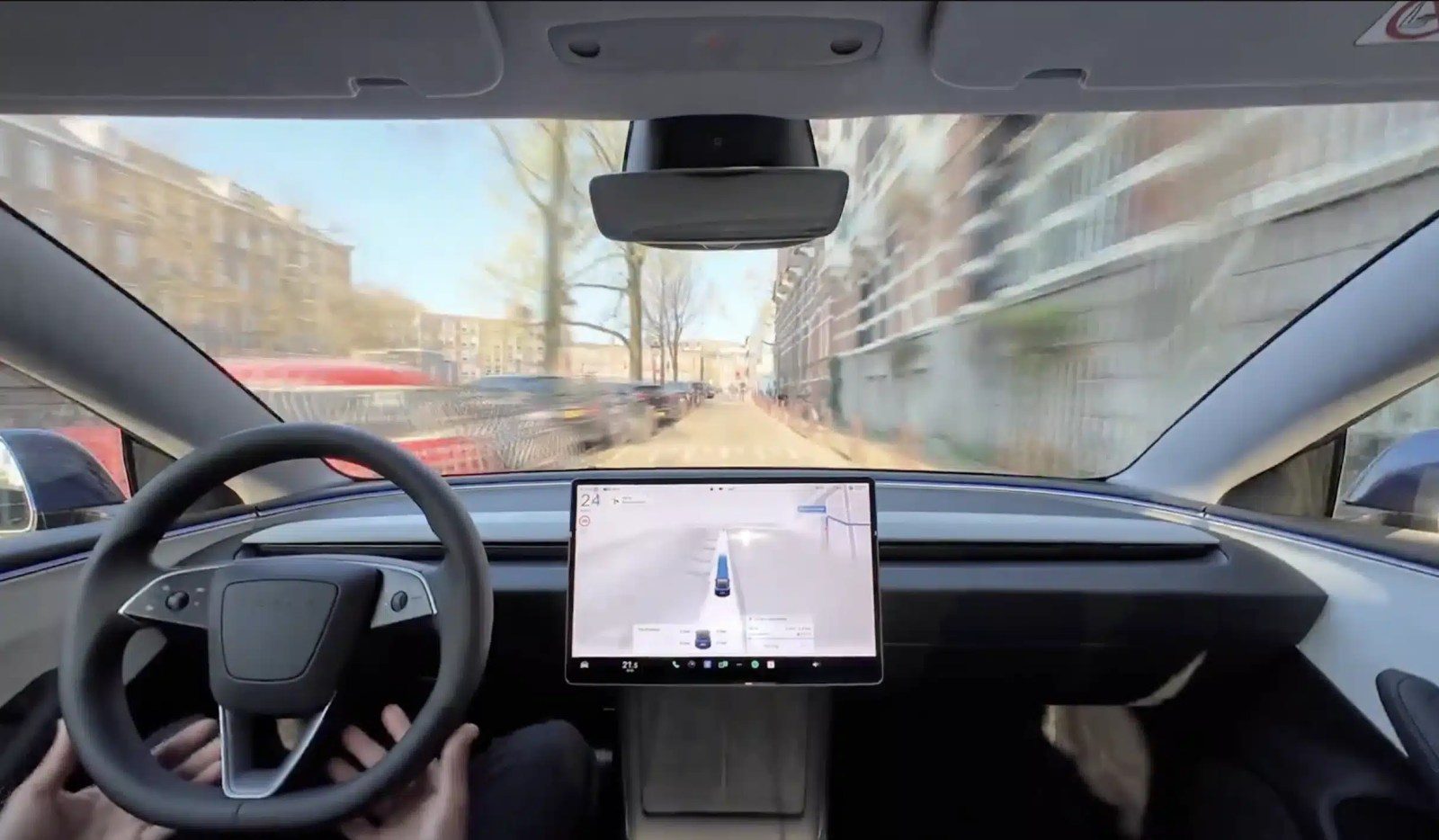
Since April 10, Dutch Tesla owners with Hardware 4 vehicles have been driving with FSD active on public roads, following the RDW’s provisional type-approval under UN Regulation 171.
Tesla vehicles equipped with FSD in the Netherlands are geo-fenced to Dutch borders — when approaching Belgium or Germany, the system alerts the driver and disables itself.
A Flemish homologation could remove that barrier for cross-border driving and open a second European market to the software.
Belgium’s federal structure adds a layer of complexity that other EU countries do not face.
Vehicle inspection and road policy have been regionalized since the sixth state reform, meaning Flanders, Wallonia, and the Brussels-Capital Region each hold competences over aspects of vehicle homologation.
De Ridder’s announcement applies to the Flemish administration’s area of responsibility.
As EV previously reported, an earlier inquiry to the cabinet of Flemish Minister-President Matthias Diependaele confirmed that internal discussions were underway, with a reply suggesting the system could be regionally approved even before the EU-level process concludes.
EU Regulators Meet in Brussels
De Ridder’s announcement landed on the same day that the European Commission’s Technical Committee on Motor Vehicles (TCMV) convened in Brussels to discuss the Dutch FSD approval.
The Dutch vehicle authority RDW presented its Article 39 file for Tesla‘s FSD (Supervised) during the 117th TCMV meeting.
The session was originally allocated a 20-minute slot within a morning block but was later extended to a dedicated one-hour afternoon session starting at 13:30, according to a revised agenda published by the European Commission.
The session is expected to serve as an informational briefing for all 27 member states, with the earliest realistic opportunity for a formal qualified-majority vote being the next TCMV session on June 30.
A vote requires at least 15 of the 27 member states representing 65% of the bloc’s population.
Article 39 of EU Regulation 2018/858 allows national authorities to grant provisional type-approval for new technologies that do not fit within existing regulatory frameworks, provided the manufacturer demonstrates equivalent safety standards.
The RDW used this pathway after conducting what it described as one of its most extensive evaluations — spanning 18 months, more than 1.6 million kilometres of on-road testing, 4,500 closed-track scenarios, and over 400 compliance requirements.
A Fragmented European Response
The Flemish announcement adds Belgium to a growing but uneven patchwork of national responses to the Dutch decision.
France has taken a markedly different position.
The Centre National de Réception des Véhicules (CNRV) told Tesla owners that it will not authorize FSD before the European Commission’s Article 39 examination and vote, noting that the system does not fully comply with UN Regulation No. 171 because it permits system-initiated manoeuvres in urban environments.
Italy’s Transport Ministry has said it will wait for EU-level discussions to conclude, though Italian Senator Carlo Calenda recently filed a parliamentary question asking whether Rome intends to prioritize FSD approval.
Spain has been testing 30 Tesla vehicles equipped with FSD since November 2025, logging nearly 80,000 kilometres with no reported incidents.
Norway, an EEA member without voting rights in the TCMV process, has signalled openness to recognizing the Dutch decision but said it plans to ask specific questions about Nordic driving conditions, incident reporting, and safeguards against confusion between driver-assistance and autonomous driving.
What Happens Next
If Flanders moves forward before the EU-wide vote, Belgium would become only the second European market where Tesla‘s FSD (Supervised) is available to owners.
The TCMV’s next meeting is scheduled for June 30.
Until a formal vote takes place, individual member states remain free to recognize the Dutch approval on a national — or, in Belgium’s case, regional — basis.
Tesla‘s public statements continue to target EU-wide availability during the summer.
The system is currently available in the United States, Canada, Mexico, Puerto Rico, Australia, New Zealand, South Korea, and the Netherlands — where Tesla owners accumulated 10 million kilometres driven with FSD during the first month.
The FSD fleet recently crossed 10 billion cumulative miles, a threshold CEO Elon Musk had cited in January as the data volume needed for safe unsupervised self-driving.