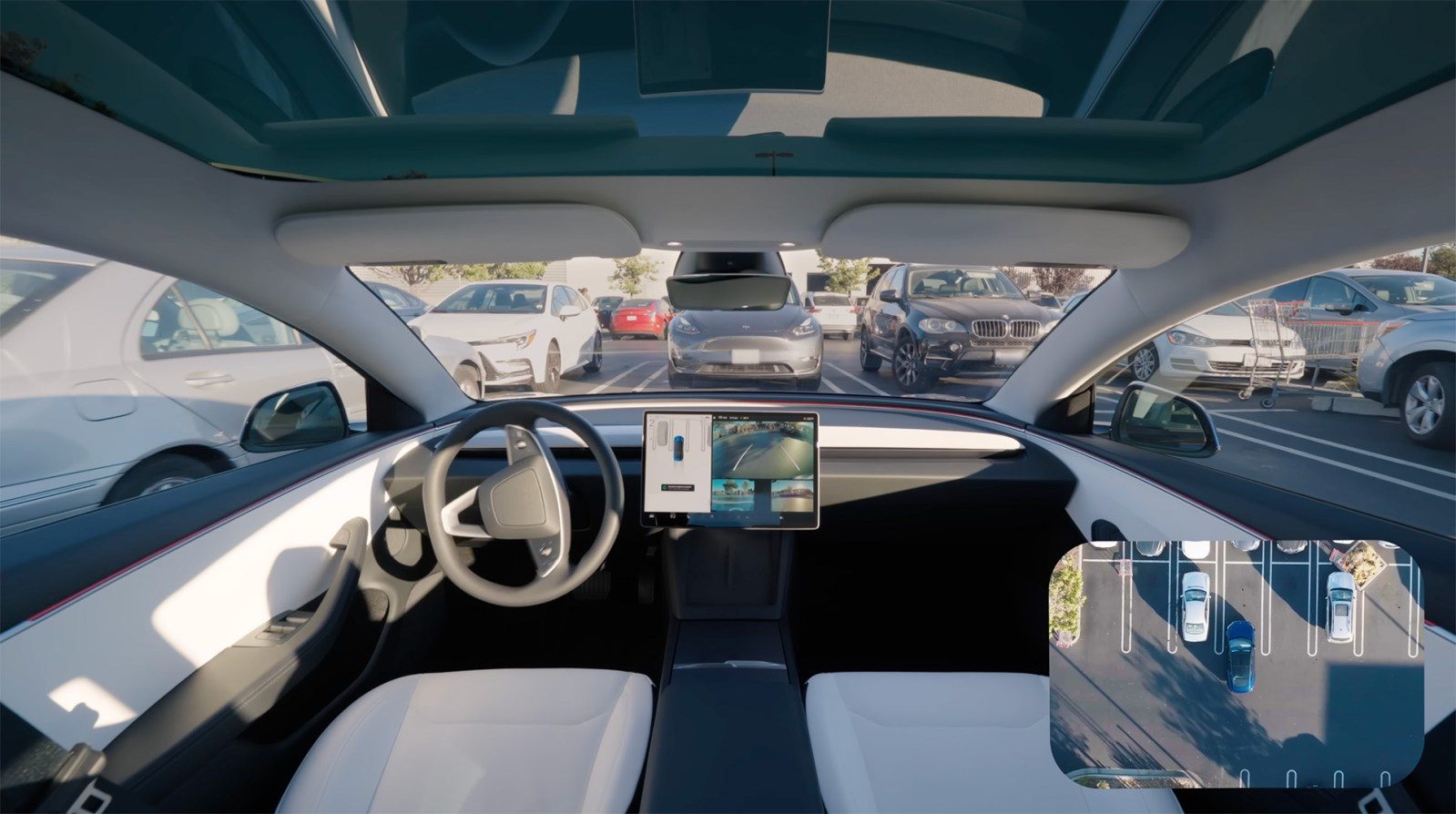

The six-metre range that has made Tesla’s Actually Smart Summon barely usable in Europe since its launch is under review, after the carmakers’ and suppliers’ associations OICA and CLEPA asked the UN working party responsible for steering rules to raise the ceiling to 10 metres, or 15 where the driver keeps a direct line of sight to the car.
Tesla released Actually Smart Summon in Europe and the Middle East with software 2024.44.3 in November 2024, letting a car drive itself to its owner across a parking lot.
In North America the feature works from about 65 metres, approximately 213 feet.
In Europe the driver’s phone must stay within six metres, close enough that owners described the result as walking alongside the car.
That limit is not Tesla’s. It is paragraph 5.6.1.2.7 of UN Regulation No. 79, which reads: “The specified maximum RCP operating range shall not exceed 6 m.” The regulation has 43 contracting parties, including the European Union, the United Kingdom, Japan and Australia.
The update was first reported by X user ‘NotAnFSDTracker’ on Saturday.
What Is Proposed
The proposal, informal document GRVA-26-38, was tabled at the 26th session of the Working Party on Automated/Autonomous and Connected Vehicles, which met in Geneva from September 14 to 18.
It would change the sentence to read that the range “shall not exceed 10 m,” adding: “This range may be extended to a maximum of 15 m if a direct line of sight between the remote-control device and the vehicle is ensured.”
The session report has not been published, and whether the working party adopted, amended or deferred the text is not yet known.
The marked-up document shows the number has already been negotiated down. OICA’s first figure was 15 metres, then 12, then 10.
The September justification names only Canada and the United States as unregulated markets.
Line of Sight
The 15-metre condition is defined in the justification as ensuring “that no objects are blocking the transmission from the remote-control device to the vehicle and therefore the sight of driver to the vehicle.” That is a radio criterion standing in for a visual one, and the document does not say how a type-approval authority would test it.
Tesla’s own owner’s manual already contains the visual version. “While Summon is active, it is recommended that you maintain clear line of sight between you and Model 3,” the Model 3 manual for Ireland reads, followed by: “Closely monitor the vehicle and its surroundings at all times and familiarize yourself with the Limitations and Warnings.”
The Safety Case
The justification runs to five numbered paragraphs and is framed entirely as a safety argument.
Radio-wave ranging “is inherently inaccurate,” the document says, citing “complicated and varying electromagnetic environment in garage, changing orientation of the remote device.” Manufacturers build in a margin to pass homologation, so “the effective usable range is reduced to a value lower than the six meters maximum.”
That short range “makes it difficult for the driver to monitor the surroundings and supervise the moving vehicle.” When the car approaches the driver, “to avoid unintended activation of Advanced Emergency Braking System, the driver may move backwards while looking forward, imposing unnecessary risks to the driver.”
A longer range “would reduce the blind area behind the vehicle, allowing the driver to better monitor the surroundings.”
“In large markets such as Canada and the United States of America, the maximum RCP operating range is not regulated,” the document says. Systems exceeding six metres “are already offered in the field, provided that the driver is required to continuously monitor the function,” and “have been used in the field for several years without any negative feedback or identified safety threats that would likely trigger regulatory action.”
No manufacturer is named. OICA represents carmakers collectively, and the language about radio ranging and garages describes conventional key-fob remote parking from any brand as much as Tesla’s phone-based version.
The Regulation and Who Applies It
UN Regulation No. 79 on steering equipment entered into force on December 1, 1988. The remote-parking provisions were added in the 02 series of amendments, which a UK government consultation document records as entering into force on October 10, 2017.
The 03, 04 and 05 series each carry the six-metre sentence, the 05 series having been adopted by the World Forum in March 2026.
A Campaign
OICA and CLEPA have been working the remote-parking provisions of R79 for more than three years.
In May 2023 they proposed extending Remote Control Parking to vehicle combinations, so a driver could stand where they can see behind a trailer. For the June 2025 session they proposed allowing the driver to brake the vehicle to a standstill within the system’s limits, to prevent “unnecessary sudden and uncomfortable stops.”
Last January, Japan secured a corrigendum to paragraph 5.6.1.2.9, two lines below the one now in play. In May, alongside the range presentation, CLEPA and OICA tabled GRVA-25-09, a further set of proposed supplements to the 03 and 04 series.
China tabled two documents at the same session: GRVA-25-37, on “regulatory alignment concerning parking related functions,” and GRVA-25-38, proposing supplements to the same series, whose content could not be obtained. China’s recorded objection to the range justification suggests Beijing is not on the same petition.
If the working party adopts the text, it goes to the World Forum for Harmonization of Vehicle Regulations for a vote, followed by an entry-into-force period.
For Tesla and any other manufacturer already type-approved with a remote parking system, the change would be made via a software update.