
Nio Inc. has opened more than 40 multi-brand ‘Sky Stores’ across China so far and plans to have about 120 operating by year-end, as the company continues its cost-cutting efforts while aiming for higher brand awareness for its two sub-brands.
The target implies about 80 additional openings in the second half of the year.
Co-founder and President Qin Lihong provided the information during a media roundtable held on Friday — following the launch of the five-seat ES8 SUV — according to automotive blogger ‘电动星球小新’ on Weibo.
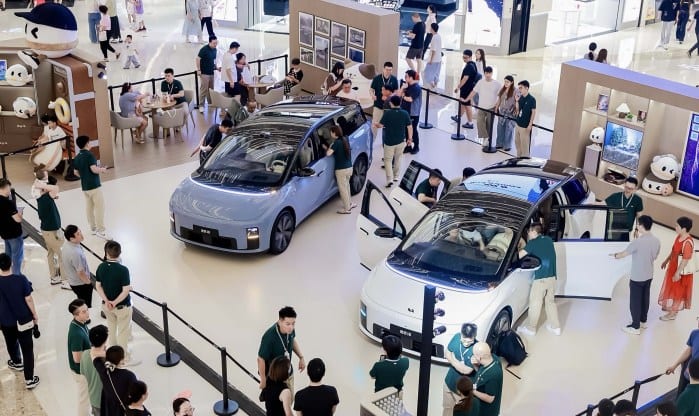
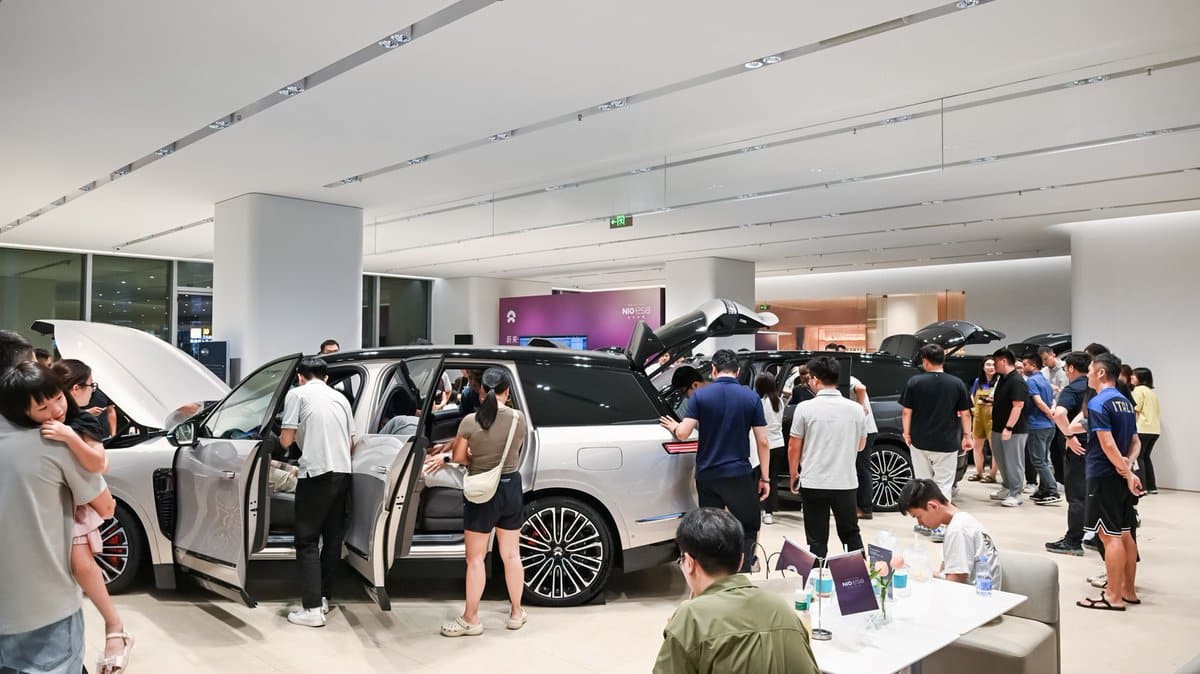
Each ‘Sky Store’ brings all three of the group’s brands — the premium Nio marque, the family-oriented Onvo sub-brand, and the compact Firefly — under a single roof, integrating pre-sales, after-sales and vehicle delivery in one location.
The new standardized store format will roll out on a larger scale in the current quarter, Lihong confirmed, saying that the locations are not confined to smaller cities.
‘Sky Stores’ will also open in major metropolitan areas broadening an initiative originally framed as a push into China’s lower-tier markets.
“In the second half of the year, our primary focus will be on channel expansion, while refining store operations and improving all aspects related to sales productivity,” the executive added.
Nio’s Retail Network
The update marks the clearest timeline yet for the pace of ‘Sky Store’ rollout since Nio opened the first location in Jiangmen, Guangdong province, in February.
Lihong said in January that the company planned to eventually expand the format into roughly 210 prefecture-level cities across China.
A 120-store year-end target would bring Nio more than halfway toward that goal within the format’s first year.
The expansion coincides with a broader restructuring of Nio‘s sales network.
As EV exclusively reported in March, Nio ended 2025 with fewer Nio Houses than it had a year earlier — the first annual contraction since the company opened its first flagship showroom in Beijing in November 2017.
First-quarter figures disclosed in May alongside the company’s earnings report showed the group ended the quarter with three fewer Nio Houses and six fewer Nio Spaces than at the close of 2025.
Nio Houses — the brand’s flagship retail locations featuring lounges, cafés, libraries and co-working spaces — have been in net decline since mid-2025.
While the premium network contracts, the Onvo sub-brand added ten dedicated stores during the first quarter.
Brand Awareness
The ‘Sky Store’ format is designed in part to address a problem that has dogged both of Nio‘s sub-brands since their respective launches: low consumer recognition.
Founder and Chief Executive Officer William Li said in late April that Onvo‘s brand awareness among general consumers sits at roughly the level the Nio brand had in 2019.
Li reiterated on the first-quarter earnings call in May that awareness remains the central challenge, noting Onvo has been delivering for only about 20 months.
The company has deployed celebrity endorsements, offline advertising in train stations and apartment elevators, and a sports sponsorship deal with Shanghai Shenhua FC for the 2026 Chinese Super League season to raise the sub-brand’s profile.
The company’s founder has described the effort as painstaking but gradually effective.
Firefly faces a similar visibility challenge.
The compact marque delivered 6,946 vehicles in June — its strongest month of 2026 — but its volume remains the smallest of the three brands.
Multi-brand stores give both sub-brands foot traffic from buyers who walk in for a Nio-branded vehicle and encounter the full portfolio.
Under Nio‘s long-term brand-mix target of 35-55-10, Onvo is expected to carry 55% of group vehicle sales, with the main brand at 35% and Firefly at 10%.
Through the first half of 2026, Onvo contributed 42,463 deliveries out of the group’s 191,123 — a 22.2% share that sits well below the 55% target.
Cost Discipline
The shift toward shared retail locations fits within Nio‘s broader cost-reduction agenda.
The company introduced a Cell Business Unit (CBU) restructure in 2025, requiring every department to track return on investment and manage individual budgets.
Under the CBU framework, Nio is pursuing its first full year of profitability in 2026 after posting its first-ever quarterly profit in the fourth quarter of 2025.
‘Sky Stores’ reduce per-brand fixed costs by consolidating the overhead of three separate showroom networks into a single site.
The model replaces dedicated Nio Houses and Nio Spaces — which carry high rents in central city locations — with leaner formats that can be deployed in cities where standalone premium showrooms would be economically unviable.
Nio posted a narrow net loss of 332.1 million yuan ($48.1 million) in the first quarter of 2026 but remained profitable on an adjusted basis, with non-GAAP operating profit of 66.8 million yuan.