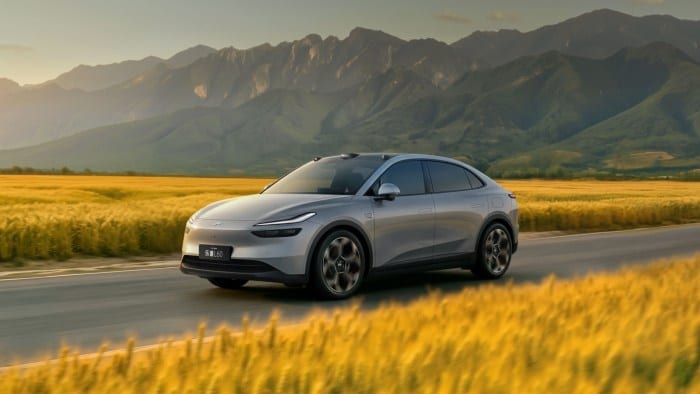
Nio‘s family-oriented sub-brand Onvo has begun rolling out the software overhaul it promised in April when it previewed the platform alongside the refreshed 2026 L90.
The Coconut 3.1.0 and Coconut+ 3.1.0 updates are reaching all 170,000-plus Onvo owners and span assisted driving, the smart cockpit, chassis intelligence, and voice control.
Onvo said on Weibo that vehicles equipped with the Nvidia Orin platform now offer intelligent driving capabilities the brand considers “industry-leading.”
The release arrives after Onvo completed an intensive product refresh over the past three months, which reshaped the sub-brand’s hardware strategy.
The 2026 L90 launched on April 21 with a LiDAR-equipped variant — the first in the sub-brand’s history — and Nio‘s in-house Shenji NX9031 autonomous-driving chip.
Onvo‘s five-seat L80 followed on May 15, carrying the same sensor strategy.
The brand also launched a refreshed version of its debut L60 on June 11, reversing the brand’s founding vision-only bet by offering a 192-line rooftop LiDAR option across all trims.
All three models now ship in two software configurations: Coconut on the Nvidia Orin-X platform, and Coconut+ on the Shenji NX9031 with LiDAR.
Coconut 3.1.0 is the software catch-up that matches the hardware rollout.
Onvo brand president Shen Fei had flagged the July timeline during the L90 event, and a cabin-focused update in March had drawn scrutiny for not addressing driver assistance — despite Shen’s January promise of a major iteration after the Spring Festival holiday.
Industry-Leading Software
Shen Fei commented on the rollout on Weibo, stating that Orin-equipped Onvo vehicles have entered the industry’s top tier for intelligent driving capabilities with this release.
“On vehicles equipped with the Nvidia Orin platform, the intelligent driving assistance capabilities are now industry-leading, making everyday driving easier, more confident, and more effortless,” he wrote.
Shen attributed the performance to Onvo and Nio sharing a unified autonomous driving technology architecture and a common data closed-loop system — a direct reference to the engineering linkage between the mass-market sub-brand and Nio‘s premium platform.
He closed by noting Onvo had introduced a range of family-oriented and fun new features and signed off with the brand’s slogan — roughly translated as “keep powering forward.”
Onvo delivered 42,463 vehicles in the first half of 2026 and surpassed 150,000 cumulative deliveries in May — approximately two years after the brand’s September 2024 launch.
End-to-End Driving Model
On Orin-equipped vehicles, the update delivers a comprehensive overhaul of the Onvo Smart Driving (OSD) end-to-end model.
Onvo stated the intelligent assisted-driving model now directly controls the steering wheel and acceleration and deceleration pedals, improving lane-change capability across the full-scenario navigate-on-pilot function.
Based on traffic conditions, the system performs more proactive speed-negotiation lane changes and gap-seeking lane changes, according to the release notes.
Intersection performance receives targeted improvements.
Yielding to oncoming traffic and dynamic lane selection have been refined, raising the intersection pass-through success rate.
Steering response is smoother, and acceleration and deceleration behaviour is gentler across all driving scenarios.
A new human-machine co-driving mode allows drivers using intelligent lane cruise or full-scenario navigate-on-pilot to take control by gripping the steering wheel.
Once the driver releases the wheel, the system seamlessly resumes authority — an approach that blurs the line between manual intervention and assisted-driving re-engagement.
Intelligent Parking Assist adds an offset parking position feature.
Drivers can now choose whether the vehicle parks left-offset, centred or right-offset within a parking slot — addressing a practical concern around door-opening clearance and pedestrian safety.
A new trip summary card in the Onvo app — requiring version 2.5.0 or above — displays per-trip metrics including zero-hard-braking and zero-intervention journey counts alongside intelligent parking assist usage, with sharing supported.
Cockpit Upgrades
Cabin changes range from entertainment to practical utility.
Full-screen mode is now available for Media Center, NetEase Cloud Music and WeSing, with full-screen and half-screen switching supported.
WeSing adds per-line and five-dimension scoring alongside a skip-intro function. QQ Music, NetEase Cloud Music and WeSing gain word-by-word synchronised lyric display in both dedicated player interfaces and media cards.
Nio Radio, described as an exclusive audio community for Nio company users, joins the media source library.
Content spans news, music, entertainment and local-life programming.
On Orin-equipped models, an Amap (Gaode) cruise traffic-light display shows real-time signal status for the current and nearby intersections even when navigation is inactive.
Coverage includes U-turn, left-turn and straight-ahead signal phases with countdown timers.
Model-specific additions round out the cockpit section.
The L90 and L80 gain a whole-vehicle seat tidy mode that resets all seats to a tidy-space position with one tap — designed for cargo loading or cabin reconfiguration.
The L60’s accessory large fridge loses its 24-hour power-supply limit; continuous cooling now runs even after the driver leaves the vehicle.
Chassis and Voice Control
On the L80 and L90 with Orin, the intelligent chassis adds protective logic for hazardous low-traction surfaces.
The update reduces wheel-slip probability on rain-wet roads, epoxy garage floors and pavement joints, and lessens the sensation of speed loss and jerkiness, according to Onvo.
Voice assistant ‘Xiaole’ receives a tens-of-billions-parameter large-model automatic speech recognition capability, raising recognition accuracy by 7% across high-frequency scenarios including vehicle control, navigation, media and conversational queries.
More than 70 new atomic vehicle-control commands expand voice-controllable functions.
Custom wake-word recognition improves without degrading standard in-car wake-word accuracy.
A dynamic sound-zone wake strategy better identifies the wake location when a user’s seat is in a deeply reclined position — avoiding seat misjudgement in comfort scenarios.