
Nio launched the five-seat version of its ES8 sport utility vehicle on Thursday, pricing the model from 382,800 yuan ($56,300) with the battery pack included.
The launch of the five seat variant comes as the Chinese EV maker moves to broaden the reach of the SUV whose deliveries have fallen for three straight months.
The entry Executive Luxury Edition drops to 274,800 yuan ($40,400) under Nio‘s Battery as a Service subscription, which allows owners to lease the battery separately and use the company’s swap network across China.
A higher Executive Signature Edition starts at 422,800 yuan ($62,200), or 314,800 yuan ($46,300) with the battery leased.
The structure values the 102-kilowatt-hour pack at 108,000 yuan ($15,900) on both trims.
Display cars are already at stores nationwide.
24,000-Yuan
Set against the three-row model it joins rather than replaces, the new variant undercuts its sibling by 24,000 yuan on a similar level trim.
Nio unveiled the third-generation ES8 at Nio Day in Hangzhou in September 2025, pricing the six-seat Executive Luxury Edition at 406,800 yuan ($59,800), 100,000 yuan below its predecessor, a cut that drew more than 100,000 firm orders within roughly 48 hours.
The five-seat car therefore arrives 5.9% cheaper than the six-seat version, with the identical 24,000-yuan gap applied to the Signature trim, which sells for 446,800 yuan ($65,700) in three-row form.
Six-seat and seven-seat versions remain on sale.
The 5-Seat ES8
The five-seat ES8 carries over the line’s body, measuring 5,280 millimetres long, 2,010 wide and 1,800 tall on a 3,130-millimetre wheelbase.
Dual motors on a 900-volt architecture produce 520 kilowatts, taking the car to 100 kilometres per hour in 3.90 seconds, and the 102-kilowatt-hour pack delivers 655 kilometres of range on China’s CLTC cycle, a figure Nio says applies with 20-inch wheels.
The company says lightweighting leaves the car about 260 kilograms below the segment average.
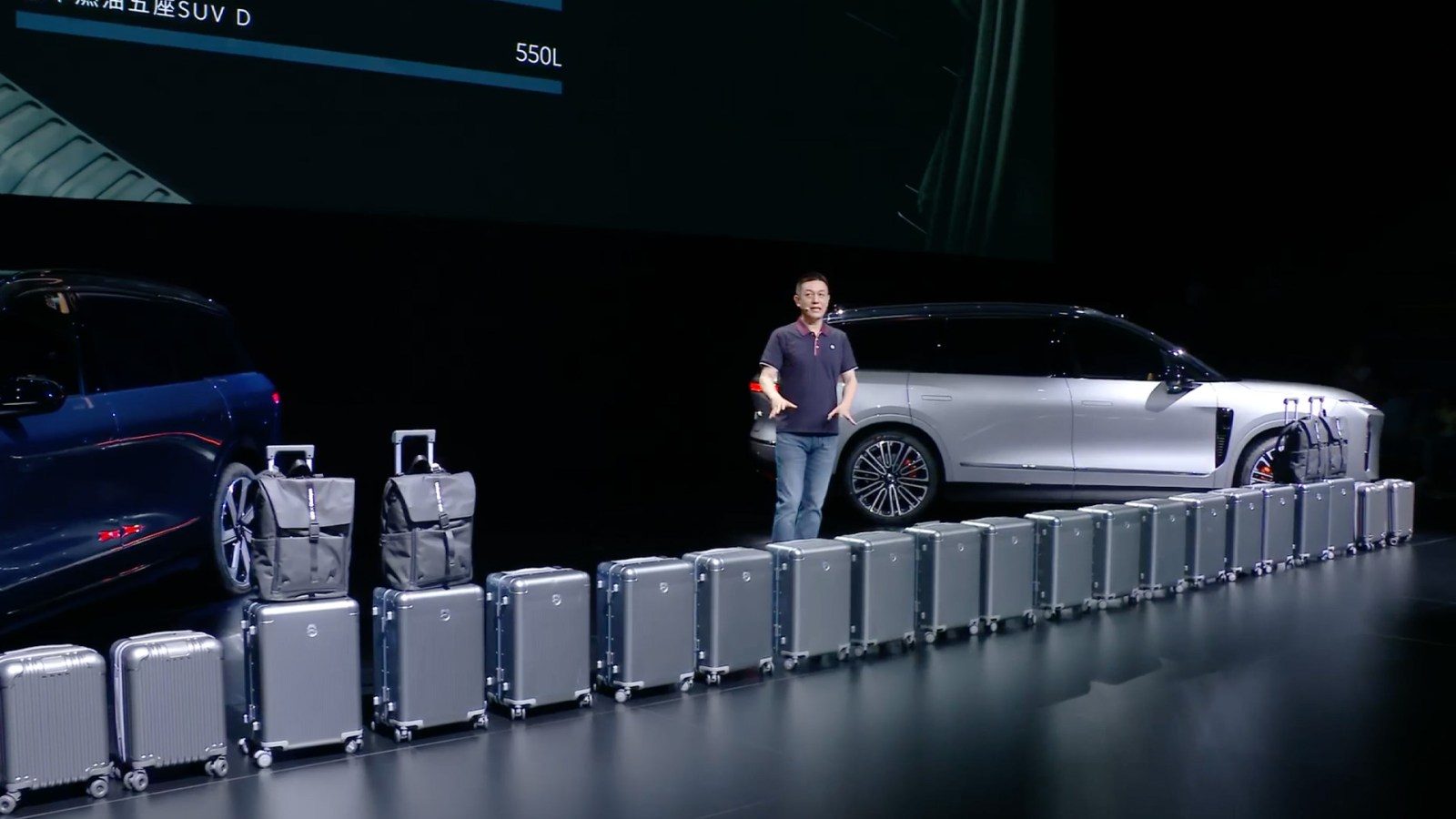
Removing the third row transforms the load bay, with maximum cargo volume reaching 3,084 litres with the second row folded, and 1,564 litres available with the seats up, split between a 230-litre front trunk and a 1,334-litre rear compartment that includes 268 litres of concealed storage.
Nio claims the boot is the largest in the industry, that usable vehicle space of 7.05 square metres sets a record for the class, and that the car swallows 21 suitcases with five people aboard.
The cabin uses a three-fold privacy partition in Haptex synthetic leather, a detail Chief Executive William Li has singled out repeatedly, alongside a wraparound divider that closes the second row off from the boot.
Front occupants get 20-way seats with a one-touch zero-gravity position, while the second row reclines to 138 degrees with powered leg and foot rests, and 1.7 square metres of electrochromic glass offers three levels of dimming.
The suspension is a dual-chamber air setup with ZF continuously variable damping, and new terrain modes cover sand, mud, gravel, snow, wetland and wading.
Buyers may choose from seven exterior colours, among them a new Moonlight Silver, and five interior themes, while first owners receive six years of in-car connectivity capped at 8 gigabytes a month.
Chips and Safety
The five-seat car runs Nio‘s NT.Cedar system, built around the in-house Shenji NX9031, which the company describes as the world’s first five-nanometre automotive-grade flagship assisted-driving chip, and its SkyOS operating system.
Perception hardware runs to 31 sensors, including three lidar units, feeding an assisted-driving stack trained on Nio‘s world model with reinforcement learning.
On safety, Nio cites top marks across the five China Insurance Automotive Safety Index categories for the ES8, with several G-plus ratings, and says the five-seat car adds curtain airbags tailored to the two-row layout among nine in total.
Projection headlights cast a light carpet across six lanes and signal lane-change intent when assisted driving is engaged.
A Segment Three Times Larger
Li has framed the variant as a push into the premium large five-seat market, a segment he says is roughly three times the size of the three-row category the ES8 currently serves.
Writing on social media before the launch, the founder said the company built the car “because our users need it.”
Li described research in which five-seat owners complained that a cluttered boot is visible to anyone in the back seat, an awkwardness he argued compounds over time, and contended that most five-seat SUVs separate passenger space from storage poorly.
Nio has framed the launch more broadly still, arguing that the all-electric era has arrived for large SUVs, a segment in China long dominated by extended-range and hybrid models.
The ES7’s Successor
The five-seat ES8 steps into a gap Nio created itself.
The model effectively replaces the ES7, which was quietly discontinued after weak sales in China, leaving the brand without a flagship two-row SUV.
Pre-orders opened on June 28, timed to the eighth anniversary of the first ES8 deliveries, with buyers able to lock a limited-time benefit under which a 5,000-yuan deposit offsets 10,000 yuan from the purchase price.
Ma Lin, Nio‘s assistant vice president for brand, signalled beforehand that the car would not be heavily discounted, casting it as the same product with fewer seats.
“The difference is simply two fewer seats,” he wrote.
Fading Momentum
The variant arrives as demand for Nio‘s best-selling model erodes.
The ES8 delivered 8,966 units in June, falling below 10,000 for the first time since its production ramp and extending a third consecutive monthly decline, according to data published on Wednesday by China’s Passenger Car Association.
Demand has roughly halved since March, when the ES8 delivered 16,255 units, a fall of 44.8% in 90 days.
Nio declined to disclose the ES8’s June figure separately when reporting group results on July 1, breaking from prior practice.
The stakes are considerable, since the ES8 accounted for 46.3% of Nio Inc deliveries across the first five months of the year, drove the company’s first quarterly profit in the fourth quarter of 2025 and carries a gross margin of roughly 20%.
Deutsche Bank attributed part of June’s weakness to customers waiting for the five-seat model.
Nio tells a different story in its launch material, saying the third-generation ES8 reached 120,000 deliveries in 275 days, has topped both the large SUV and 400,000-yuan-plus segments for six consecutive months, and led both on retail sales in the first half of 2026.
Both accounts can hold at once: the ES8 remains the best-selling car in its class while selling far fewer of them than it did in March.
Pure Electric Against Range Extenders
Figures from the China Automobile Dealers Association, compiled by ChinaEV Home, put the Aito M9 at the head of China’s full-size SUV market last month on 10,070 units, a climb of 11 places, ahead of the ES8 on 8,966 and the ES9 on 8,595.
Leapmotor‘s D19 took fourth on 8,034, XPeng‘s GX rose 17 places to fifth on 6,737, and Li Auto‘s L9 placed sixth on 6,106, followed by the Zeekr 9X, the Huajing S, the Onvo L80 on 4,086 and the Aito M8.
The powertrains behind those numbers are not alike.
Nio‘s three entries, the ES8, the ES9 and the Onvo L80, are sold only as battery-electric cars, so their volumes represent pure-electric demand alone.
The M9 and the M8 are offered in both extended-range and battery-electric versions, and their totals combine the two, while the L9 carries an engine to generate electricity and the 9X is a hybrid.
Taken together, Nio holds two of the top three places, and the ES8 and ES9 combined outsell the M9 by a wide margin.
The ES8 remains among the best-selling cars in its class while selling far fewer of them than it did in March.
The Onvo L80 Question
Qin has dismissed concerns that the Onvo L80 would cannibalise the five-seat ES8, or the reverse, citing a price gap of “more than 100,000 yuan” and arguing the two are complementary.
Management told staff in mid-April that the L80 would rank among the most important launches of the second quarter, alongside the Nio ES9.
The L80’s start has disappointed.
After delivering 5,949 vehicles in the final 15 days of May, Onvo handed over 4,086 in June, and while registrations fell 31% month on month, the underlying run rate collapsed further, from roughly 2,780 units a week to about 950.
The L80 entered the market at 242,800 yuan ($35,700), 3,000 yuan below its pre-sale price and 17,700 yuan under Tesla‘s Model Y in China, falling to 156,800 yuan ($23,000) under the battery subscription.
Rivals Beyond Nio
Competition is intensifying across China’s premium large SUV market, and not only in the three-row segment.
Zeekr opened pre-sales on Wednesday for a five-seat version of its flagship 9X, extending a model launched in September 2025 from 465,900 yuan ($68,500) as the Geely-backed brand’s first hybrid, with launch incentives worth up to 90,000 yuan and pre-sale pricing yet to be disclosed.
The Huawei-backed Aito M9, sold in battery-electric and extended-range forms with five and six seats, starts at 479,800 yuan ($70,600) and ranks among China’s best-selling luxury SUVs.
Li Auto competes with the extended-range L9, from 459,800 yuan ($67,600), and a refreshed L8 repositioned as a five-seat flagship from 369,800 yuan ($54,400).