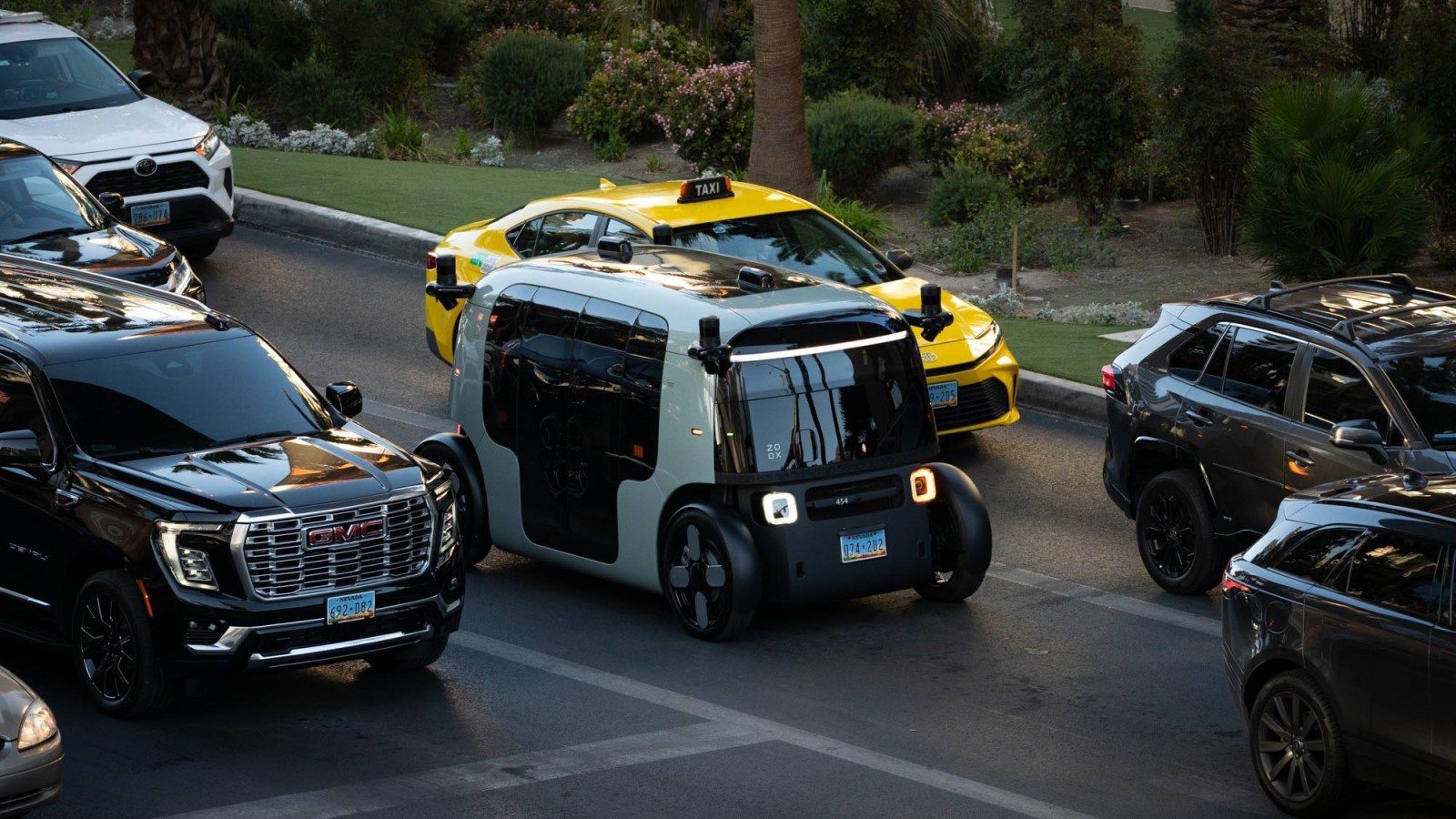

The National Highway Traffic Safety Administration (NHTSA) granted Amazon-owned Zoox a temporary exemption to commercially deploy its purpose-built robotaxis — marking the first time the agency has allowed a vehicle without traditional human controls to charge passengers for rides.
The NHTSA announced the decision on Thursday, as part of a broader set of actions aimed at accelerating autonomous vehicle development in the United States.
The exemption covers up to 2,500 vehicles annually over two years, and is subject to what the agency described as an “enhanced, adaptable oversight structure that can evolve as Zoox‘s technology advances.”
The ruling removes the last major federal regulatory barrier standing between Zoox and a revenue-generating robotaxi service.
Zoox‘s custom-built vehicles lack steering wheels, brake pedals, and other conventional driver controls, putting them in conflict with eight Federal Motor Vehicle Safety Standards written decades before self-driving technology emerged.
The agency is providing exemptions from those standards, which include requirements for windshield defrosting and light vehicle braking systems.
Las Vegas First, California Pending
A Zoox spokesperson told TechCrunch that the company will soon begin charging for rides, starting in Las Vegas.
Additional markets will follow as Zoox completes state-level requirements for commercialization.
In California — where the company is headquartered, and currently offers free rides in San Francisco — the company still needs driverless deployment permits from the state Public Utilities Commission and the Department of Motor Vehicles (DMV).
Zoox‘s CEO Aicha Evans called the decision a milestone for both the company and autonomous mobility more broadly.
“We are honored to receive the first-ever commercial exemption for a purpose-built robotaxi from NHTSA,” the CEO wrote in a statement, adding that it enables them to “begin charging for our service and take another step toward bringing autonomous ride-hailing to more communities.”
Road to Deployment
NHTSA first granted Zoox a demonstration exemption in August 2025, allowing its bidirectional, carriage-style vehicles to operate on public roads and carry passengers in cities including San Francisco and Las Vegas.
The exemption did not permit the company to collect fares.
Zoox applied for the commercial exemption last year and completed a public comment period earlier this year.
NHTSA said it determined the vehicle is as safe as an equivalent vehicle meeting the federal safety standards being waived.
The company’s fleet has logged nearly 2 million driverless miles and carried approximately 350,000 passengers across its testing cities.
Zoox also struck a deal with Uber in March to make its vehicles available through the Uber app in Las Vegas, with Los Angeles integration planned for next year.
NHTSA’s Broader AV Push
The Zoox exemption was one of five policy actions NHTSA announced on Thursday under Secretary Sean Duffy’s Innovation Agenda.
The agency is partnering with SAE Industry Technologies Consortia on a three-year, $5 million project called A2SCEND to gather data toward the first federal AV performance standards.
NHTSA Administrator Jonathan Morrison said the regulator expects to have those standards developed by the end of the Trump administration.
The agency is also publishing an interim final rule allowing vehicles manufactured before an exemption is formally granted to qualify for commercial deployment, updating its Part 555 exemption process, and opening a federal docket for public feedback on revised AV safety guidance.
The update marks the first one since 2017, covering emergency responder interactions, safety management systems, remote assistance and post-crash behaviour.
A sixth application is already in the queue. NHTSA said it is reviewing a petition from Robomart for a driverless low-speed vehicle under FMVSS No. 500, with a separate notice seeking public comment to follow.
The moves extend a direction the agency has been signalling for months. Morrison said earlier this month that requiring steering wheels in fully driverless vehicles “doesn’t make any sense”, and that such mandates could be removed within five to ten years.
NHTSA had already proposed removing the brake pedal requirement for purpose-built autonomous vehicles under FMVSS No. 135, with the comment period closing on July 27.
However, not every signal has pointed the same way.
Morrison also wrote to AV developers this month instructing them to immediately address what the agency called a clear pattern of driverless vehicles interfering with law enforcement and other first responders.
If the FMVSS amendments are finalised, the exemption route becomes unnecessary — and with it the 2,500-vehicle ceiling that now applies to Zoox.
Competitors
Tesla took the opposite regulatory route.
Rather than petitioning for an exemption, the company self-certified the Cybercab against existing federal safety standards. Vice president of vehicle engineering Lars Moravy has said the model is therefore not subject to NHTSA’s 2,500-vehicle annual cap.
Tesla has not applied for an FMVSS exemption for the Cybercab, and has not set out its path to regulatory approval.
Cybercab production began at Giga Texas earlier this year, roughly six weeks ahead of the April target Musk had outlined at the 2025 annual shareholder meeting, with installed annual capacity now above 125,000 units.
Drone footage this month showed more than 150 units on site.
The company operates its Robotaxi service using modified Model Y vehicles across three Texas cities, and has expanded that fleet to roughly 175 registered vehicles. Separately, Tesla reported more than 380,000 unsupervised Cybercab miles across seven cities in its second-quarter results.
Alphabet’s Waymo operates driverless rides through modified Jaguar I-Paces and, more recently, the purpose-built Ojai.
The Ojai is manufactured by Zeekr in China and fitted with Waymo’s sixth-generation Driver system in Mesa, Arizona — a supply chain that leaves it exposed to the tariffs now applied to Chinese-built vehicles.
The model began carrying passengers in San Francisco, Phoenix and Los Angeles in late May, and service is due to reach Denver, Las Vegas and San Diego later this year.
Unlike the Zoox vehicle, the Ojai retains conventional controls and requires no FMVSS exemption.