
Lucid has borrowed $2.1 billion from its Saudi majority owner’s credit line in a little over six months, leaving about $400 million untapped, as its shares closed at a record low that values the company at $1.49 billion.
The EV maker drew $400 million on October 6 from the delayed draw term loan provided by Ayar Third Investment Company, an affiliate of Saudi Arabia’s Public Investment Fund (PIF), according to a regulatory filing on Friday.
“On October 6, 2026, Lucid Group, Inc. drew $400 million of Delayed Draw Term Loan (“DDTL”) facilities pursuant to its existing agreement with Ayar Third Investment Company, an affiliate of the Public Investment Fund,” Lucid said in the filing.
It was the second $400 million draw in six weeks, after one on August 24 that Lucid disclosed in a separate filing, and the fourth this year.
Lucid shares closed at $3.79 on Friday, their lowest closing price since the company went public in 2021 and down 64.1% since the start of the year and 82.5% from a year earlier, Nasdaq data show.
The filings come a month before Lucid reports third-quarter results on November 9.
Three Draws in Three Months
Lucid made its first draw on the facility, $500 million, on April 1, and followed it with an $800 million draw on July 6.
The two most recent draws took the total borrowed after the end of June to $1.6 billion in three months.
Following the October draw, principal outstanding under the loan stands at about $2.1 billion, with about $400 million of capacity remaining, Lucid said.
The facility was signed in August 2024 at $750 million, raised to $1.98 billion in November 2025 and lifted by a further $500 million in April to about $2.48 billion, according to Lucid’s quarterly report for the second quarter.
The loan matures in August 2029 and carried interest at the Secured Overnight Financing Rate plus 5.75 percentage points when it was signed, according to the original 2024 filing.
The quarterly report says the facility may be used for working capital and general corporate purposes, and none of the filings gives a reason for the timing of the draws.
Lucid’s total liquidity was $3.0 billion at the end of June, made up of $775.5 million of cash, cash equivalents and investments, $1.98 billion of undrawn loan capacity, $270.4 million under an asset-based credit line and $2.3 million under a facility from Gulf International Bank, according to the report.
Drawing the loan turns undrawn capacity into cash but does not add to that liquidity total.
How PIF’s Support Has Changed
PIF and its affiliates have put about $8.9 billion of common and preferred equity into Lucid since 2018 and lent it $2.1 billion more under the loan, according to an EV tally of company filings.
Including the undrawn portion, PIF’s commitments total about $11.4 billion, more than seven times Lucid’s current market value, by EV‘s calculation.
Lucid’s market value was $2.53 billion on April 20, when the stock hit what was then a record low, and it has fallen by more than 40% since.
The form of the support has changed over time.
PIF put about $2.7 billion into Lucid’s private preferred shares between 2018 and 2021 and $200 million into the share sale that accompanied its 2021 stock-market listing, then bought common stock in 2022 and 2023, before switching to convertible preferred stock with a $1 billion Series A in March 2024 and a $750 million Series B in August 2024.
Ayar bought about $1.03 billion of common stock alongside a public offering in October 2024, its most recent purchase of new common shares from the company, according to filings.
Since then, PIF’s new money has come as a $550 million Series C preferred in April and as loans.
Ayar also agreed to buy about $1.07 billion of Lucid stock through prepaid forward contracts tied to Lucid’s 2025 convertible note sales, with delivery expected around the notes’ 2030 and 2031 maturities, though that money went to a bank counterparty rather than to Lucid.
A Majority Built on Preferred Stock
PIF beneficially owned 282,986,912 Lucid shares, according to a prospectus filing on August 12.
Of those, 105,898,045 were shares the preferred stock could convert into at the end of June, leaving 177,088,867 common shares held outright.
That is 44.9% of the 394,070,176 shares outstanding at the end of July, by EV’s calculation, below the 58.8% of common stock Lucid said Ayar held in October 2024.
Counting the preferred as converted, PIF’s beneficial stake is about 56.6%, in line with the 56.85% reported in its April ownership filing and the majority that carried every proposal at Lucid’s June annual meeting.
The preferred stock pays a 9% annual dividend in additional stock rather than cash, compounding quarterly, and ranks ahead of common shareholders in a liquidation.
Its liquidation preference reached $3.07 billion at the end of June on $2.3 billion invested, the quarterly report shows.
That preference is set at the greater of the accrued value multiplied by a percentage defined in the stock’s terms or the value of the shares it converts into, according to the report.
The Series A and B preferences together rose $203.4 million, or 8.8%, in the first six months of 2026.
At Friday’s price, the 105.9 million shares the preferred could convert into were worth about $401 million, by EV’s calculation, a fraction of its liquidation preference.
PIF’s 177.1 million common shares were worth about $671 million.
That compares with about $4.7 billion PIF paid for common stock through its 2018 investment, which converted into shares when Lucid went public, and its 2022, 2023 and October 2024 purchases, a paper loss of about $4.1 billion, or 86%, by EV’s calculation.
How the $2.3 billion of preferred stock is marked depends on the measure, with a conversion value of about $401 million and a liquidation preference of $3.07 billion.
The $2.1 billion PIF has lent under the loan ranks ahead of both.
Nearly $8B Ahead of Common Shareholders
Lucid’s debt principal stood at about $3.3 billion at the end of June, made up of convertible notes due in 2026, 2030 and 2031, a revolving facility from Gulf International Bank, which Lucid lists as a related party of PIF, and the first $500 million of the PIF loan.
Adding the $1.6 billion drawn since lifts that to roughly $4.9 billion, by EV’s calculation, assuming no other changes since June.
Together with the preferred stock, that puts nearly $8 billion of claims ahead of common shareholders, more than five times Lucid’s market value.
About $204 million of 1.25% convertible notes issued in 2021 mature on December 15, the remainder of a $2.01 billion issue Lucid largely repurchased with proceeds from new notes in 2025.
Those refinancings raised the coupon to 5% on $1.1 billion of notes due in 2030 and to 7% on $975 million due in 2031, the quarterly report shows.
Lucid’s accumulated deficit reached $17.67 billion at the end of June, and stockholders’ equity was negative $1.06 billion, against positive $717.3 million at the end of 2025.
The Cash Plan
Lucid’s free cash flow was negative $2.91 billion in the first half of 2026, by EV’s calculation from the quarterly report, after a second-quarter net loss of $1.03 billion.
The company said in August it had identified $1.4 billion of cash improvements for 2026, including $600 million to $800 million from inventory, about $500 million from capital spending and about $200 million from operating costs.
It said in its quarterly report that current liquidity and projected operating cash flows would provide adequate liquidity for at least the next 12 months.
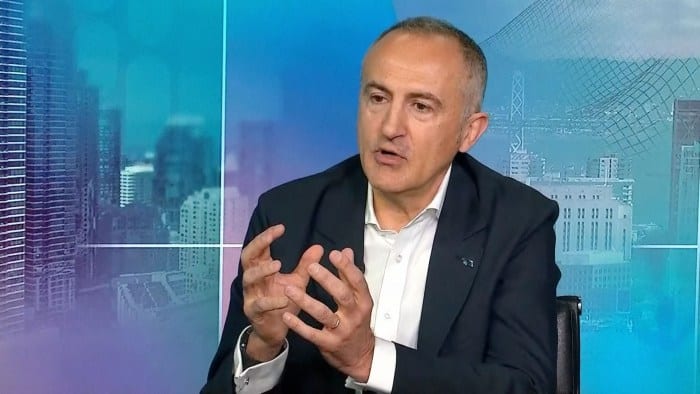
Chief Executive Officer Silvio Napoli told CNBC in August that “at some point, we will need more capital”, while pointing to financing that runs “well into 2027” and promising the next raise would be done in a way that is “very positive” for investors and shareholders.
Cantor Fitzgerald models Lucid’s next capital raise in the third quarter of 2027, according to a note it published after Lucid’s second-quarter results.
Lucid delivered 3,806 vehicles in the third quarter, down 6.7% from a year earlier, and built 2,954, delivering 852 more vehicles than it produced as it cut inventory.
The company has not said how much of the inventory target it has reached.
Other Saudi Lifelines
PIF’s support reaches beyond equity and loans.
The Saudi government, a related party of PIF, accounted for $96.2 million of Lucid’s second-quarter revenue, or 23.7%, and has committed to buy more than 4,000 vehicles a year through 2032, according to then-Chief Financial Officer Taoufiq Boussaid.
Under a 2023 agreement, the government may buy up to 100,000 vehicles over ten years, with a minimum of 50,000, according to the quarterly report.
The Saudi Industrial Development Fund, which Lucid also lists as a related party of PIF, has committed loans of up to about $1.4 billion, subject to conditions, the report shows.
Lucid has also incurred about $682.4 million of capital spending under design and construction contracts with Al Bawani, a PIF affiliate, for AMP-2, its plant in Saudi Arabia, according to the report.
Saudi investor Prince Alwaleed bin Talal disclosed a 5% stake in July, holding 19,513,000 shares now worth about $74 million, according to his ownership filings.
His private office told Asharq Business in July that he had invested about $99.6 million at an average of $5.11 a share, in a position built over the preceding weeks, leaving a paper loss of about $25.7 million, or 26%, at Friday’s close, by EV‘s calculation.
Shares Trade Below Every Recent Target
Lucid’s $3.79 close compares with the $8.112 price of its April share offering and the $10.816 conversion price of PIF’s Series C preferred.
The stock is down more than 99% from its split-adjusted peak of $577.50 in 2021.
Short interest reached 94.4 million shares on September 30, about 24% of shares outstanding and more than double the level at the end of 2025, the highest in at least a year, Nasdaq data show.
Uber, which invested $500 million through two share purchases tied to its robotaxi deal, holds 37,753,583 shares worth about $143 million at Friday’s close, by EV‘s calculation, a paper loss of about $357 million, or 71%.
Uber paid $21.87 a share for its first 13.7 million shares in September 2025 and $8.32 for 24 million more in April, an average of about $13.24, by EV’s calculation from Lucid’s filings.
Analysts’ median price target is $7 across five analysts, according to Price Target, an archive of Wall Street analyst research reproducing notes on AI, semiconductor and automotive stocks.
Morgan Stanley, which rates the stock Underweight, has the lowest target among recent notes in the archive at $5, about 32% above Friday’s close.
Baird kept its $6 target and Neutral rating after the third-quarter deliveries, while Citi, the only Buy rating among recent notes, cut its target to $11 from $14 in August.