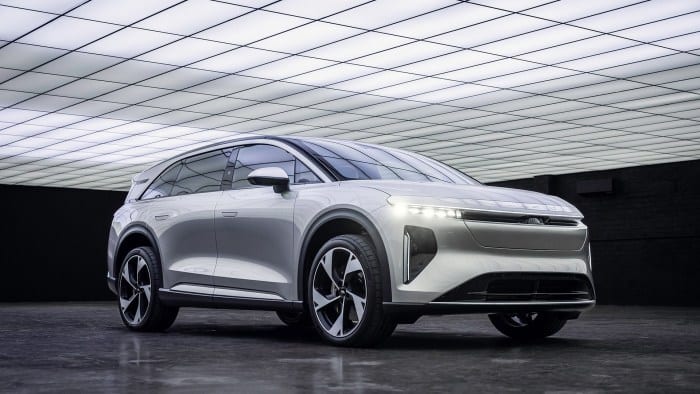
Saudi Arabia’s Public Investment Fund (PIF) has invested approximately four times what Lucid is worth as of Monday morning, after the EV maker’s shares fell to a new all-time low.
Lucid shares traded as low as $6.90 in the opening minutes on Monday, down 4.59% at $6.97 with the company’s market capitalisation at $2.53 billion.
PIF and its affiliated entities have committed approximately $9.5 billion to the Newark, California-based automaker since 2018 — 3.75 times the company’s current equity value.
The new low came less than a week after Lucid announced a $1.05 billion capital raise alongside the appointment of Silvio Napoli as its permanent CEO.
Three Announcements, One Day
Lucid shares spiked to an intraday high of $10.56 after Napoli was announced — a 14.5% surge from Monday’s $9.24 close.
The rally erased within hours as two follow-on press releases revealed the dilution mechanics behind the announcement.
Ayar Third Investment Company, an affiliate of PIF, committed $550 million of convertible preferred stock — dilutive to common shareholders.
Uber separately increased its investment in Lucid from $300 million to $500 million with an additional $200 million commitment, alongside expanding its vehicle purchase commitment from 20,000 vehicles to at least 35,000.
Lucid then priced a $300 million registered public offering of common stock, with BofA Securities acting as sole underwriter.
The combined raise totalled approximately $1.05 billion — less than four months after interim CEO Marc Winterhoff had told Bloomberg in December that Lucid was “funded well into 2027” thanks to PIF’s term loan support.
The stock has fallen from the April 14 intraday high of $10.56 to $6.97 this Monday — a 34% decline over six trading days that erased all post-CEO-announcement gains and then some.
PIF’s $9.5 Billion Stack
The scale of PIF’s cumulative commitment has built through seven distinct phases since 2018.
In 2018, PIF committed $1 billion to Lucid to finance development of the Air sedan, construction of the Arizona factory, and the launch of retail operations in North America.
In November 2022, Ayar Third Investment Company entered a $915 million private placement for common stock, closed in the final weeks of the year.
Six months later, a further $1.8 billion investment was completed.
In March 2024, Ayar committed approximately $1 billion in a private placement — five months before a further $1.5 billion investment combining $750 million in convertible preferred stock and the remainder in an unsecured loan.
Last November, PIF agreed to increase a delayed draw term loan credit facility from $750 million to approximately $2 billion — expanding committed credit by roughly $1.25 billion and boosting Lucid‘s total liquidity by nearly $1.3 billion.
Last week, Ayar Third committed an additional $550 million in convertible preferred stock.
Cumulative committed capital now totals approximately $9.55 billion, according to EV‘s tally of the seven PIF tranches disclosed in regulatory filings and company press releases since 2018.
Lucid‘s $2.53 billion market capitalisation means PIF’s cumulative outlay is 3.75 times the equity value of the company it controls.
From $92B to $2.5B
Lucid shares traded as high as $577.50 on a split-adjusted basis in late 2021 — equivalent to a peak market capitalisation of approximately $92 billion at the time.
The current share price of $6.95 represents a decline of roughly 98.8% from that peak.
In August 2025, Lucid executed a 1-for-10 reverse stock split while trading in the $2 to $3 range on a pre-split basis.
Winterhoff dismissed suggestions at the time that the move was driven by delisting concerns, framing it instead as a measure to attract institutional investors restricted from holding low-priced securities.
Since the split took effect in September 2025, the stock has continued to hit successive all-time lows.
The 60% Stake
PIF holds approximately 58.4% of Lucid‘s 363.42 million shares outstanding, according to the company’s most recent disclosures.
The stake has remained consistently between 58% and 60% across quarterly filings since 2024, with marginal variation driven by new share issuance in each capital raise.
Ayar Third Investment Company — PIF’s investment vehicle for Lucid — is the company’s controlling shareholder.
Board chairman Turqi Alnowaiser, who has served as a Lucid director since April 2019, is deputy governor and head of international investments at PIF.
The Privatisation Question
The growing gap between PIF’s cumulative outlay and Lucid‘s public market value has recurrently fuelled speculation that PIF could take the company private — a scenario first floated by deals website Betaville in January 2023 and revived whenever Lucid‘s share price hits fresh lows.
Winterhoff addressed the question directly in a September 2025 interview with Semafor.
“I don’t know of any ambitions right now to take it private,” Winterhoff said.
“If PIF were to take it private, it would immediately become a Saudi automotive manufacturer — which, outside of the [Gulf] region, would not be the greatest selling point for being a global company.”
The German executive said he didn’t see the move as “the right strategy” for the EV maker.
“So you actually need to, in my opinion, [keep it] the way it is right now to be seen as a global and an American company,” he stated.
“Again, I’m not in those discussions, but I think that would not be the right strategy for Lucid,” Winterhoff added.
Nick Twork, Lucid‘s vice president of communications, expanded on the logic in an X post in December 2025.
“The PIF is a shareholder,” Twork wrote before defending that the Fund is the most impacted by a stock dilution.
“Their performance is measured on the performance of their investment and valuation upside,” he added. “The impact of any theoretical dilution is much higher on them than any other shareholder.”
“They are long term investors driven by a strategic vision for value creation. Any dilution plays against them, like any investor,” Twork concluded.
The Funding Runway Ahead
Lucid ended 2025 with $4.6 billion in total liquidity, CFO Taoufiq Boussaid told investors at the Q4 2025 earnings call in late February.
Boussaid said that was sufficient to fund operations into the first half of 2027.
A day after those earnings, Winterhoff confirmed on CNBC that additional capital would be required before the company reaches profitability.
“Yes, we will basically watch when it makes sense to do so,” Winterhoff said.
“There will be another fundraise.”
The $1.05 billion combined raise on April 14 is that fundraise.
Lucid reported a net loss of $978.4 million in Q4 2025 and an operating loss of approximately $3 billion for the full year.
Quarterly cash burn has averaged near $850 million, according to company disclosures.
What Napoli Inherits
Silvio Napoli, who spent nearly 31 years at Swiss elevator manufacturer Schindler Group, takes over as CEO despite never having led an auto company before.
He inherits a business whose controlling shareholder has already committed nearly four times the current equity value.
The new CEO’s stock options vest in milestone tranches tied to Lucid reaching market capitalisations of $5 billion, $10 billion, $15 billion and $17.5 billion — each measured on a 45-day volume-weighted average price, as EV reported last week.
At current levels, Lucid would need to roughly double its market capitalisation just to unlock Napoli’s first milestone tranche, and multiply it nearly seven-fold to reach the top.
Even then, the highest milestone at $17.5 billion would remain below 20% of Lucid‘s 2021 peak valuation — and still short of the cumulative $9.5 billion PIF has already invested, measured on a 2x payback basis.