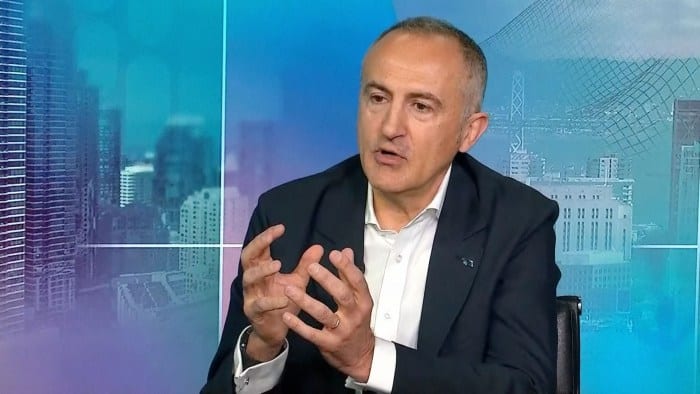

Lucid chief executive Silvio Napoli declined to rule out another capital raise in a CNBC interview on Wednesday, and instead promised the next one would be done in a way that is “very positive for investors and shareholders.”
Pressed the day after the company reported a quarterly net loss that nearly doubled to $1.03 billion and revenue that missed Wall Street consensus, Napoli was direct about the direction of travel.
“At some point, we will need more capital,” he said, describing the open questions as when the raise happens and what shape it takes, decisions he tied to the strategic plan his new leadership team is building.
Napoli has recently halved the number of direct reports as part of the restructuring.
The chief executive said the company is funded through 2027, pointing to a plan to improve 2026 cash flows by roughly $1.4 billion and to financing secured “well into 2027.”
Meanwhile, Napoli cited simultaneous demands including factory ramping in Saudi Arabia and the cash-hungry Midsize program — explaining why the question was never whether, only when.
The timing hinges on work not yet finished: Lucid suspended its 2026 guidance in the spring and has warned that Wall Street’s standing estimates no longer reflect its plans, with a new outlook promised later this year and 2027 targets at the year-end results — the same plan Napoli says will determine what form the raise takes.
The promise is a measurable one, because Lucid has raised capital multiple capital raises (approximately eight to nine discrete equity, preferred, and convertible transactions) in the twenty-four months before Napoli made it.
The market’s verdict on the interview was immediate: the shares crashed 13.9% to $6.70 on Wednesday as Napoli spoke, touching $6.18 intraday — before recovering to $6.95 by midday Thursday, a price that leaves the stock down 34% this year, 68% over twelve months.
The 52-week range goes from a high of $25.23 to a low of $2.37.
The latter touched in a violent plunge on July 14 on more than 155 million shares traded.
Six hours earlier, EV reported that adviser AlixPartners had presented going-private and Chapter 11 scenarios to the board, before the shares clawed back most of the drop after the company called the report “completely false”.
The name of Lucid’s main backer appears on every single operation.
Ayar Third Investment, the PIF affiliate, bought pro-rata in both public offerings, took the preferred stock and the credit facility outright, and backstopped both convertible deals with prepaid forward purchases of its own stock totaling roughly $1.07 billion.
The two-year record shows thatno raise cleared the market without Riyadh or a committed partner anchoring it.
What the Last Raises Did
Investors who bought the October 2024 offering — 262.4 million shares sold alongside a matching 374.7 million-share purchase by Saudi Arabia’s Public Investment Fund at $2.591 apiece, $25.91 adjusted for the reverse split — have lost about 73% measured against Thursday’s price.
Uber fared no better as a strategic buyer: the ride-hailing company’s first $300 million tranche, placed at $21.87 in September 2025 alongside the robotaxi agreement, has lost roughly 68%, and its combined $500 million equity investment was worth about $262 million at press time.
Buyers of the convertible notes sold in November 2025 watched the reference share price of $16.99 lose roughly 59% in nine months, leaving their $20.81 conversion right hopelessly out of the money.
The notes now function as straight debt paying 7.00%, on a balance sheet that was paying 1.25% for the paper those notes replaced.
The most recent equity buyers are also underwater.
The 36.1 million shares sold at $8.112 in April, part of a roughly $1 billion package raised days after the stock’s collapse toward all-time lows, had lost about 14% by Thursday.
The common share count grew from about 232 million split-adjusted in August 2024 to 394 million by late July — an increase of roughly 70% in two years.
The company executed a one-for-ten reverse split in September to keep its share price within Nasdaq listing rules, and stockholders’ equity turned negative, a deficit of roughly $1.1 billion at the end of June, despite nearly $6 billion of equity and equity-linked capital flowing in against net losses of $5.4 billion in 2024 and 2025 alone.
The preferred stock adds a claim that grows on its own: the three Ayar tranches, bought for a combined $2.3 billion, carried liquidation preferences of roughly $3.1 billion by the end of June — the gap opened purely by compounding dividends and the instruments’ minimum-return mechanics, ranking ahead of every common share.
The Terms Have Hardened With Every Round
The record shows something else about how Lucid raises money: each round has been more expensive than the last.
Straight common equity in October 2024 gave way to 5.00% convertible notes the following April, protected by capped calls; the November refinancing dropped the capped calls and priced at 7.00%; and April 2026 added $550 million of senior convertible preferred stock paying the Public Investment Fund a 9% dividend that compounds quarterly.
The move comes on top of roughly $1.75 billion of earlier preferred tranches accruing the same way, all ranking ahead of every common shareholder.
The same April amendment stripped the $1 billion minimum-liquidity covenant from the PIF credit facility, and the company has since drawn $1.3 billion of it, including $800 million on July 6, days before the AlixPartners revelations that briefly sent the shares to their all-time low.
Cantor Fitzgerald, which slashed its delivery forecast after the results, models the next capital raise in the third quarter of 2027 — squarely against Napoli’s assurance that “in ’27, we are fine.”