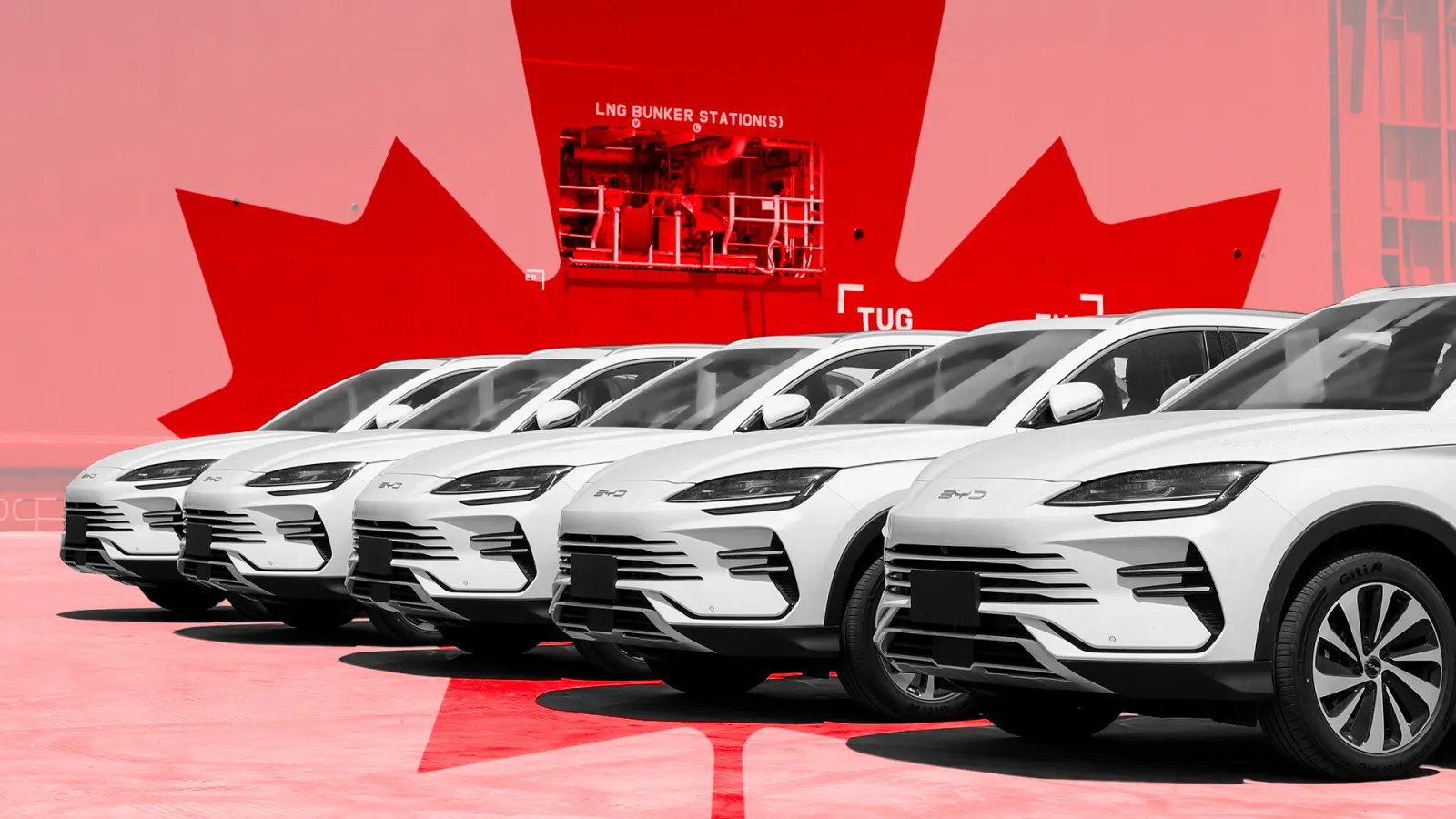
Three of China’s biggest automakers are open to building electric vehicles in Canada through local joint ventures, Industry Minister Mélanie Joly said, the strongest signal yet that Ottawa’s tariff-for-access bargain with Beijing could yield factories on Canadian soil.
BYD, Chery and Geely each told Joly during the Minister’s week in China that they would consider the joint-venture route, she told reporters on Monday despite not offering details on the talks.
“I was engaging with all these companies to see how that can be done,” Joly told reporters on a media callback held from Tokyo, the stop on her itinerary after the China meetings.
The minister met the three carmakers — plus a fourth, Shanghai Launch Automotive Technology — during a swing through Shanghai and Beijing aimed at converting market access into investment.
All four, she said, are willing to weigh the structure Ottawa is demanding.
The Price of Entry
Joly has set four conditions, unchanged since she first laid them out, for any Chinese EV investment in Canada.
The deal must be a joint venture that is majority Canadian-owned, meet Canadian labour standards, use Canadian parts, and run on software that keeps user data secure.
Short of that, she said, a Chinese automaker’s only way into Canada is the import quota itself.
Joly also wants Canadian suppliers building Chinese-designed cars under contract, pointing to Magna International, which already assembles XPeng models at a plant in Austria.
Her larger pitch is that a Canadian-Chinese venture could export worldwide, not merely serve the home market.
The openness is most striking for BYD, whose executives had earlier balked at ceding majority control, with one telling Bloomberg the company would build in Canada only if it owned the plant outright — a position EV reported sits squarely against Joly’s terms.
Geely has been the warmest of the group, already selling in Canada through its Western brands and signaling it would localize production.
Chery, the most active recruiter on the ground, brings joint-venture experience from abroad, with arrangements that could put its cars on lines in Britain, Spain and South Africa.
A Quota That Keeps Climbing
The opening traces to January, when Prime Minister Mark Carney broke with Washington and struck a deal in Beijing, scrapping Canada’s 100% surtax on Chinese EVs for a tariff near 6%.
In return, Beijing eased the retaliatory duties that had hammered Canadian canola and other farm exports.
The arrangement lets in 49,000 Chinese-built EVs in its first year — less than 3% of the Canadian market — with the cap rising about 6.5% annually to roughly 67,000 by 2031.
“This is already set, and this was communicated back in January, so no surprises,” Joly said of the expansion.
Building cars locally, with Canadian parts, would let the Chinese brands sell well beyond those quota limits — the incentive Ottawa is dangling in front of them.
First retail deliveries under the quota are expected to build through the second half of 2026, with Tesla already shipping Shanghai-built Model 3 sedans into Canada under the same low rate — a reminder the framework rewards Western brands that manufacture in China as much as Chinese ones.
Washington Is Watching
The talks land at a fraught moment for North American trade, weeks before the USMCA joint review opens on July 1.
US Trade Representative Jamieson Greer has pressed Canada and Mexico to align their external tariffs against China, warning that preferential access to the US market depends on it.
“If the Mexicans and the Canadians want … preferential access into the U.S. market, they need to make sure that they’re controlling their own economic borders,” Greer told a House committee in April, singling out subsidized Chinese autos.
Greer has also said the US will not loosen its own rules barring Chinese-linked software and hardware from connected cars, and has flagged tighter rules of origin for vehicles.
He has paired the pressure with a carrot, suggesting that if Canada and Mexico curb Chinese inflows, Washington could grant their goods easier access in return.
US politicians have seized on the deal too, with Republican Senate candidate Mike Rogers urging Washington to use the stalled Gordie Howe Bridge as leverage to force Canada to shut the cars out.
Asked how she would square the imports with US demands, Joly said Canada’s negotiators would defend the country’s interests, and that the deal had already won Canadian farmers and fishers better footing in the Chinese market.
‘We Shouldn’t Be Naive’
Carney appeared to acknowledge the US unease at this month’s G7 summit in France, where an open microphone caught him defending the quota to President Donald Trump.
“Less than 3 per cent of our market, 49,000 cars,” Carney was heard saying, adding: “It’s a cap, we capped, a hard line.”
Trump replied, “That’s good. I like it” — though it is not clear Carney mentioned that the cap climbs every year.
Not everyone is convinced the courtship serves Canada. Flavio Volpe, who heads the country’s auto-parts manufacturers’ association, said Carney struck the deal to protect farm and seafood exports, not the car industry.
“The government’s going to have to reconcile what Washington wants with what we agreed with in Beijing,” Volpe said.
Others question the premise. Vina Nadjibulla of the Asia Pacific Foundation of Canada warned against reading the automakers’ overtures as ordinary corporate decisions.
“We shouldn’t be naive,” she said. “In the case of China, the government plays a critical role, and we cannot assume that these are market-driven private sector conversations.”