
BYD sold 419,211 new energy vehicles at wholesale in July, a 21.8% increase from a year earlier and a third consecutive month of annual growth, the Shenzhen-based company said on Saturday.
The figure rose 3.9% from June’s 403,472 units, making July the company’s strongest month of 2026 and slightly below the 420,398 vehicles recorded in the final month of 2025.
Passenger new energy vehicles accounted for 411,072 units, up 20.5% from a year earlier and 3.5% from June, while commercial vehicles contributed 8,139, up 149.2% year over year and 31.7% sequentially.
The headline figure covers every marque the group sells. Alongside the mainstream Dynasty and Ocean networks, it includes the three sub-brands BYD runs above them — Denza, Fangchengbao and Yangwang — which the company breaks out in the same monthly release.
Fangchengbao sold 41,213 units in July, a 190.6% increase from a year earlier and a 15.7% rise from June, setting an all-time monthly high for the brand.
Denza sold 19,196, up 68.8% year over year but down 5.7% from June, and Yangwang sold 485, up 43.1%.
The figures leave the Dynasty and Ocean lineups at about 350,178 units, a 2.7% rise from June.
Cumulative new energy vehicle sales have now passed 17.3 million units.
A model-level split is not part of the monthly release.
The China Passenger Car Association is expected to publish its model-by-model figures next week, which will break each brand down to the nameplate.
Exports Are Carrying the Company
Sales of passenger vehicles and pickups outside China reached a record 179,841 units in July, a 124.3% increase from a year earlier.
Last month’s figures represent roughly 43% of the month’s total, broadly in line with June’s share.
Domestic sales worked out at about 239,370 units, down roughly 9% year over year — a decline, but a far narrower one than the 22.0% drop recorded in June and the 39.6% contraction across the first half.
The narrowing of that domestic gap, rather than the export record, is the more consequential development in this month’s numbers.
BYD has leaned on overseas demand to offset a shrinking home market for most of 2026, a pattern that only works while the domestic decline stays contained.
Target Progress
Sales for the first seven months of 2026 total 2,227,722 new energy vehicles, down 10.5% from the same period of 2025.
The decline narrowed from the 15.7% drop recorded across the first half.
BYD has guided to full-year sales of 5.0 million to 5.5 million new energy vehicles, implying growth of 10% to 20% on the 4.60 million units sold in 2025.
Measured against that range, the year-to-date total represents 44.6% of the lower bound and 40.5% of the upper bound.
Reaching the floor would require an average of 554,456 vehicles a month across the final five months. Clearing the ceiling would require 654,456 a month.
Both figures sit far above July’s 419,211 and above any monthly total BYD has recorded during 2026 or 2025.
The overseas picture is the one part of the guidance running to plan. Sales of passenger vehicles and pickups abroad totalled 969,208 units through July, or 43.5% of cumulative volume, against a raised full-year target of 1.5 million — a completion rate of 64.6%.
Chairman Wang Chuanfu said at the 2025 annual general meeting that the company was on track to exceed that overseas figure, and management has separately guided domestic sales to 3.5 million to 4.0 million units, a band the year-to-date domestic total of about 1.26 million leaves 31.5% to 36.0% complete.
Most Chinese automakers closed the first half with less than 40% of their annual targets achieved.
The Battery Transition Behind the Slump
The recovery tracks the tail end of a technology changeover rather than a demand swing.
BYD has been switching from the first-generation Blade Battery to a second-generation pack with flash-charging capability, a production line overhaul that lengthened delivery cycles on several core models through the first half.
As that changeover has wound down, the capacity bottleneck has eased, which is the mechanism behind three consecutive months of improving year-over-year comparisons.
Whether the domestic line returns to growth rather than merely a shallower decline is the question the August figures will answer.
Fangchengbao Has Overtaken Denza
The premium marques are the one part of BYD‘s portfolio growing faster than the group as a whole.
Fangchengbao, the off-road line built around the Bao 5, Bao 8 and the newer Tai and Ti models, now outsells Denza by more than two to one, having grown 190.6% year over year in a month when group volume rose 21.8%.
Its cumulative sales are approaching 500,000 units. In June the Ti7 alone accounted for 23,710 of the brand’s 35,607 deliveries, which is where the growth is concentrated.
Denza, which began as a joint venture with Mercedes-Benz and retains a premium positioning from it, passed 20,000 monthly sales for the first time in June on the strength of the D9 multi-purpose vehicle before easing to 19,196 in July.
Yangwang, the ultra-luxury line carrying the U8 and the U9, remains a rounding error on volume at 485 units, though its function is halo rather than scale.
Together the three took 14.8% of passenger volume in July, up from 14.2% in June.
That share matters more than the absolute numbers. All three carry materially higher average prices than the Dynasty and Ocean lines, so a rising premium mix determines whether the volume recovery is also a revenue recovery — a question the group total cannot answer on its own.
The structure is being simplified abroad. BYD is folding Dynasty and Ocean under a single badge internationally, running Denza and Fangchengbao as a joint operation and keeping Yangwang standalone, brand and public relations general manager Li Yunfei said.
Several Fangchengbao models are rebadged as Denza for export, the Bao 5 and Bao 8 selling abroad as the B5 and B8, which is why the two brands are run together outside China.
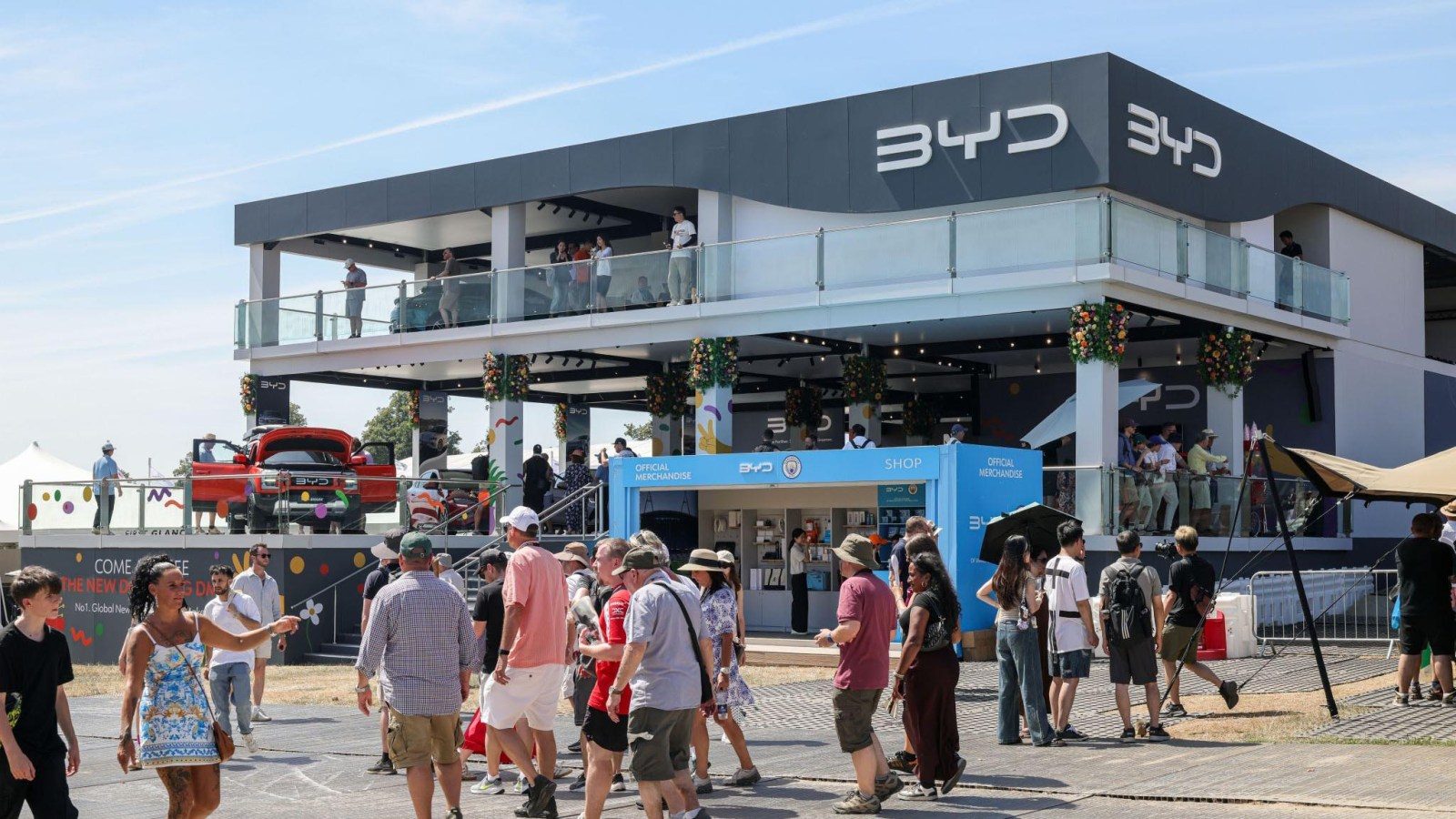
The premium push has a visible edge to it. BYD took 2,016 square metres at Goodwood across three of its brands, the largest stand in the event’s 33-year history, and used it for the global debut of the Denza Z from £142,900.
In June, passenger battery electric vehicles accounted for 201,472 units, down 2.6% year over year but up 1.4% sequentially — a split that showed plug-in hybrids doing more of the work than the headline number suggested.
The company launched the Da Tang, its first D-segment flagship sport utility vehicle in the Dynasty line, in mid-June after taking more than 100,000 pre-orders, and the model’s first full months land in this reporting window.
Production passed a seventeen-millionth new energy vehicle in early July, a milestone the company marked with a Seal 08.
Second-generation Blade battery packs and ultra-fast charging rated up to 1,500 kilowatts continue to roll out across the range, the technology transition that constrained output through the first half now working in the other direction.
Nameplate-level detail within each brand arrives with the CPCA data next week.
Europe and the Wider Push
BYD overtook Tesla in European registrations in the first half, registering 174,144 vehicles against Tesla‘s 170,351 — a gap of fewer than 4,000 units, where a year earlier the Chinese company trailed by roughly 39,000.
The company offers in its portfolio considerably cheaper vehicles, including hybrid models.
The five largest Chinese-owned groups together took about 11% of the EU, EFTA and UK market over the same period, up from approximately 10.6% through the first five months.
BYD‘s German subsidiary has targeted 50,000 vehicle sales in the country for 2026, and trial production has begun at its first European passenger vehicle plant in Szeged, Hungary.
Plants are open or under construction in Brazil, Hungary, Turkey, Thailand and Indonesia, and the business now spans 119 countries and regions.
Brand Spending and a Robot
BYD has paired the export push with sponsorship spending aimed squarely at European visibility, becoming Paris Saint-Germain’s automotive and mobility partner after earlier deals with Manchester City and Inter Milan.
The company and its premium Denza marque will supply vehicles for the club’s daily operations, in a deal that makes Paris Saint-Germain the latest major European side to replace an established carmaker with a Chinese one after five years without an automotive sponsor.
Separately, BYD confirmed to Chinese financial media that it will unveil its first humanoid robot in a few days at its Di Space experience venues, with a teaser from its Zhengzhou site pointing to early in the month.
Executive VP Stella Li has said the company plans an open robotics platform producing both in-house machines and products co-developed with partners, and that she wants two or three robots in every store.