Chinese Commerce Minister Wang Wentao called on Europe’s automakers to help broker a resolution to the China-EU car trade dispute, pressing Mercedes-Benz CEO and ACEA head Ola Källenius and Germany’s top auto lobby to keep the bloc’s markets open to Chinese manufacturers.
Wang held a video call on Monday with Källenius, who also serves as President of the European Automobile Manufacturers’ Association (ACEA).
He met separately with Hildegard Müller, President of the German Association of the Automotive Industry (VDA), China’s Commerce Ministry said in readouts published on Monday evening Beijing time.
Beijing backs investment by its automakers in Europe and wants dialogue and consultation to produce a “mutually acceptable, constructive” solution to the auto-sector dispute, Wang said in his meeting with Müller, according to Reuters.
Hybrid Pressure Mounts
Wang’s diplomatic push landed as the trade friction between Brussels and Beijing enters a new phase.
The EU imposed additional anti-subsidy duties of up to 35.3% on battery-electric vehicles manufactured in China in October 2024.
Plug-in hybrids were excluded from those levies and remain subject only to the standard 10% import tariff.
EU imports of hybrids from China rose from about 3,800 vehicles in October 2024 to 50,000 in July 2026, the Financial Times reported.
Brussels has asked Beijing to voluntarily cap Chinese-made hybrids at around 15% of the EU market, down from more than a third currently, or face the prospect of additional tariffs.
Brussels has asked Beijing to voluntarily cap Chinese-made hybrids at around 15% of the EU market, down from more than a third currently, or face the prospect of additional tariffs, the newspaper reported on September 17.
China’s Commerce Ministry said the next day that it firmly opposes “so-called voluntary export restraints,” calling them a serious violation of WTO rules.
Foreign Ministry spokesperson Guo Jiakun said the same day that China would “closely follow the EU’s moves and take necessary measures to safeguard the legitimate rights and interests of Chinese companies.”
Neither of Monday’s readouts mentioned hybrids or quotas, but Wang’s remarks to Müller reinforced that stance.
“China doesn’t want to see the European side choose a path of protectionism, restrict or close markets, and cause markets around the world to become mutually closed off,” the ministry quoted him as saying.
“China is not the source of the economic and trade problems the EU faces, but a partner in solving them together,” he told Müller, according to the readout.
Seeking Factory Sites
The calls also came as Chinese automakers accelerate their search for manufacturing footprints inside the EU.
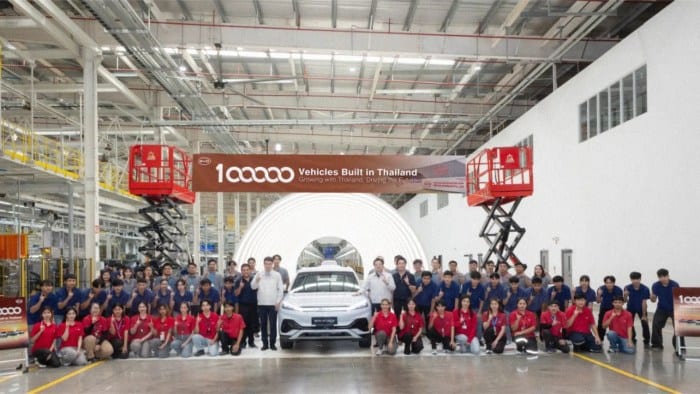
BYD expects mass production at its first European plant, in Szeged, Hungary, in the fourth quarter, and has said it wants to acquire an existing factory in southern Europe for a second facility.
Geely agreed in July to form a joint venture at Ford‘s Valencia plant in Spain, where it will build two electric SUVs from 2028.
Leapmotor plans to build cars with Stellantis in Spain, and Dongfeng has signed a non-binding memorandum with Stellantis to explore production at its Rennes plant in France. Chery has teamed up with a local partner to take over a former Nissan plant in Spain.
The race to set up local assembly has intensified ahead of the European Commission’s proposed “Made in Europe” rules, which would set minimum local-content requirements for electric vehicles sold in the bloc.
BYD’s European adviser Alfredo Altavilla told Reuters in June there is “no time to start a greenfield plant today” and that Chinese manufacturers are focused on acquiring and refurbishing existing sites.
The local-content push is already reshaping supply chains on the European side.
Dacia moved production of its Spring city car from Dongfeng’s Wuhan plant to Renault’s factory in Slovenia, repricing the second-generation model at €17,900 ($20,500) to escape the EU’s countervailing duties on China-built EVs and regain access to France’s purchase incentive schemes.
BMW has been negotiating a minimum pricing agreement with the European Commission to replace tariffs on its Chinese-made electric MINI models, Handelsblatt reported in February.
Wang told Müller that China supports its automakers investing in Europe and is committed to exploring solutions under the China-EU trade consultation mechanism, based on principles of compliance, balance and non-discrimination.
He told Källenius he hoped ACEA would “play a positive role” in pushing the EU to meet China halfway and reach an early agreement that complies with World Trade Organization rules and the domestic laws of both sides and “takes into account the interests of both industries,” according to the ministry.
Källenius told Wang that ACEA “firmly supports free trade and market openness” and welcomes investment in Europe by Chinese carmakers and parts suppliers, according to the Chinese readout. He said the association was willing to “voice the industry’s views” in support of dialogue.
ACEA and Mercedes have not published their own account of the call.
The same day, Foreign Minister Wang Yi told German Foreign Minister Johann Wadephul in a phone call that “China and the EU should not fight a trade war,” according to Xinhua.
Fourth Contact Since February 2025
Monday’s video call was at least the fourth contact between Wang and Källenius since February 2025, according to Chinese Commerce Ministry readouts.
The two first spoke on February 14, 2025, when the minister pressed Mercedes-Benz and ACEA to push the European Commission toward a political decision on the tariff dispute.
At the time, Wang said the two sides should build on progress from multiple rounds of consultations and urged Brussels to “meet China halfway.”
Källenius said then that the European automotive industry, including Mercedes, supports resolving differences through dialogue and consultation.
The two met in Beijing in March 2025 and again on April 23 this year, when Wang said recent EU trade measures had caused “substantial damage” to China-EU relations.
Mercedes-Benz pledged in February 2025 to uphold its long-term commitment to the Chinese market and deepen cooperation with Chinese partners.
The company maintained that position on Monday, according to the readout, which quoted Källenius as saying Mercedes “firmly believes that only by deeply cultivating the Chinese market can it stand firm globally.” It comes even as its China sales contract and its car division’s adjusted return on sales is guided at between 3% and 5% in 2026, from 5.0% in 2025.
Källenius Under Pressure
Wang’s choice of interlocutor carries weight beyond Källenius’s ACEA title.
Mercedes-Benz is one of the most China-exposed automakers in Europe’s premium segment, and one of the most vulnerable to the geopolitical forces reshaping both sides of the trade.
Mercedes-Benz’s two largest individual shareholders are both Chinese.
BAIC, the state-owned automaker, holds 9.98%, while Li Shufu, founder of Geely Holding Group, controls 9.69% through Tenaciou3 Prospect Investment.
Combined, the two stakes total 19.67%. That is above the 15% threshold in the Connected Vehicle Security Act, which could bar Mercedes from selling connected cars in the US.
The Senate Commerce Committee advanced the bill unanimously on July 22. Senator Bernie Moreno said Mercedes would have until 2030 to comply and could seek waivers. Mercedes says no shareholder holds more than 10%.
Källenius faces the task of navigating trade hostility toward China in Washington while maintaining the commercial relationship Beijing expects from its investment ties.
On the Chinese side of the ledger, Mercedes-Benz is losing ground rapidly.
The automaker sold 98,600 passenger cars in China in the second quarter, down 30% from a year earlier.
First-half volume fell 28% to 210,200 units.
Xiaomi, a company that shipped its first car in April 2024, outsold Mercedes in China in the quarter with 104,199 vehicles.
The electric CLA L sedan, the first model built on Stuttgart’s new MMA platform for Chinese customers, sold just 627 units in the first half of 2026 before production was reportedly suspended.
Wang told Källenius that China welcomes European automakers, including Mercedes-Benz, to expand investment in China and deepen innovation partnerships with Chinese counterparts.
For a company whose full-year 2025 revenue from China fell 33.6% to €16.5 billion ($18.8 billion), the invitation carries commercial significance — and limits the room for ACEA’s President to take a confrontational stance toward Beijing.
Broader Context
Chinese brands accounted for around 6% of EU registrations between January and April 2026, up from 3.2% a year earlier, according to ACEA data.
Industry tracker Jato Dynamics projects Chinese-brand registrations in Europe will exceed 1.3 million vehicles this year, up from about 50,000 in 2020.
Wang’s outreach to both ACEA and the VDA signals Beijing’s strategy of engaging directly with Europe’s auto industry establishment ahead of EU Trade Commissioner Maroš Šefčovič’s visit to Beijing on October 8 and 9 for the next round of China-EU trade talks.