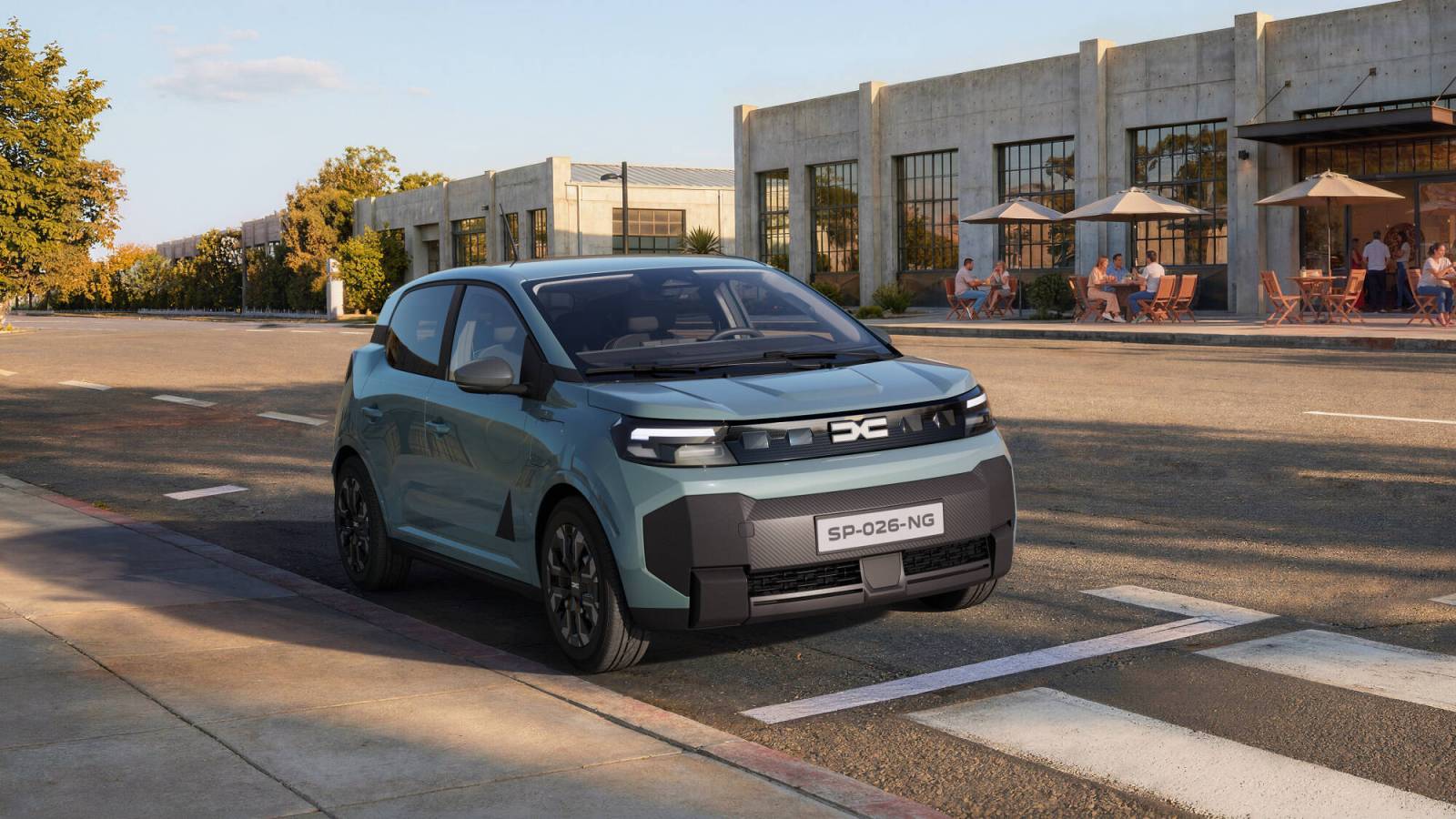

Dacia unveiled the second-generation Spring on Tuesday, a larger, Slovenian-built replacement for the China-made city car that has been Europe’s cheapest electric vehicle.
The model is priced from €17,900 ($20,800) and was designed to regain the subsidies and escape the tariffs that had left the outgoing model 55th in the French sales ranking this year.
The Spring EV is the first of four fully electric models the Renault Group brand has committed to launching by 2030 under the strategic roadmap it set out in March, and the first Dacia developed under the group’s new programme to cut design cycles to under two years.
“New Spring is the smart A-segment EV choice made in Europe,” Dacia said in its release, describing a model that “keeps the name of the previous generation but changes everything else.”
Production moves from Dongfeng’s Wuhan plant, where the first generation was built, to Renault’s Novo Mesto factory in Slovenia, alongside the Twingo E-Tech with which it shares the group’s RG-EV Small platform, its 60 kW motor and its 27.5 kWh battery.
Being built in Europe takes the Spring out of the European Union’s countervailing duties on China-built EVs and back into France’s incentive schemes.
Dacia said the revamped Spring will start at €17,900 and its release says the whole range is priced under €20,000 before incentives; the full price list has not been published.
The market launch is expected for late this year with first deliveries in early 2027, and the China-built Spring stays on sale in the meantime as the cheaper option.
A Bigger Car, One Powertrain
The new Spring is 3.85 metres long and 1.74 metres wide, 15 cm longer and 18 cm wider than its predecessor, a change Dacia leads its release with as giving “a stronger, more robust stance” and more interior space.
Every version has the same front-mounted 60 kW (80 hp) motor with 175 Nm, 0 to 100 km/h in 12.1 seconds, a top speed of 130 km/h, and a 27.5 kWh lithium iron phosphate battery giving up to 250 km on the WLTP cycle at 12.7 kWh per 100 km.
The outgoing first generation offered 52 or 75 kW, a 24.3 kWh pack, and 225 km.
A 6.6 kW AC charger is standard, taking the battery from 15% to 80% in nine hours on a domestic socket, 5 hours 40 minutes on a heavy-duty socket, or 2 hours 55 minutes on a 7 kW wallbox.
An optional fast-charge pack adds an 11 kW AC charger, which cuts that to 1 hour 55 minutes on a three-phase wallbox, and a 50 kW DC charger for 15% to 80% in 28 minutes.
Without the pack, the car cannot use a DC charger at all.
Dacia’s justification is its own owner data saying the first-generation Spring drivers average 34 km a day at 34 km/h and charge at home in 75% of cases, so “one charge per week will be sufficient for most.”
Two Trims, Four Colours
The Expression trim carries a 7-inch digital instrument cluster, Dacia’s Media Control system with steering-wheel controls and a phone holder in place of a central screen, manual air conditioning, rear parking sensors, an electric parking brake and 15-inch steel wheels.
The Journey trim adds a 10.1-inch touchscreen running Media Nav Live with wireless Apple CarPlay and Android Auto, eight years of connected navigation, a reversing camera, a hands-free card and 16-inch wheels.
The Record It Replaces
The Spring has sold more than 210,000 units in over 40 countries since 2021, about 50,000 of them in Germany, and in 2025 it sold 35,034 worldwide, up 53%, becoming Europe’s best-selling A-segment EV for the first time, according to Dacia.
It received new motors and the Renault Group’s first LFP battery in an autumn 2025 update.
A €5,000 manufacturer discount took the German base car to €11,900 early this year, the entry Essential trim was then withdrawn, and the range now lists from €18,700 with up to €3,000 off, so the new car’s €17,900 is well below the outgoing list price and about 50% above the discounted floor.
Dacia sold 697,408 vehicles in 2025, up 3.1%, passing 10 million since 2004, with hybrids more than doubling to 19.2% of passenger-car sales on the Duster and Bigster.
The Sandero was Europe’s best-selling car in 2024 and 2025, and its electric successor, expected toward the end of 2027, is the second of the four planned EVs.
Against the Chinese City Cars
The new Spring lands between the Leapmotor T03, sold through Stellantis at about €18,900 in Germany, and the BYD Dolphin Surf at about €20,000, both Chinese-built and both carrying the EU duty the Spring now avoids.
Above it sit the Twingo E-Tech at €19,490 in France, the Citroën ë-C3 and the Hyundai Inster, and from 2028 Stellantis’s Pomigliano E-Car at about €15,000.
China’s exporters are targeting the segment hardest. A00 and A0 battery-electric cars were 56.5% of Chinese BEV exports in August, up from 45.2% a year earlier, according to the CPCA figures released on Tuesday.