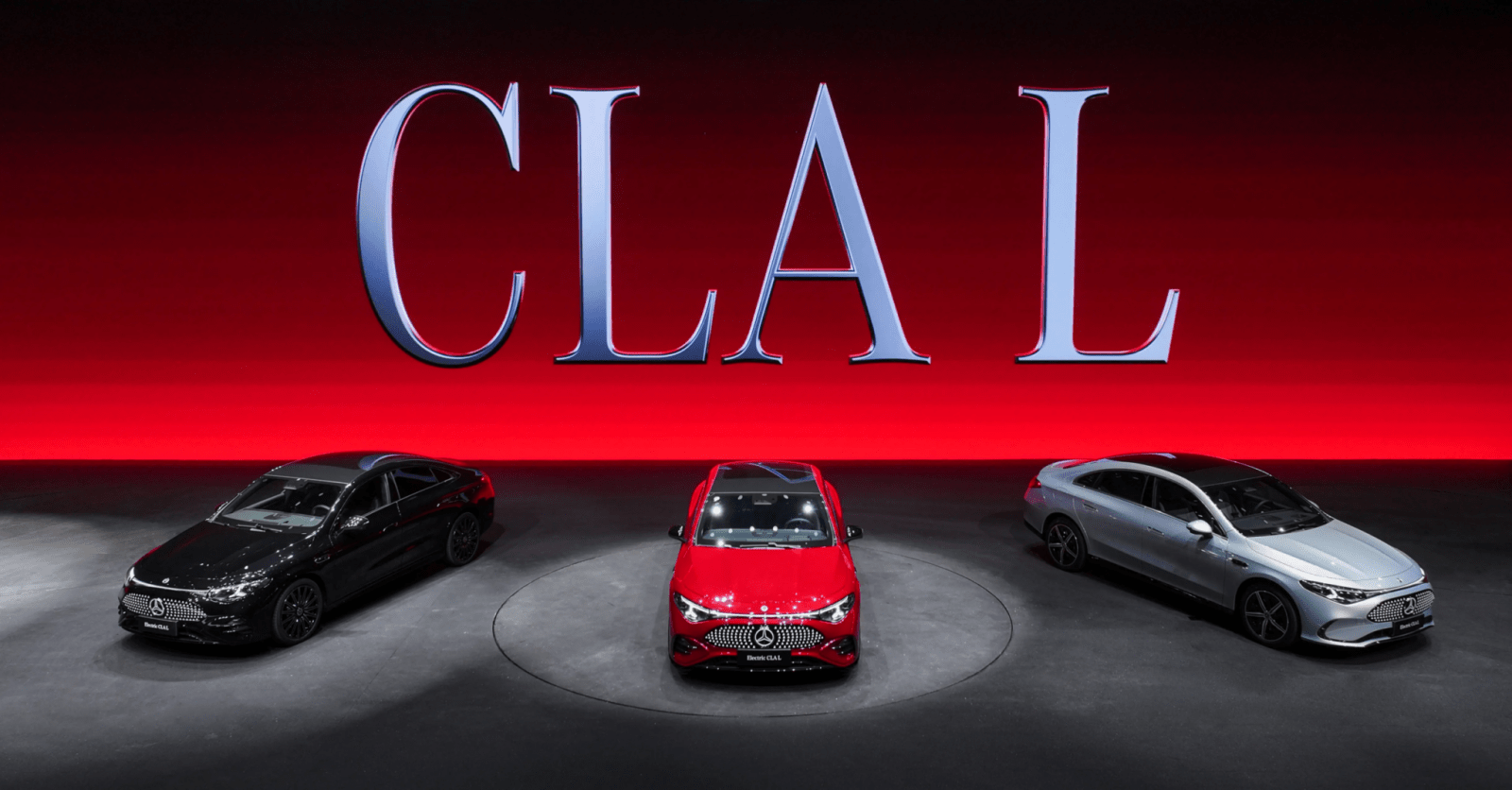

Mercedes-Benz has reportedly suspended production of its electric CLA L sedan in China after the model sold just 627 vehicles in the first half of 2026.
The information was first reported by the German blog mbpassion, which cited industry sources saying output of the long-wheelbase variant has been temporarily halted at the Beijing Benz Automotive Co. (BBAC) joint venture plant.
Mercedes-Benz has not commented on the report. The model was developed exclusively for the Chinese market.
The CLA L was the first vehicle built on Mercedes‘s new MMA platform to reach Chinese customers.
Equipped with an 800-volt electrical architecture and the automaker’s new MB.OS operating system, the sedan was positioned as proof that Stuttgart could still compete with domestic rivals in a market increasingly defined by software, speed of iteration and price.
Registration data cited by mbpassion paints a stark picture of demand.
January saw 35 new registrations, followed by 21 in February.
A brief spike to 358 units in March suggested early momentum, but volumes collapsed to 52 in April and 161 in May.
June recorded zero registrations, though mbpassion noted that the cause of the June blank — whether the reported production halt, pipeline effects or other factors — remains unclear.
CLA Built for Chinese Preferences
Mercedes followed a playbook used across several of its sedan lines in China, stretching the CLA’s wheelbase by four centimeters to 2,830 mm for the L variant.
Overall length grew from 4,720 mm on the European model to 4,760 mm, while width and height stayed the same.
The additional space benefits rear-seat passengers — a key purchase criterion in China — though the CLA’s coupe-like roofline limited the extension relative to earlier long-wheelbase models such as the C-Class L and E-Class L.
On the powertrain side, the CLA L claims up to 860 km (534 miles) of driving range under China’s CLTC testing cycle.
Mercedes rates the European-spec CLA at up to 792 km (492 miles) under the stricter WLTP standard, making a direct comparison difficult, though the Chinese figure reflects both a different test protocol and local calibration.
The German automaker also partnered with ByteDance to integrate Chinese digital services and apps, and fitted enhanced Level 2+ driver-assistance systems developed in collaboration with Momenta, the Chinese autonomous driving specialist.
MB.DRIVE ASSIST PRO — the system launched with the CLA in China in late 2025 — was intended to narrow the software gap with domestic competitors offering point-to-point navigation assist as standard or near-standard equipment.
30% Q2 Sales Decline
The CLA L’s struggles arrive against a backdrop of accelerating decline for Mercedes across its entire China portfolio.
The automaker sold 98,600 passenger cars in China in the second quarter of 2026, down 30% from a year earlier — its steepest quarterly drop in a downturn now stretching past two years.
First-half volume totalled 210,200 units, a 28% year-over-year contraction.
Annual sales peaked at roughly 765,000 vehicles in 2023 and have fallen every year since.
At the current run rate, Mercedes is on pace to deliver fewer than 450,000 cars in China in 2026, a decline of roughly 40% in three years.
Mercedes has dropped out of China’s top 20 passenger vehicle brands by wholesale volume in the first half of the year, according to data from the China Passenger Car Association (CPCA). A year earlier, the brand ranked 18th.
During the same second quarter in which Mercedes fell below 100,000 units for the first time in more than a decade, Xiaomi — a company that shipped its first car in April 2024 — delivered 104,199 battery electric vehicles in China, surpassing Mercedes‘s total passenger car output.
CLA Thrives in Europe
The contrast between markets makes the CLA L result more notable.
Mercedes‘s global BEV sales rose 51% in the second quarter to 52,900 units, driven overwhelmingly by Europe, where BEV volume surged 87% to 43,500.
German BEV sales more than doubled. CEO Ola Källenius has described the electric CLA, GLC and new S-Class as generating order books stretching into the second half of the year.
China, however, has not followed.
The CLA L’s 627-unit first half suggests the model has failed to convert the technical specification — 800-volt architecture, long range, local software — into purchase decisions.
Chinese buyers in the segment can choose from BYD, Nio, Xiaomi and XPeng models that typically offer comparable or superior software integration, faster development cycles and aggressive pricing.
New energy vehicles — battery electric, plug-in hybrid and extended-range models — have held above 50% of all vehicle sales in China since late 2025.
The shift has rewarded vertically integrated domestic platforms while pressuring foreign brands still transitioning away from combustion-heavy lineups.
Financial Pressure Mounts
Mercedes warned earlier this year that its car division’s adjusted profit margin could fall to between 3% and 5% in 2026, down from 5% in 2025.
Full-year 2025 revenue from China fell 33.6% to €16.5 billion ($18.8 billion).
Net profit nearly halved to €5.3 billion ($6.5 billion).
CFO Harald Wilhelm set a medium-term China volume target of 500,000 to 600,000 annual sales with high single-digit margins — a range whose upper end still sits well below the volumes the company achieved between 2020 and 2023.
Mercedes has framed 2026 as a transition year anchored by what Källenius has called the largest model offensive in the company’s history.
Orders have opened for the electric C-Class, and the all-electric GLA is set for its world premiere later this month.