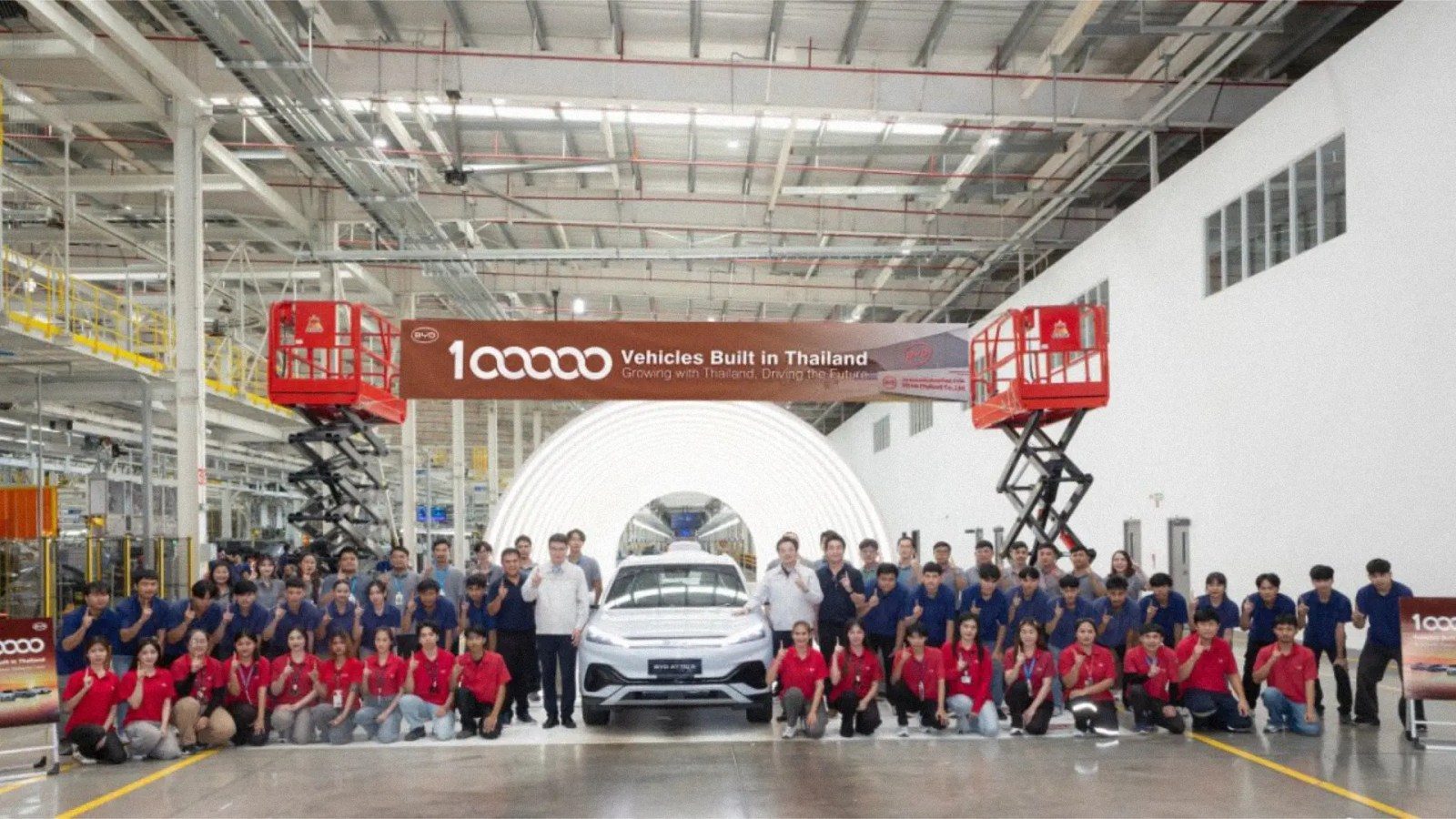

BYD‘s Thailand plant has produced its 100,000th new energy vehicle about 26 months after starting operations, the Chinese automaker said on Wednesday, even as output there has slowed.
Overseas factories are taking on a larger role as the Chinese automaker sees record export demand.
A white Atto 3 rolled off the line in Rayong province on Monday, according to the local management.
The Yuan Plus (sold as Atto 3 outside China) was the first model BYD introduced when it entered Thailand in 2022.
The company marked the milestone alongside Rever Automotive, its local distributor under the Rever Group, at a media event at the plant.
Located in the WHA Industrial Estate, the facility is BYD’s first wholly owned overseas passenger vehicle production base.
Operations began in July 2024 with a designed annual capacity of 150,000 vehicles.
BYD has invested 35.9 billion baht ($1.1 billion) in Thailand, according to figures presented at the event.
Production Pace Slows
The plant built its 10,000th vehicle in November 2024 and its 70,000th in November 2025, or about 4,800 a month over that stretch.
The next 30,000 took about 10 months, a pace of roughly 3,100 a month, about a third slower.
Over its first 26 months, Rayong has averaged about 30% of its designed capacity. At the pace of the last 10 months, it is running closer to a quarter.
BYD’s Camaçari plant in Brazil, which began assembling vehicles in July 2025, reached its own 100,000th vehicle this July, in about half the time.
Rayong assembles five models: the Dolphin, Atto 3, Seal 5 DM-i, Sealion 5 DM-i and Sealion 6 DM-i.
All five carry “Made in Thailand” certification from the Federation of Thai Industries.
Thailand remains BYD’s most important market in the Asia-Pacific region.
Cumulative deliveries in the country, including imported vehicles, exceeded 130,000 units in July.
Localized Production
BYD employs about 6,000 people at the Thai plant, including about 5,700 Thai nationals, or 95% of the workforce.
Local content accounts for about 50% of components.
BYD works with more than 266 Thai parts manufacturers and distributors.
Of these, 125 are domestic manufacturers of materials and components, with more than 1,090 component items certified under TAI standards, according to details released during a media tour of the plant.
Rayong covers the full manufacturing chain, from stamping, welding and painting to final assembly.
A 7,900-ton automated press anchors the stamping shop, which can supply about 6,000 sets of body components a month.
Across about 70,000 square meters, the welding plant runs 20 production lines and up to 520 robots.
Output reaches up to 45 vehicles per hour, and the lines can support up to 10 models. In the paint shop, 64 robots apply primer and topcoat, while a regenerative thermal oxidizer treats volatile organic compound emissions.
Battery production also runs locally.
A Blade Battery plant at the WHA Rayong 36 Industrial Estate, BYD’s first battery-pack facility outside China, operates three lines with capacity for 150,000 packs a year.
A wiring-harness plant produces about 6,500 sets a month.
Higher Costs, Higher Taxes
Building cars in Thailand still costs more than importing them from China, Benson Ke, General Manager of BYD Auto (Thailand), told Autolife Thailand. He cited smaller production scale, research and tooling costs, and lower volumes at Thai suppliers.
BYD has met its local-production obligations under Thailand’s EV 3.0 incentive scheme, Ke said. It has not yet met those under EV 3.5 and expects to do so in 2027.
EV 3.5 requires carmakers to build two vehicles in Thailand for every one imported under the scheme in 2026, rising to three in 2027.
Thailand’s national EV board agreed in principle on September 10 to a tiered excise tax, with the highest rate on fully imported EVs, above the current 10%.
Finance Minister Ekniti Nitithanprapas has said a rate of about 30% is under consideration. The finance ministry expects to finalize the rates by the end of September.
Pratarnwong Phornprapha, Chief Executive Officer of Rever Group, backed the change. He told Autolife Thailand that the Thai market should now be a contest between those who invest in the country and those who do not, rather than between Chinese and Japanese carmakers.
He said the new structure would initially affect prices of every Denza model and some BYD models, and that sales targets would need to change.
Export Hub for ASEAN and Europe
Rayong also serves as an export base.
Exports accounted for about 40% of the plant’s production in the early part of 2026, according to the media tour details.
Cumulative exports have passed 24,000 vehicles, shipped to Europe, Australia and South Asia.
Rayong made its first shipment to Europe in August 2025, sending more than 900 Dolphin hatchbacks to markets including the UK, Germany and Belgium.
Eight-month overseas sales reached 1,157,954, already above the 1.05 million BYD sold abroad in all of 2025.
Exports now make up about 43% of group volume, up from around 25% at the start of the year.
Management raised its 2026 overseas target for the third time to 1.9 million–2.0 million vehicles and told investors shipping capacity, not manufacturing, was constraining overseas volumes.
Domestic sales moved the other way.
BYD delivered 1,505,755 vehicles in China through August, down 32.7% year over year.
Export demand is also driving hiring at home. BYD’s Xi’an base is recruiting several thousand workers after retooling for its second-generation Blade Battery, Yicai reported.
In Brazil, BYD’s Camaçari complex has passed 8,000 direct employees and is hiring 1,500 people for a third shift.
In Southeast Asia, BYD opened a second regional plant on September 3 in Subang, Indonesia, also with capacity of 150,000 vehicles a year.
European Plants Next
Europe is the next stage of BYD’s localization push.
The company’s first European passenger car plant, in Szeged, Hungary, began trial production in January. Management expects vehicle assembly to start in November or December, with capacity of 200,000 vehicles a year at full ramp.
BYD will ultimately need three assembly plants and one battery factory in Europe, special adviser Alfredo Altavilla said last week.
BYD expects to decide on a second site by year-end, with Spain and France among preferred locations.
China-built BYD electric vehicles face a combined 27% tariff in the European Union: a 17% countervailing duty on top of the standard 10% import levy. Cars exported from Rayong avoid the countervailing duty, which applies only to vehicles built in China.
The EU’s draft Industrial Accelerator Act would set a local-content threshold of about 70% for subsidies and public procurement.
BYD said it would continue to expand local manufacturing, develop talent and strengthen its supply chain in Thailand.