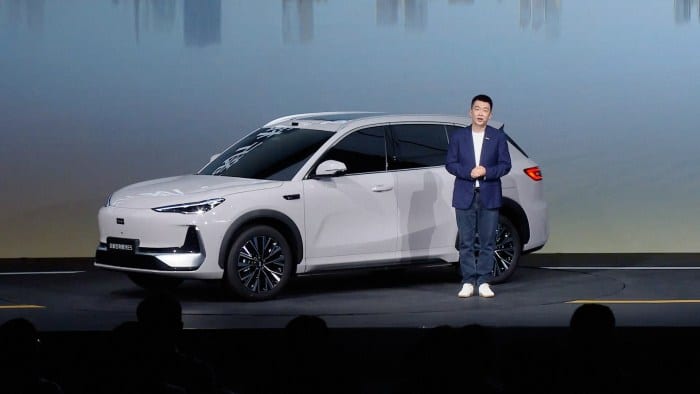

Geely‘s premium brand Zeekr said on Thursday that the five-seat version of its flagship hybrid SUV — the Zeekr 9X — will officially launch on July 28.
Firm orders will open at 10:00 a.m. Beijing Time, with the company skipping the launch event, an unusual step in China’s auto industry.
Prices for the five-seat variant of the model have yet to be announced.
Zeekr‘s move comes less than three weeks after domestic rival Nio launched a five-seat version of its ES8 — with deliveries beginning the following day across more than ten Chinese cities.
Nio priced its variant from 382,800 yuan ($56,600) with the battery included — 5.9% below the six-seat counterpart — and from 274,800 yuan ($40,600) under Battery as a Service.
Founder and CEO William Li has framed the five-seat large SUV market as roughly three times the size of the three-row segment.
Nio‘s co-founder and President Qin Lihong had already stated at the Beijing Auto Show in April that “if we don’t launch it, competitors will.”
Zeekr‘s five-seat 9X now counts among those competitors.
BEV Versus Hybrid
Both vehicles target buyers in the premium large SUV space, but their powertrains diverge sharply.
Nio‘s ES8 is fully electric, running dual motors on a 900-volt architecture with a 102-kWh battery and 655 km of CLTC range.
Zeekr‘s 9X is the brand’s first hybrid model, pairing a 2.0-litre turbocharged engine with electric motors for shorter pure-electric range but substantially longer combined driving distance.
Dimensions are close, however.
Nio‘s ES8 stretches 5,280 mm on a 3,130-mm wheelbase; Zeekr‘s 9X measures 5,239 mm on a 3,169-mm wheelbase.
Nio holds a cargo advantage in five-seat form.
Removing the third row gives the ES8 1,334 litres behind the second row and 3,084 litres with seats folded — figures the company calls the largest in the segment.
On pricing, the six-seat 9X starts at 465,900 yuan ($68,800) — roughly 83,100 yuan ($12,300) above the five-seat ES8’s entry point.
Zeekr has not disclosed whether the five-seat version will undercut the six-seater, as Nio‘s does.
Pre-sale Benefits
Pre-sales for the five-seat 9X opened on July 8, with limited-time benefits worth as much as 90,000 yuan ($13,300).
A 5,000-yuan reservation deposit can be applied toward a 10,000-yuan ($1,500) reduction on the purchase price — a structure Nio also used for its five-seat ES8 pre-orders.
Benefits include a complimentary Naim premium audio system, a sliding display and powered running boards.
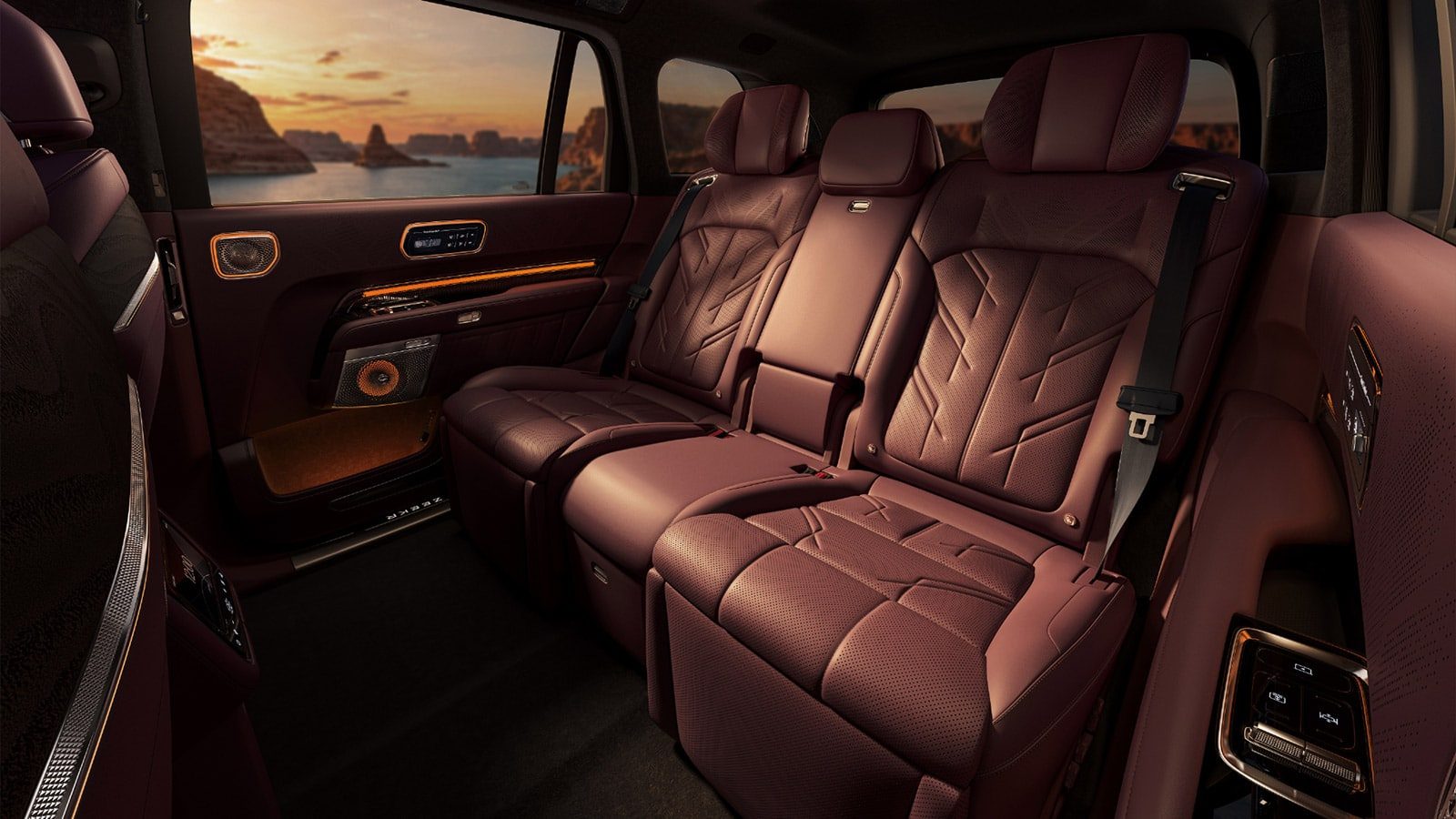
Interior images released by Zeekr show the five-seat cabin finished in brown leather.
Second-row occupants sit on zero-gravity seats with powered leg rests, heating, ventilation and massage.
Legroom stretches to as much as 1.4 metres. A centre armrest replaces the middle seat and houses physical controls, cup holders and two wireless phone chargers.
Powertrain Carries Over
Zeekr has not disclosed separate specifications for the five-seat variant, which is expected to carry over the powertrain from the existing six-seat 9X.
Built on Geely‘s SEA-S platform — the super-hybrid variant of its Sustainable Experience Architecture — the 9X uses a full-stack 900-volt high-voltage system.
Entry-level trims produce a combined 660 kW (885 hp) from a dual-motor setup and accelerate from 0 to 100 km/h in 3.9 seconds.
Higher-trim versions add a third motor, pushing output to 1,030 kW (1,381 hp) and cutting the sprint to 3.1 seconds.
Battery options span 55 kWh and 70 kWh, delivering 300 km and 380 km of pure electric range on the CLTC cycle. Combined range reaches roughly 1,200 km on the larger pack.
Zeekr‘s G-ASD H9 assisted driving system runs on 1,400 TOPS of compute and supports as many as five LiDAR sensors.
Delivery Figures
Cumulative deliveries of the 9X are approaching 70,000 units since the model launched in September 2025, at a starting price of 465,900 yuan ($68,800).
June deliveries came in at 6,382 units, down 24.4% from May and extending a three-month slide. Monthly volumes peaked at 10,191 units in March — a 94.5% surge from February — before softening through the second quarter.
First-half deliveries totaled 46,869 units.
Across its full lineup, Zeekr delivered 35,169 vehicles in June, up 110.6% year on year and a new monthly record.
First-half brand deliveries reached 178,370, an increase of 96.6% from the same period a year earlier.
Crowded Segment
Competition in China’s premium large SUV market has intensified rapidly.
Data from the China Automobile Dealers Association placed the Huawei-backed Aito M9 at the head of the full-size SUV segment in June on 10,070 units, followed by Nio‘s ES8 on 8,966 and ES9 on 8,595.
Leapmotor‘s D19 took fourth on 8,034, XPeng‘s GX rose to fifth on 6,737, and Li Auto‘s L9 placed sixth on 6,106 — all ahead of the 9X.
Nio‘s three entries — the ES8, the ES9 and the Onvo L80 — are sold only as battery-electric vehicles, so their volumes represent pure-electric demand.
Aito‘s M9 combines battery-electric and extended-range sales, and Zeekr‘s 9X is a hybrid.
Several rivals have also expanded into five-seat configurations.
Aito relaunched the M9 in May with a five-seat option starting from 479,800 yuan ($70,900) and Huawei’s ADS 5 system as standard.
XPeng‘s GX launched at a promotional price of 269,800 yuan ($39,900) with both fully electric and range-extended powertrains.