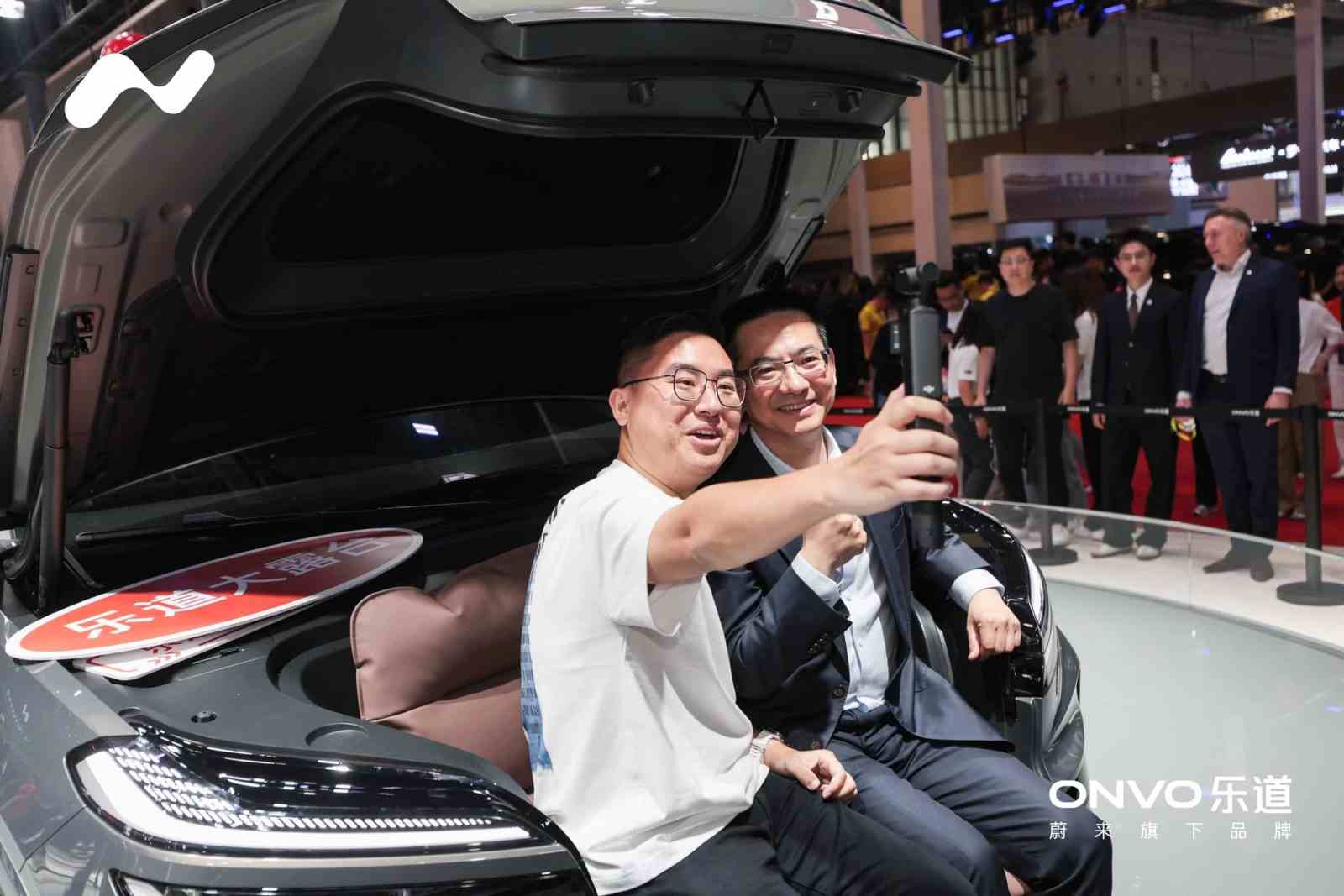

Nio Inc.‘s co-founder and President Qin Lihong dismissed on Friday concerns that the upcoming Onvo L80 and a five-seat variant of the ES8 would cannibalize each other’s sales in China.
Questioned at a media Q&A session on the opening day of the Beijing Auto Show whether the two models would conflict in positioning, Lihong said that “if we don’t launch it, competitors will.”
According to the session’s transcript, the President noted that large five-seat SUVs are about to flood the market and Nio‘s prepared products should roll out in orderly fashion to claim the segment first.
He emphasized the “more than 100,000 yuan” ($16,100) of price difference between the L80 and the upcoming five-seat ES8, suggesting that the two should be complementary rather than competing.
The L80 is a five-seat version of the Onvo L90 three-row SUV, sharing most of its components with the three-row SUV model.
Noting that the number of large six-seat SUVs on the market is already saturating, the executive sees the L80 and five-seat ES8 as growth engines for the Shanghai-based EV maker.
The L80 is set to open pre-orders on April 28, with the official launch and deliveries scheduled for mid-May.
At an internal meeting earlier this month, Li had called the L80 “a revolutionary product” for the 200,000-yuan-plus large five-seat SUV market, and predicted it would boost L90 and L60 sales, “just as L90 previously boosted L60.”
During the same briefing, Onvo‘s brand chief Shen Fei guaranteed that there will be no production capacity constraints for the third model.
“L80 production is no problem, place your orders freely,” he said.
Five-Seat SUVs
Nio‘s founder and CEO William Li argued at a media roundtable this week that traditional large five-seat SUVs have failed to deliver on their promise of practicality.
“To put it simply, the traditional large five-seat vehicles haven’t really been that practical — just like how the previous six-seat models weren’t truly practical either,” he said.
Onvo‘s head of product Yu Bin said user research had revealed growing demand for vehicles that accommodate a wider range of daily scenarios.
“There are still many unmet needs. So in the L80, we will focus on delivering a more refined product experience in this area,” Yu noted.
Speaking about the L80 on Friday, the CEO described its cabin as representing more than an incremental upgrade.
“As a large five-seat model, the L80’s interior space design is highly imaginative — the experience represents a qualitative leap, not just quantitative change,” Li said.
Competition
Li also addressed the pace of competition.
Taking the “front trunk” of the L90, ES8, and ES9 as an example, he noted that at the first L90 launch event in July he had argued the technology was ahead of competitors by “two to three years.”
Now, he said, it seems “leading by one year would already be good.”
The competitors on the same stage read market trends in much the same way, the Chief Executive added.
The growing competition is shown by launches of large six-seat SUVs in the second half of 2025 and upcoming models this year — many of them scheduled to debut at the Beijing Auto Show.
Li repeated a point from his internal letter at the beginning of the year: “The auto industry competes on three-to-five percentage points — the difference between top-tier and elimination is just that tiny bit.”
Competing to the end, he said, “systematic capability” is the most essential factor in the finals round.
Nio ES8 x Onvo L90
The cannibalization question is not new for Nio‘s leadership.
When the Onvo L90 launched just a month before six-seat ES8 last year, Li said that “L90 and ES8 customers have little overlap,” dismissing the competition between the two.
By then, he said the L90 “mainly attracts entry-level users from Volkswagen, Toyota, Honda, and BBA, with few from Nio.”
Lihong said at a media session following the ES8 pre-launch last August that pre-orders for the ES8 had already exceeded those of the Onvo L90 in the same period after their respective pre-launches.
The third-generation ES8 went on to sell out its entire 2025 production capacity within 36 hours of its launch and accumulated over 100,000 orders within 48 hours.
The model became the single biggest contributor to Nio’s first-ever quarterly profit in the final three months of 2025.
While ES8 deliveries jumped considerably, however, the Onvo L90 saw its initial momentum fade after three months of deliveries above 10,000 units.
In January and February, Onvo recorded its worst monthly results since launching in 2024. Sales recovered significantly in March.
Li drew a direct line from the success of the L90 and ES8 in reshaping the large three-row SUV segment at his internal meeting.
“Before these launches, extended-range [large three-row] vehicles dominated,” he said.
“Afterward, the situation reversed. In the latest monthly data, extended-range now accounts for only about 60% of pure electric sales in this segment — this is a major shift,” Nio Inc.‘s founder added.
ES9 x ES8
When the ES9 was unveiled earlier this month — joining the ES8 as a six-seat SUV in the lineup — management was also clear about a potential overlap.
“The ES9 is more oriented towards administrative and business use, while the ES8 covers all scenarios including family, workplace, and company needs,” the CEO said.
Given that, Li said that “the two models will not cannibalize each other’s sales but instead create synergy, jointly expanding the base of the high-end market.”
According to the Nio chief, orders from first-time buyers in the days after the ES9 pre-launch were “more than 1.5 times the figure from the equivalent period after last year’s ES8 product and technology launch event.”
The ES9 also appeared to have lifted demand across the range.
“ES8 orders increased significantly, and ET9 orders reached a recent high,” Li told staff recently. “Many users came to look at ES9 and ended up preferring something more driver-focused, choosing ET9. Others felt ES9 was too large and chose ES8 instead.”
The ES9 opened pre-sales in three trims starting from 528,000 yuan ($77,400), or 420,000 yuan ($61,600) under Nio‘s Battery as a Service scheme.
The official launch is due on May 28, with deliveries scheduled to begin on June 1.
Outlook
Li told employees that “executing strategic new product launches well” is the quarter’s most important objective.
“These are all high-margin large vehicles,” he said. “The next two months are critical.”
The company’s management is highlighting the launch of the L80 and the ES9 SUVs as the center of the second quarter.
“If we seize Q2 well — with new product launches, model year transitions, and capability upgrades — we will reach a new level, making Q3 and Q4 easier,” the CEO said.
Nio Inc. delivered 83,465 vehicles in the first quarter — up 98.3% year over year — and is targeting 40–50% delivery growth for the full year, implying between 456,000 and 489,000 vehicles across its three brands.