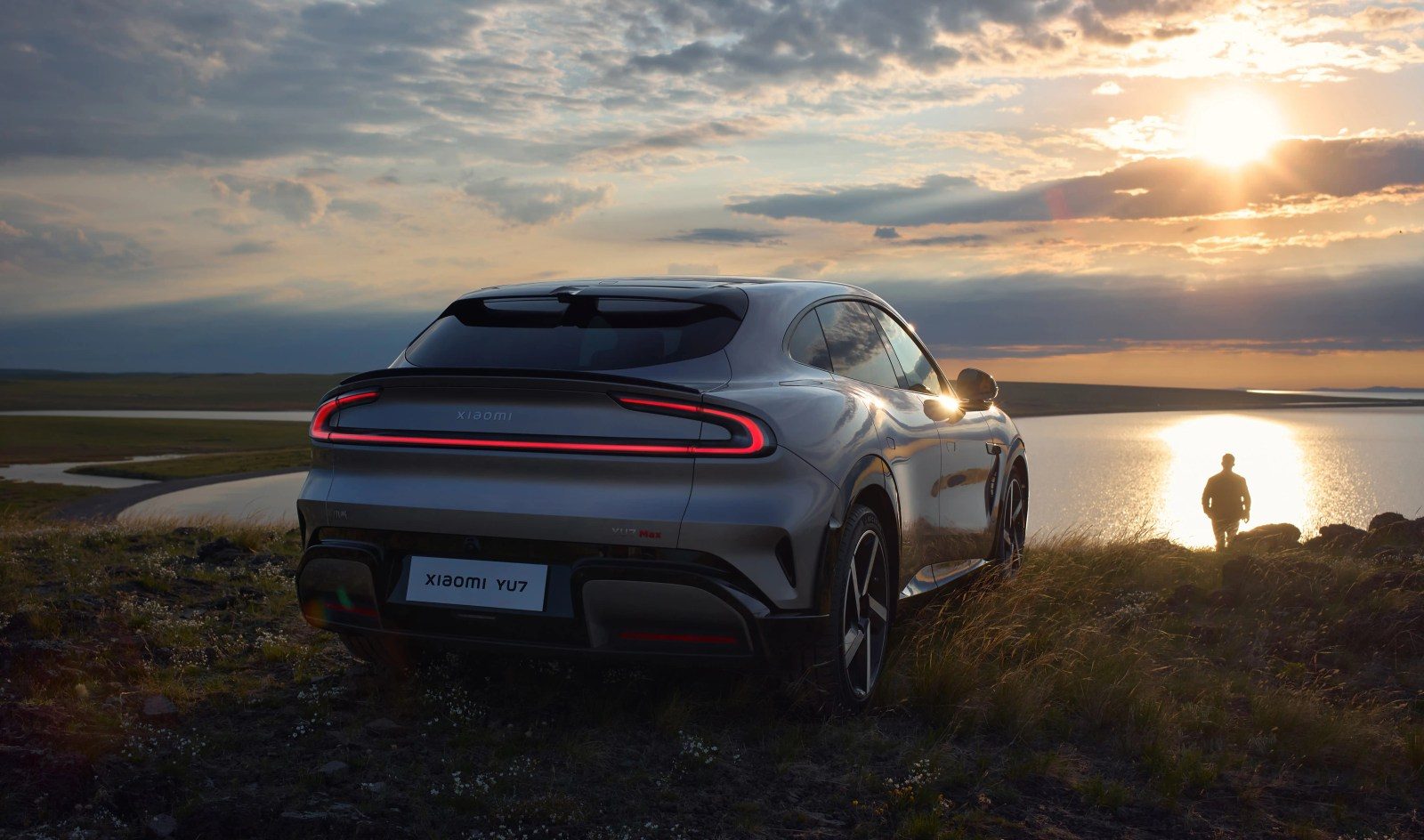

Xiaomi delivered more than 30,000 vehicles in July, a fourth consecutive month above that threshold, as the company continues not to disclose the exact figure or model split.
The China Passenger Car Association is expected to publish both next week.
New orders across the four weeks of July ran at 5,400, 5,600, 7,400 and 5,700 units, according to Thinkercar data cited in a Deutsche Bank research note led by analyst Wang Bin.
The company co-founded and led by Lei Jun delivered 30,452 vehicles in July 2025, so the year-over-year comparison will hinge on where above 30,000 the real figure lands.
The Quarterly Picture
Xiaomi‘s disclosed quarterly numbers give a cleaner read than the monthly wording.
The company delivered 80,856 vehicles in the first quarter of 2026, up 6.6% from 75,869 a year earlier, according to its first-quarter results published on May 26.
Revenue from the EV, AI and other new initiatives segment reached 19.9 billion yuan, up 6.9%, of which 19.0 billion yuan came from vehicle sales and 900 million yuan from after-sales and other sources.
Average selling price worked out at roughly 235,000 yuan.
Segment gross margin fell to 20.1% from 23.2% a year earlier, and the unit posted an operating loss of 3.1 billion yuan — about 38,300 yuan for every vehicle delivered, against a loss near 500 million yuan in the first quarter of 2025.
Xiaomi attributed the margin decline to the retreat of vehicle purchase tax subsidies, a lower mix of the higher-margin SU7 Ultra, and rising core component costs.
The business had turned its first quarterly operating profit in the third quarter of 2025 and its first annual profit for the full year.
The segment accounted for 20.0% of group revenue, making it Xiaomi‘s second-largest business.
Second-quarter deliveries came to 104,199 vehicles by CPCA monthly data, a 28.9% increase on the first quarter, taking the first-half total to 185,055 units.
Second-quarter financial results have not yet been published and are expected in late August, which is when the margin trajectory becomes readable again.
Overseas sales are planned to begin in the second half of 2027, starting with Germany, followed by right-hand drive markets in the first half of 2028, supported by a Munich R&D centre opened in 2025 and staffed with engineers drawn from BMW, Porsche, Mercedes-Benz and Lamborghini.
The Target Is Moving Out of Reach
Xiaomi has set a 2026 delivery target of 550,000 vehicles, roughly 34% above the 411,082 units it delivered in 2025.
First-half deliveries of 185,055 represent 33.6% of that goal.
Adding a July figure of at least 30,000 lifts the year-to-date total to at least 215,055, or at least 39.1% completion with five months remaining.
Reaching 550,000 from here would require an average of about 66,989 vehicles a month from August through December.
At the half-year mark the same calculation produced roughly 60,824 a month, the figure Deutsche Bank rounded to about 61,000. A month above 30,000 has therefore pushed the required pace up by more than 6,000 units rather than down.
The company’s best month on record is 50,212 vehicles, set in December 2025. The pace the target now demands runs about a third above that high.
Most Chinese automakers closed the first half behind their annual goals, but few face a gap of this shape.
Two Models Moving in Opposite Directions
The YU7 SUV delivered 104,559 units across the first half and has become the volume mainstay, while the SU7 sedan delivered 80,496, down 48.3% year over year as the model works through a generational transition.
The monthly line has been volatile. Deliveries ran 21,440 in March, when the new-generation SU7 reached customers, 36,702 in April, 32,759 in May and 34,738 in June.
June, the last month with published detail, showed both trends clearly. Volume rose 36.5% year over year and 6.0% sequentially, with the YU7 rebounding 64.0% to 14,324 units after five consecutive months of decline.
The SU7 contributed 20,414 units in the same month, down 12.1% year over year and extending a ninth straight month of annual decline.
The YU7 recovery followed a price move rather than a product cycle. A cheaper YU7 Standard variant arrived on May 21 from 233,500 yuan, alongside the high-performance YU7 GT from 389,900 yuan.
The 990-horsepower dual-motor SUV that lapped the Nürburgring Nordschleife in 7:22.755, a production-SUV record.
Cumulative deliveries of the SU7 and YU7 together passed 700,000 units, founder and chief executive Lei Jun said on July 30.
By the end of June the YU7 had reached 258,232 cumulative deliveries in China, against 471,207 Tesla Model Y sold in the country over the same period.
Two further models remain in the pipeline without confirmed dates, the YU9 large SUV and the SU7 L sedan.
Sky Nomad Pricing
Everything in Xiaomi’s second half rests on a series that has not yet gone on sale.
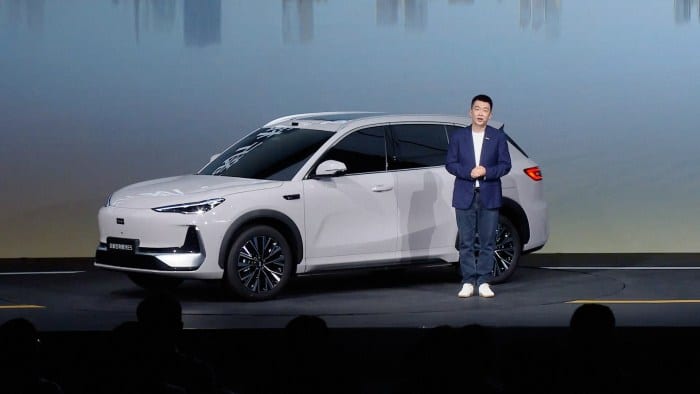
Sky Nomad, known in Chinese as Pengcheng, is the company’s second product series after the SU7 and YU7 and its first move into extended-range powertrains, ending a lineup that has been fully electric since 2024.
Pre-orders opened on July 30 at 299,900 yuan for the seven-seat N90 Max and 259,900 yuan for the five-seat N70 Max, against a 1,000-yuan refundable deposit, with the launch set for September.
Both are top-specification trims, with Pro and standard versions to follow, so the series entry point will fall below those figures.
The pricing lands well under the 339,000 yuan Tesla charges for the six-seat Model Y L in China, and close to the 249,800 yuan Li Auto asks for the new L6.
Deutsche Bank called the pricing aggressive and attributed it directly to Xiaomi‘s volume pressure. Shares fell after the debut.
The series runs on a new Kunlun architecture developed from scratch since early 2023, with a flat floor, six seat rails and front seats that rotate 180 degrees to face the second row in a 2+2+3 seven-seat layout.
The N70 Max offers a 52 kilowatt-hour lithium iron phosphate pack or a 76 kilowatt-hour ternary pack, reaching up to 505 kilometres of all-electric range on the CLTC cycle, while the N90 Max manages 464 kilometres and a combined 1,705 kilometres on a full tank and charge.
Battery sourcing marks a break from the past.
Sunwoda is expected to supply roughly 60% of Sky Nomad cells and CALB the remaining 40%, moving away from the exclusive CATL arrangement behind the SU7 and YU7.
Regulatory clearance to build extended-range vehicles at the Beijing plant came through in June.
The Segment Bet Is Contested
Retail sales of extended-range vehicles in China totalled 450,000 units in the first half, a 15.1% decline year over year, so Xiaomi is entering a contracting segment.
That has drawn an unusually public argument. Lei defended the move on Weibo, saying the extended-range market is far from saturated and that neither powertrain is inherently superior.
Onvo brand chief Shen Fei, formerly a senior vice president at Nio, rejected the case directly, framing the shift as a step backward for a company built on fully electric cars.
Last week, Xiaomi took a 23% stake in a Chinese battery-swap startup in the same period, an investment in technology its new range-extended SUVs are structurally unable to use.
The two companies have clashed before, with Nio founder William Li publicly disputing Xiaomi’s range record claim for the YU7.