
Most of China’s major automakers closed the first half of 2026 with less than 40% of their annual sales targets completed, as pressure increases to accelerate deliveries over the remaining six months of the year.
Overseas markets have become a critical release valve for companies such as BYD, Chery, Geely and XPeng, even as trade barriers multiply across Europe, North America and parts of Asia.
A dealer survey published by the China Automobile Dealers Association showed its Vehicle Inventory Alert Index at 57.2% in June, above the warning line, with the majority of dealers missing their H1 targets.
The challenge is now compounded by the reinstatement of a 5% purchase tax on new energy vehicles from the first day of 2027, which could, however, help increase sales ahead of the incentive change.
Tech Giant Xiaomi
Xiaomi delivered approximately 180,000 vehicles in the first six months of 2026, a 15% year-over-year increase that was less than half the growth rate its 550,000-unit target demands.
Completion stood at about 33%, with a concrete figure set to be available once China’s CPCA discloses June figures.
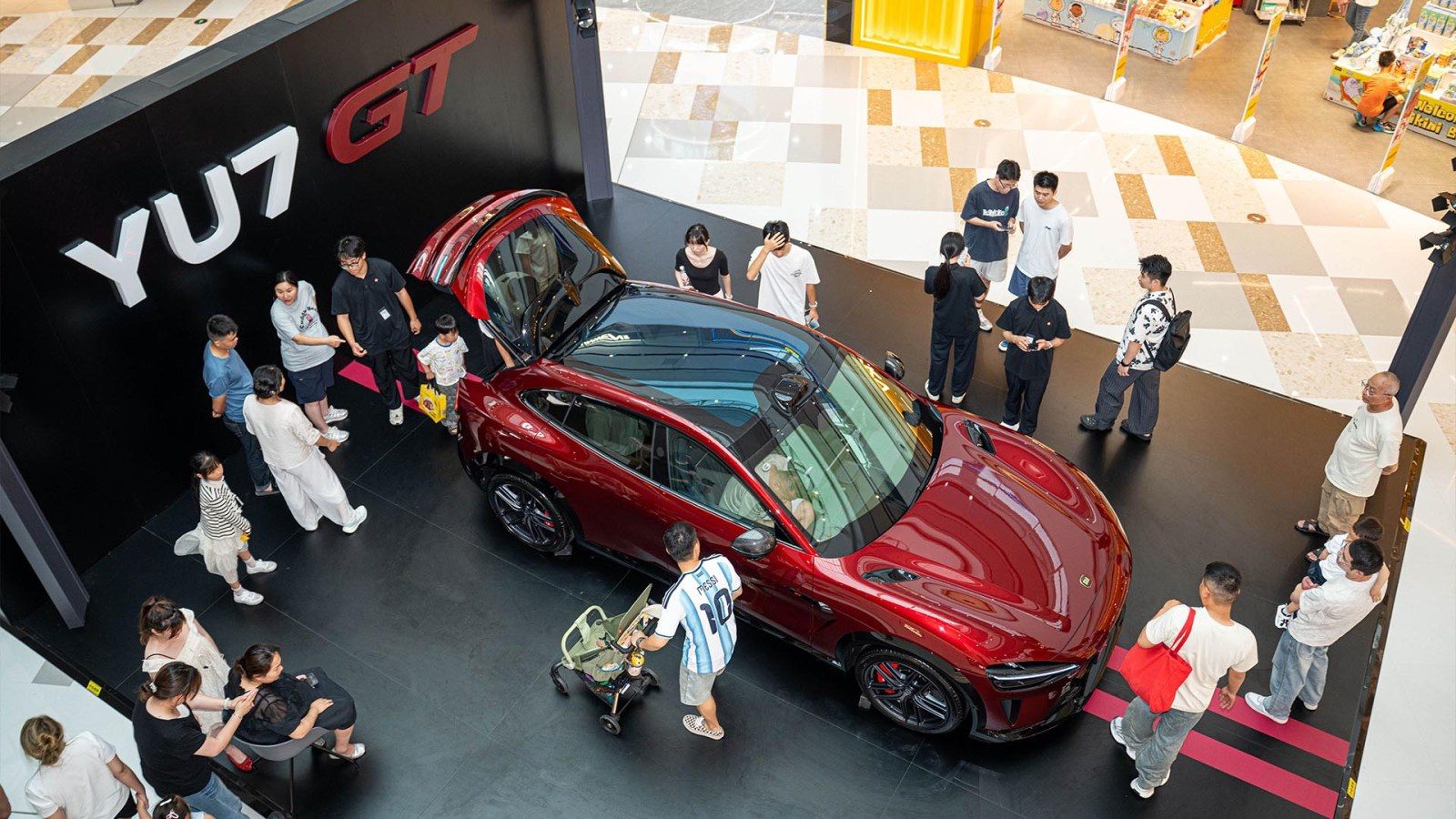
YU7 monthly deliveries declined for five consecutive months from a January peak of 37,869 to 8,736 in May, and total monthly volume plateaued “around 30,000” from April through June.
The tech giant does not reveal specific monthly figures. China’s Passenger Car Association (CPCA) usually publishes them in the second week of each month.
Xiaomi rolled out purchase subsidies and financing incentives last week and launched a cheaper YU7 Standard variant in May.
European entry, while confirmed, is not expected until the second half of 2027.
The company is preparing to enter the extended-range market later this year, following the steps of competitors such as XPeng, which also started offering the hybrid powertrain late last year.
XPeng Trails 2025 Page
XPeng delivered 165,977 vehicles, placing its completion rate between 27.7% and 30.2% of a 550,000-to-600,000-unit target — among the lowest of the major startups.
Deliveries fell 27.4% year-over-year through April.
A turning point arrived with the GX flagship SUV, which helped push June to 40,126 deliveries, the brand’s strongest month of 2026.
The company, founded and led by He Xiaopeng, is now preparing to launch the L03 globally later this month.
XPeng aims to double overseas sales from the 45,008 units shipped in 2025.
Li Auto’s Stall
Li Auto‘s 193,472 deliveries represented a 5.1% year-over-year decline — the only major startup to post negative growth between January and June.
Completion stood at 35.2% of a 550,000-unit target.
June deliveries fell 15% to 30,895, the weakest month of the quarter.
The struggles reflect intensifying competition in the premium NEV segment, where Xiaomi‘s YU7, the Onvo L90 and an expanding XPeng lineup have eroded Li Auto‘s once-dominant position.
The Li Xiang-founded company launched the all-new L8 on June 23 and has the all-new L6 scheduled for July, accelerating a generational refresh of its extended-range lineup.
Internationally, the automaker picked the Benelux region as its first European market and signed dealer partnerships in the UAE and Saudi Arabia.
Leapmotor’s Fast Growth
Stellantis-backed Leapmotor delivered 356,487 vehicles so far in 2026, a 60.8% year-over-year increase.
June alone brought a record 93,376 units — the first time the brand cleared the roughly 83,000-unit monthly pace its one-million-unit target implies.
Completion stood at 35.6%, however.
Chairman Zhu Jiangming acknowledged earlier this year that the 1 million-unit target was challenging, but maintained it remained achievable.
Leapmotor is on track to surpass 100,000 European sales this year, and confirmed plans for a second premium brand targeting the segment above 300,000 yuan.
BYD’s Overseas Surge
BYD sold 1.81 million passenger vehicles in the first six months of 2026, including 789,400 units shipped overseas — about 43.6% of total volume.
The Shenzhen-based company has guided to full-year sales of 5.0 to 5.5 million NEVs, implying a first-half completion rate of 32.9% to 36.2%.
Chairman Wang Chuanfu said at BYD’s 2025 AGM that the company is on track to exceed its 1.5 million-unit overseas sales target, of which roughly 52.7% has already been achieved.
Wang warned in March that competition in China’s EV market had reached a “knockout stage.”
Geely and Chery
Geely reported first-half sales of 1.42 million vehicles, up 1.0% year-over-year, and has completed 41.2% of its 3.45-million-unit target.
The standout within the group was Zeekr, which delivered 178,400 vehicles and already cleared 50% of its annual goal — the only tracked brand to cross the halfway line.
Chery Group posted the highest completion rate at 42.4%, with sales of 1.36 million vehicles between January and June, up 7.7% year-over-year.
Overseas exports exceeded 940,000 units — an all-time record for any Chinese automaker, surpassing the 900,000-unit mark in just six months.
Chery operates in more than 130 countries and has been the most active Chinese automaker in preparing for a Canadian launch.
Nio
Nio delivered 191,100 vehicles across its three brands in the first half, a 67.4% year-over-year increase and a new first-half record.
A second quarter of 107,658 vehicles fell short of the 110,000-to-115,000 range CEO William Li had guided.
Nio is banking on the ES9 flagship SUV, the Onvo L80 and refreshed L60, and continued Firefly contribution to power the second-half ramp.
Internationally, the group’s performance remained muted — German registrations crashed 88% in first half and total exports through April stood at just 315 vehicles.
Nio is targeting 40 countries by year-end, up from about 20 at the close of 2025, but President Qin Lihong has acknowledged early-2026 overseas sales fell considerably short.
The EV maker has guided for deliveries of between 456,000 and 489,000 units this year — which indicates that the results have the completion rate between 39.1% and 41.9%.
H2 Outlook
Most automakers failed to achieve more than half of their annual sales targets as the year reaches its middle, signaling a white-hot competitive phase ahead.
The looming end of annual vehicle and vessel tax exemptions for NEVs from January 2027 adds further urgency, as Beijing continues normalizing the policy framework that built the world’s largest EV market.
CPCA’s Secretary-General Cui Dongshu, quoted by local media outlet Cailian Press, said the auto market would gradually stabilize in the third quarter and return to a growth trajectory in the fourth, retaining potential for recovery.