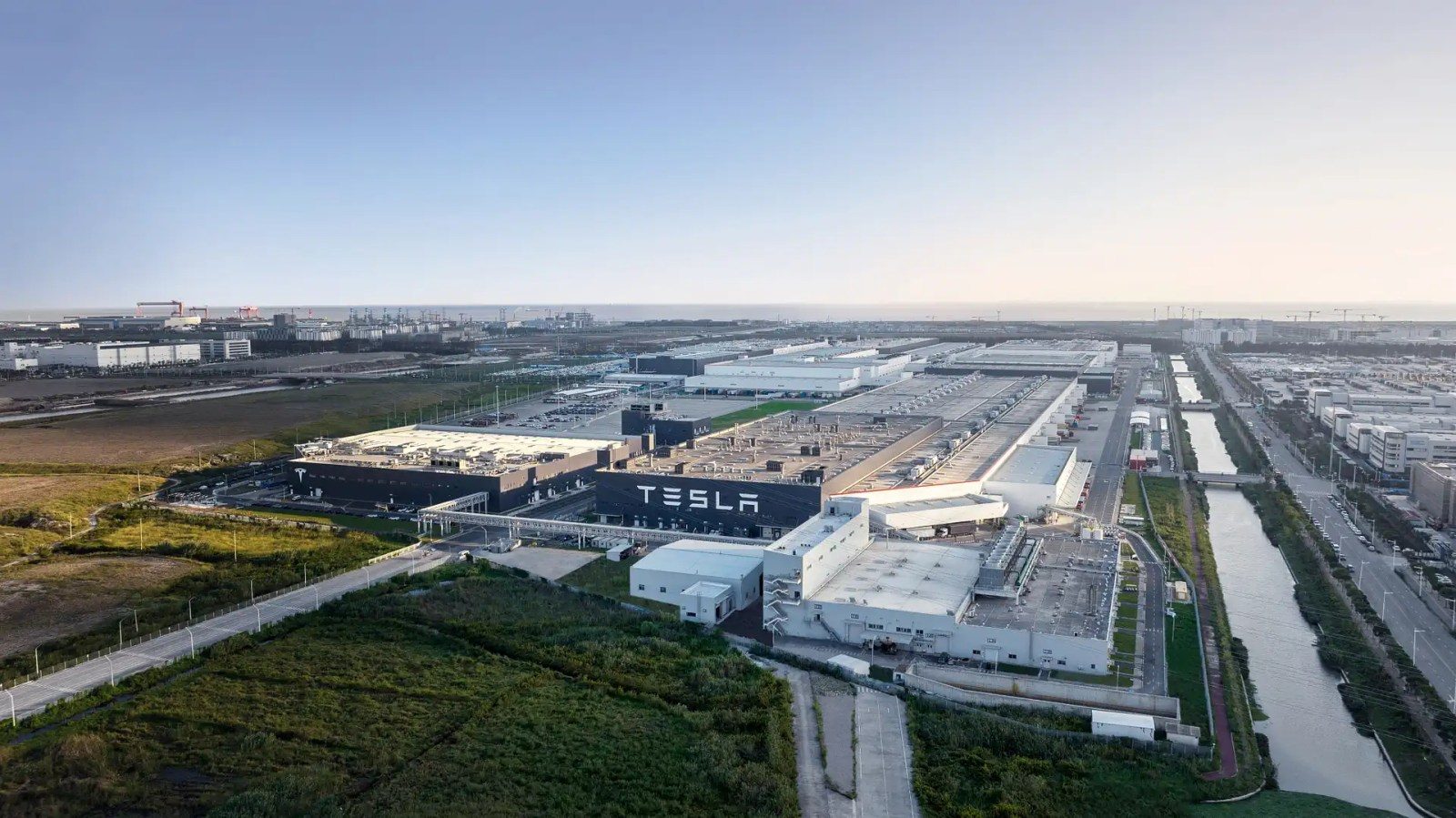

Tesla‘s Shanghai plant shipped 295,324 vehicles abroad in the first seven months of 2026, surpassing the 226,034 units exported for all of 2025 by 30.6%, according to data from the China Passenger Car Association (CPCA).
The surge reflects the role of the company’s highest-output factory as a global export hub, supplying markets from Canada and South Korea to Europe.
July alone accounted for 66,330 export units, a 143.3% year-over-year jump and an 83.4% increase from June, as GigaShanghai typically prioritizes exports in the first month of each quarter.
The figure topped the previous monthly record of 54,504 vehicles set in October 2022 — making it the strongest export month in the plant’s history.
Overseas shipments accounted for 70.9% of Tesla China’s wholesale sales in July, the highest share since January’s 73.3%.
The contrast with domestic performance is stark.
Tesla delivered 27,249 vehicles in China in July, down 32.9% from a year ago.
The figures also represented a 48.5% decline from June, marking the second consecutive month of a year-on-year drop.
Driven by exports, however, total wholesale sales from the Shanghai plant reached 93,579 vehicles in July — the company’s strongest July ever.
Shanghai’s Global Role
Tesla operates four vehicle production facilities worldwide.
Fremont, California builds the Model 3 and Model Y for North America.
Gigafactory Berlin-Brandenburg in Grünheide, Germany, produces the Model Y, supplying both European buyers and several markets outside the region, including Canada.
Gigafactory Texas in Austin builds the Cybertruck and the Model Y.
Gigafactory Shanghai, the company’s largest and most utilized production base with annual capacity of about one million vehicles, produces both the Model 3 and Model Y — including the six-seat Model Y L variant.
Shanghai supplies virtually all of Tesla‘s Asia-Pacific markets — Australia, New Zealand, Japan, South Korea, Thailand, Singapore and Malaysia — and continues to ship Model 3 sedans to Europe.
Shipments from Shanghai to other markets exceeded domestic Chinese deliveries in the second quarter for the first time, underscoring the facility’s transformation into a low-cost export engine.
On the other hand, China’s share of Tesla‘s global deliveries slipped below 30% for the first time since late 2020.
China-Built, Canada-Shipped
A trade agreement struck in January between Prime Minister Mark Carney and Chinese President Xi Jinping replaced Canada’s 100% surtax on Chinese-built EVs with a 6.1% most-favored-nation tariff rate under a 49,000-vehicle annual quota.
The deal took effect on March 1 and Tesla moved quickly to exploit it, pulling US-built Model 3 inventory from its Canadian website and redirecting supply to Shanghai.
The first Shanghai-built Model 3 sedans arrived at Canadian delivery centers in late May.
By mid-July, Tesla had claimed roughly a quarter of the first-window quota, with almost all early volume consisting of Model 3 sedans from Giga Shanghai.
The 6.1% tariff sits well below the 25% Section 232 national security tariff applied to US-built vehicles entering Canada, giving Tesla a clear financial incentive to source from China.
The Shanghai-built Model 3 Premium RWD starts at C$39,490 — the lowest price Tesla has offered on any vehicle in Canada.
European Demand
The Model 3 for European markets is imported from Shanghai, despite the countervailing duties the European Commission imposed on Chinese-built battery electric vehicles in October 2024.
Tesla‘s individually assessed rate of 7.8%, layered on top of the bloc’s standard 10% import duty, is the lowest among all manufacturers exporting from China — far below the 35.3% ceiling applied to non-cooperating companies.
Giga Berlin chief André Thierig acknowledged earlier this year that the German plant cannot match Shanghai’s cost efficiency, arguing however that the European factory remains viable once logistics and trade costs are factored in.
Tesla‘s combined European market share reached 2.4% in the first half of 2026, matching BYD for the first time.
The gradual rollout of Full Self-Driving (Supervised) across European markets has provided an additional demand catalyst.
The Netherlands became the first country to grant FSD type approval in April, followed by Lithuania, Estonia, Belgium and Denmark.
An EU-wide vote has yet to take place, with the next opportunity expected at the October 2026 TCMV session.
France, Italy and Sweden have declined to authorize the system nationally until the Commission’s Article 39 examination concludes.
South Korea Emerges
South Korea has become one of Shanghai’s fastest-growing export destinations.
Tesla registered 56,139 vehicles in the country in the first half of 2026, capturing a 30.5% share of the imported passenger car market and already reaching 93.7% of its full-year 2025 volume of 59,916 units.
Second-quarter deliveries of 35,175 units marked a 144% year-over-year increase and the company’s strongest quarter ever in the country.
Seoul raised its maximum EV purchase subsidy to 6.8 million won ($4,700) for 2026 and eliminated consumption and acquisition taxes on battery-electric vehicles.
Tesla broadened its local lineup with the Model Y L and Cybertruck. FSD (Supervised), available in South Korea since late 2025, has also contributed to buyer interest.