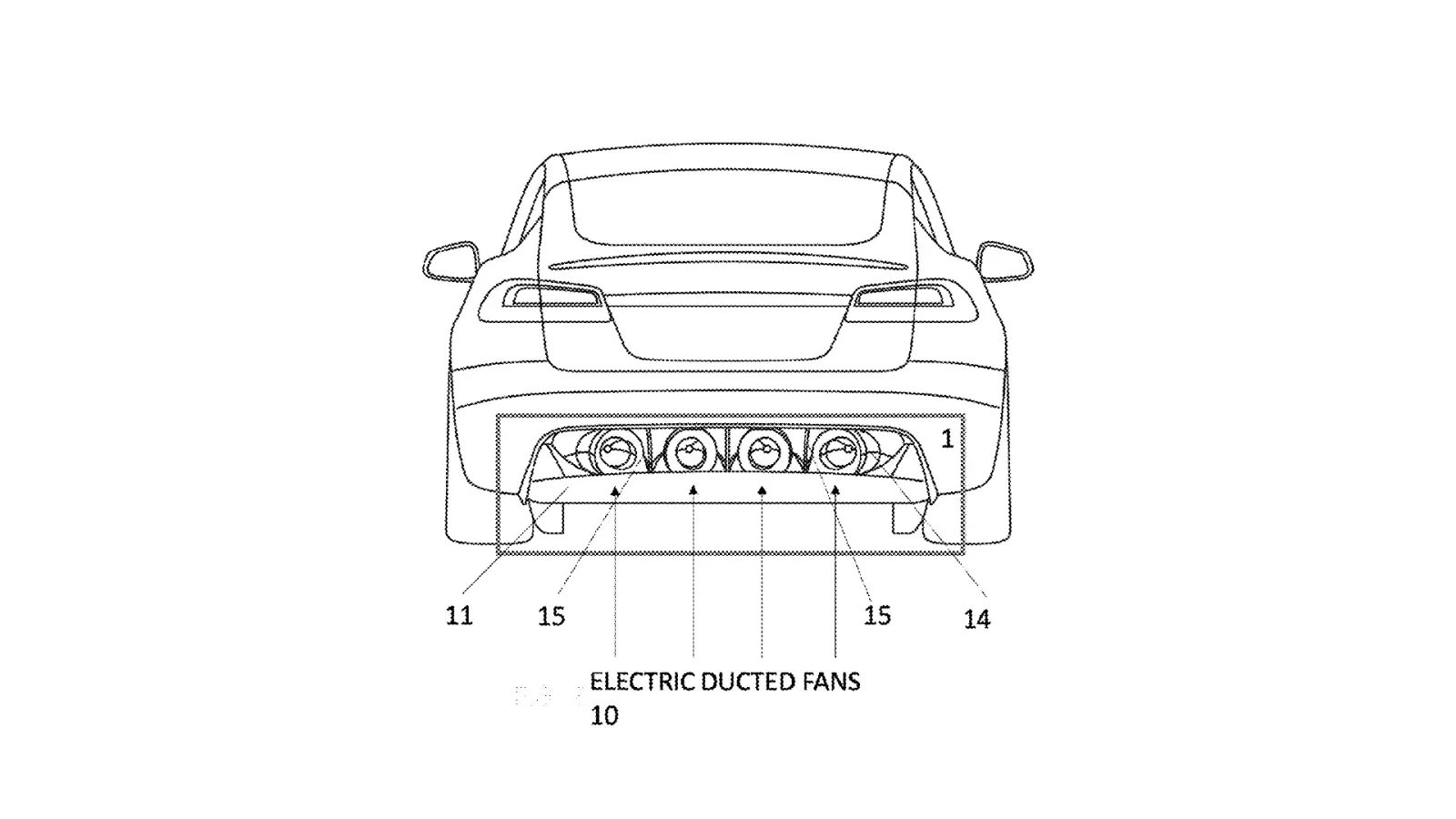

Tesla was granted a US patent on Tuesday for a battery-powered fan system that pulls air from beneath a vehicle to generate downforce at any speed, a filing that describes extractors in a rear diffuser and does not describe flight.
The company filed the application in January 2024, and claims priority to a provisional application dated January 17, 2023.
The abstract on the face of the grant states that the invention is “an electric vehicle comprising a ducted fan system configured to increase downforce and reduce drag.”
It says the system “can include a diffuser extending from an input on an underbody of the vehicle and to an outlet on a rear side of the vehicle,” that it “can be connected to a high voltage battery and a control system,” and that the vehicle “can further include a second diffuser to enhance downforce.”
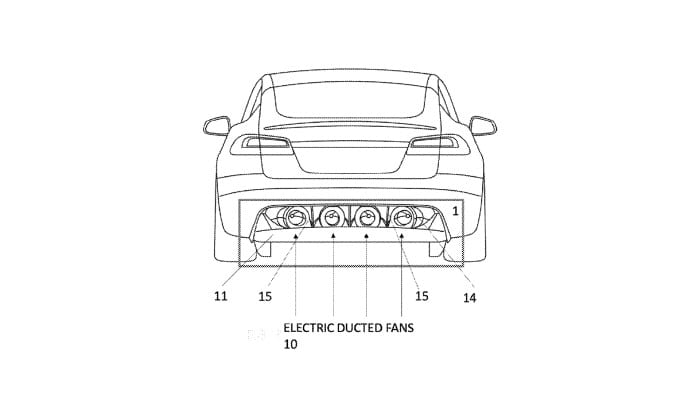
The drawings show four axial fans set side by side in a rear diffuser and separated by vertical strakes. An inlet between the rear wheels feeds a duct that rises to that outlet. The outlet is wider than the inlet. Tesla treats the widening as a diffuser, so extracted air leaves more slowly than it would through a constant-area nozzle.
A second layout adds two smaller side inlets behind the main opening.
Tesla writes that a single central inlet tends to draw air forward from behind the car rather than from under the floor, causing the fans to spend energy “wasting power.” A raked plate at the tail is described as a second diffuser.
Power is taken from the traction battery. The fans are tied to the vehicle’s control system and can be switched on by the driver or engaged automatically at defined speeds, according to the specification as reported.
Tesla says the fans can work “without use of additional elements below the vehicle,” meaning without skirts sealing the floor to the road.
That distinguishes the grant from a separate Tesla patent issued in August 2025, which combines fans with deployable skirts that form a sealed or partly sealed volume under the vehicle.
That patent, titled “Adaptive vehicle aerodynamics for downforce,” was filed on April 29, 2025 and granted on August 5, 2025, more than a year after Tuesday’s application was filed.
It uses a sealed chamber under the car at low speeds and only side skirts at higher speeds.
Tuesday’s grant is also Tesla’s second downforce filing to become public in a week.
An application published on September 24, describes a hidden rear wing producing up to 700 kg of downforce at speeds above 100 mph that retracts before a collision. That filing has not been granted and, like Tuesday’s patent, does not name a model.
The vehicle in the drawings is a Tesla Model S. Tesla halted Model S and Model X production in April.
The underlying provisional was filed in January 2023, when the Model S Plaid was still the company’s performance sedan.
The patent does not name the second-generation Roadster. It does not mention flight, hover, lift, rockets or cold-gas thrusters. It is classified under vehicle-body aerodynamics, not propulsion.
A granted patent gives Tesla the right to exclude others from making, using or selling the claimed system in the United States. It does not confirm that Tesla will put the system into production.
Fan-assisted downforce has a long history in racing.
Chaparral ran the fan-driven 2J in the Can-Am series in 1970, and Brabham’s BT46B won the 1978 Swedish Grand Prix with a rear fan before the team withdrew it.
On the electric side, McMurtry Automotive’s Spéirling set a Goodwood hill-climb record in June 2022, seven months before Tesla’s provisional, and has been demonstrated inverted on a rig.
McMurtry says the production Spéirling Pure generates “up to 2000kg” of downforce “from 0mph.”
The car costs £995,000 ($1.32 million), with deliveries due to begin later this year, the company said in July.
Tesla postponed a Roadster demonstration from October 1 to October 15 on Monday, citing severe weather near Waco, Texas, and the requirement that the event be held outdoors.
The Information has reported that Tesla and SpaceX have been developing cold-gas thrusters for a remote hover demonstration. That hardware is not the subject of Tuesday’s patent.
The idea dates to June 2018, when Chief Executive Officer Elon Musk wrote on X that a “SpaceX option package” for the Roadster “will include ~10 small rocket thrusters arranged seamlessly around car.”
The thrusters would use “ultra high pressure air in a SpaceX rocket COPV bottle,” he wrote the next day.
Tesla first showed the second-generation Roadster in November 2017. The company has not said whether the car that appears on October 15 will use the fans described in the grant.