Tesla registered 11,119 vehicles in South Korea in June, a 74% increase from the 6,377 units sold a year earlier, according to data released Friday by the Korea Automobile Importers & Distributors Association (KAIDA).
The result brought second-quarter sales to 35,175 units — the company’s strongest quarter ever in the country and a 144% year-over-year jump from the 14,394 vehicles registered in the same period of 2025.
First-half registrations reached 56,139 units, giving Tesla a 30.5% share of South Korea’s imported passenger car market and positioning the Elon Musk-led company as the best-selling overseas brand in the country.
June marked Tesla‘s third consecutive month above 10,000 units in South Korea, following April’s record of 13,190 vehicles and May’s 10,866.
On a quarter-over-quarter basis, second-quarter sales rose 67.8% from the 20,964 units registered in the first three months of the year — a period that was itself the company’s second-best quarter in the country.
The second quarter of 2026 surpassed the previous record of 24,400 vehicles set in the third quarter of 2025 by more than 44%.
The first-half total of 56,139 units already represents 93.7% of Tesla‘s full-year 2025 volume in South Korea, which stood at 59,916 vehicles.
At its current run rate, the company is on pace to nearly double last year’s annual figure.
Tesla‘s market share among imports surged from 13.9% in the first half of 2025 to 30.5%, a 16.6-percentage-point gain that allowed it to overtake German luxury brands BMW and Mercedes-Benz.
Model Y L Drives June Sales
The six-seat Model Y L was the best-selling imported vehicle in South Korea in June, with 5,155 units registered.
Tesla‘s Model Y Premium Long Range followed in second place with 3,318 units.
For the first half as a whole, the Model Y Premium led with 31,767 units, while the Model Y L — which only went on sale in the country in early April — already ranked as the third best-selling import with 6,947 units.
Tesla introduced the Model Y L in South Korea with a starting price of 64,990,000 won ($43,100) after the six-seat SUV cleared energy efficiency certification with the Korea Energy Agency earlier this year.
The stretched three-row variant — which adds 150 mm to the wheelbase and features a 2+2+2 seating layout with captain’s chairs — first debuted in China in August 2025, where deliveries began the following month.
South Korea became one of several other Asian markets to receive the model, alongside Japan, Thailand, Hong Kong, Singapore, Malaysia, Macau and the Philippines.
On Thursday — nearly a year after its Chinese debut — the company launched the Model Y L in the United States at $61,990 as a fully loaded Launch Series trim, built at Giga Texas.
Chief Executive Officer Elon Musk had previously said US production would not begin before the end of 2026 and suggested the model “might not ever” arrive domestically, citing the company’s focus on autonomous driving.
The US variant is rated at 325 miles of range with a 4.4-second zero-to-60-mph time.
BMW and Mercedes
BMW ranked second among imported brands in the first half with a 21.3% market share, selling 39,150 vehicles — a 2.3% year-over-year increase.
Mercedes-Benz placed third at 16.2%, registering 29,776 units, an 8.6% decline from the same period a year earlier.
Both German automakers saw their market shares contract by more than five percentage points, with BMW‘s dropping 6.5 points and Mercedes‘s falling 7.4 points.
Tesla outsells both brands in the country despite offering only fully electric vehicles, while BMW and Mercedes sell a mix of internal combustion engine, hybrid and battery-electric models.
In April, Tesla sold more vehicles than the two German brands combined, a gap that has narrowed but persisted in subsequent months.
The company raised prices across its Model 3 and Model Y lineup by up to 7 million won ($4,500) on Wednesday, a day after the South Korean government confirmed it had passed the national EV subsidy eligibility evaluation.
The price increases — the second round this year — came as the Ministry of Climate, Energy and Environment simultaneously excluded BYD from the subsidy programme for the second half of 2026.
Imported Car Market, EV Shift
Total imported passenger car registrations in South Korea reached 184,032 in the first half of 2026, a 33.2% increase from 138,120 in the year-earlier period, according to KAIDA.
In June alone, 38,059 imported vehicles were newly registered, up 27.5% year over year.
The growth was driven largely by electric vehicles.
EVs accounted for 45.5% of all imported car registrations in the first half, up from 23.5% a year earlier.
A total of 83,790 EVs were registered among imports during the period, a 158.5% year-over-year increase.
In June, EVs crossed the halfway mark for the first time, reaching 51.1% of imported vehicle sales with 19,453 units.
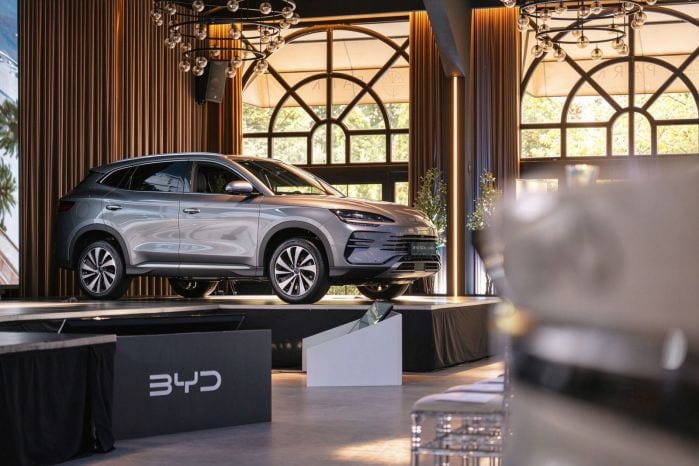
Chinese automaker BYD ranked fourth among import brands with an 11,675-unit first half, an 807.9% surge from a year earlier.
The company’s market share expanded from 0.9% to 6.3%.
BYD‘s Dolphin placed third among individual models in June with 2,747 registrations.
The subsidy exclusion announced this week, however, could weigh on its second-half performance, as buyers will no longer receive government purchase incentives on BYD models.
South Korea raised its maximum EV purchase subsidy to 6.8 million won ($4,700) for 2026, up from 5.8 million won ($4,000) the previous year, with a national subsidy budget of 936 billion won ($658 million).
The country has also eliminated consumption and acquisition taxes on battery-electric, hybrid and hydrogen vehicles.
The price cap for subsidy eligibility remains at 53 million won ($36,700) this year but will drop to 50 million won ($34,600) in 2027.