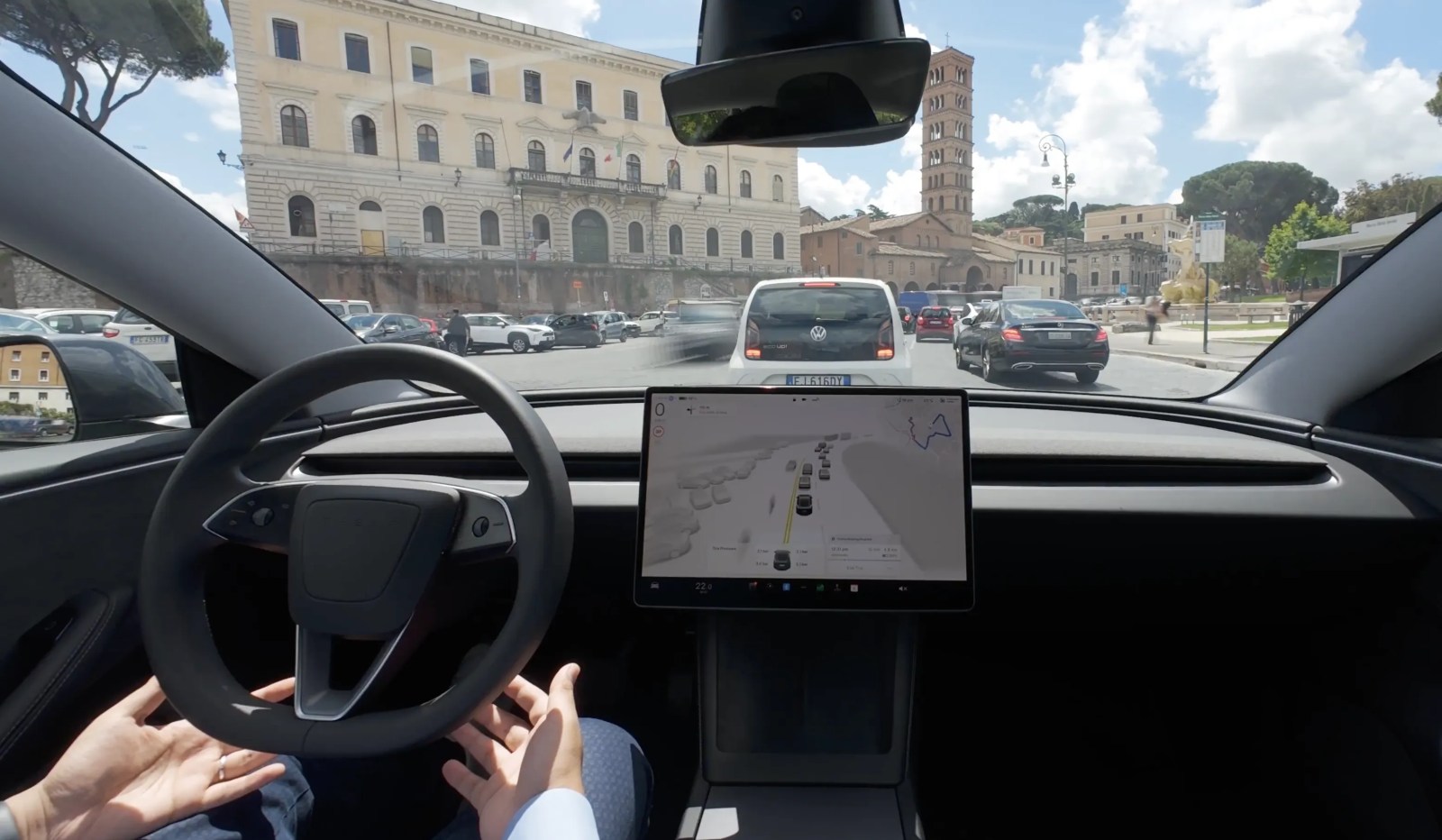
Tesla‘s next major version of its Full Self-Driving software, V15, will go to wide release next month, Chief Executive Officer Elon Musk said on X on Saturday, giving the first specific month for a customer rollout.
“FSD V15 goes to wide release next month. It will be something special,” Musk wrote. When a user asked “V15 with a holiday update?”, Musk replied: “Yeah.”
The software is not yet available to customers. Cars in North America are running FSD v14.3.13 in software update 2026.44.1, which began reaching vehicles on November 17.
Musk did not say whether the software will still carry the “Supervised” label that Tesla uses for FSD in its quarterly filing.
A Two-Letter Teaser
Musk’s post came hours after Tesla Super Intelligence, a business-verified AI account affiliated with Tesla on X, posted “XV,” the Roman numeral for 15.
VP of AI Software Ashok Elluswamy reposted it minutes later with the same two letters.
Musk then quoted Elluswamy’s post. “XV is the beginning of the ‘super’ part of Tesla SI,” he wrote.
In the same post that announced the timing, Musk called Tesla AI “not yet deserving of ‘super'” and “the most efficient AI on Earth.”
What Musk Promised on Saturday
One owner replied that he hoped V15 would avoid potholes and be able to park in a home garage.
“Yeah. The new user interface will re-render reality in a mind-bending way. Hard to describe, but it’s awesome,” Musk answered. Elluswamy quoted that reply with a sparkle emoji.
Another owner asked V15 to stop “refusing to use HOV lane” and to stop waiting “until the last possible second” to change lanes before turns. “Should be fixed in V15,” Musk said.
Tesla has not published release notes, a version number or a statement on the release.
Already in Robotaxis
Tesla has been running early V15 builds in its driverless ride-hailing fleet since at least July, the same fleet it opened around the clock this month.
“The currently operating Robotaxi fleet is already running early versions of the V15 FSD software,” Elluswamy said on the second-quarter earnings call on July 22.
“For V15, we have planned roughly about seven major improvement tracks,” he said. The builds in the fleet had “already 40% of those tracks merged together,” he added.
“As we continue to complete our work on V15, we will see that the car is going to be ridiculously safe and capable,” Elluswamy said.
On the third-quarter call on October 21, he said the software for the Cybercab and the Model Y is the same, according to a transcript.
“Pretty soon we’ll be able to release the same software as part of the V15 release to customers,” Elluswamy said.
He said that “somewhere around Q2 next year” Tesla could “turn on some of the first customer vehicles to be part of the Robotaxi fleet.”
V15 will also bring the first part of Tesla’s own AI-based maps. “You’ll see the start and end of trips already use this technology pretty soon as part of the V15 release,” Elluswamy said on the October call.
AI4 Only
Musk said in April that V15 would run on the AI4 computer, which Tesla also calls Hardware 4, in current cars.
“That will be a complete overhaul of the software architecture. And we’ll run on AI4,” he said on the first-quarter call on April 22, according to a transcript.
Older cars are excluded. “Hardware 3 simply does not have the capability to achieve unsupervised FSD,” Musk said on the same call. He said Hardware 3 has “only one eighth of the memory bandwidth of Hardware 4.”
Musk said Tesla would offer FSD buyers with those cars a discounted trade-in for an AI4 car, as well as a computer and camera upgrade.
A Moving Target
V15’s bigger model was first promised for 2025.
“Tesla is training a new FSD model with ~10X params and a big improvement to video compression loss,” Musk wrote on August 6, 2025. “Probably ready for public release end of next month if testing goes well.”
Five days later, he linked that gain to FSD 14, describing a release “in about 6 weeks” with “a 10X higher parameter count.”
The larger model did not arrive with V14. “Our rate of advancement with the small model has been so fast that the large model has not yet caught up. V15 will be the large model,” Musk wrote on April 9.
The same day, he said “V15 will far exceed human levels of safety, even in completely unsupervised and complex situations.”
In August 2025, he had said V14 would be “better than human for sure” and that “V15 has a shot at 10X.”
On the April call, Musk set the window. “There’s a version 15, hopefully by the end of this year, but certainly by early next year,” he said.
He also said Tesla would hold back large-scale driverless operations until V15 was done.
“It wouldn’t be right for us to go to a very large scale unsupervised FSD when we know that there are software improvements in the pipeline that would improve safety,” Musk said.
Interim Deadlines
Elluswamy tied round-the-clock Robotaxi service to V15 work in September.
“Next month or so. The next tech to merge on the v15 plan will enable it,” he wrote on September 4 in reply to a rider who wanted 24/7 rides.
Tesla opened 24/7 service in all eight of its Robotaxi cities on November 12, about 10 weeks later. In October, Musk had said avoiding pets at night was the main limit on the hours.
A week after the September post, Elluswamy listed what V15 would add. “Even earlier prediction of hazards, even faster reaction time and overall significantly better safety and collision avoidance coming as part of the next big upgrade (v15),” he wrote.
On November 14, after Tesla opened Cybercab sales to select customers, Elluswamy wrote of the privately owned cars: “It’ll work unsupervised inside all the same geo locations as @robotaxi, just serving the owners’ needs.”
Regulators
The release comes as U.S. safety regulators examine FSD’s camera system.
The National Highway Traffic Safety Administration opened an engineering analysis on March 18 covering an estimated 3,203,754 Tesla vehicles equipped with FSD.
The probe is looking at whether the system detects reduced visibility from glare, fog and airborne dust and warns drivers in time. It lists nine crashes, including one fatal crash.
In Europe, Italy approved the supervised system on Friday, making it the 12th EU country to allow it.
Musk said on the October call that he hoped for EU-wide approval “maybe within a few months,” adding that he “would be surprised if it takes longer than Q1.”
Chief Financial Officer Vaibhav Taneja said on the October call that FSD had “over 1.7 million paid customers globally,” and that for the first time half were on subscriptions.
More than 75% of North American deliveries in the third quarter included a sign-up for a paid FSD subscription, he said.
Tesla shares closed down 7.6% at $345.82 on Friday in a broad selloff in EV and technology stocks. They are down 23.1% this year from their 2025 close of $449.72.
Tesla holds its annual shareholder meeting on December 3 at 3:00 p.m. Central Time at Gigafactory Texas, according to its proxy statement.