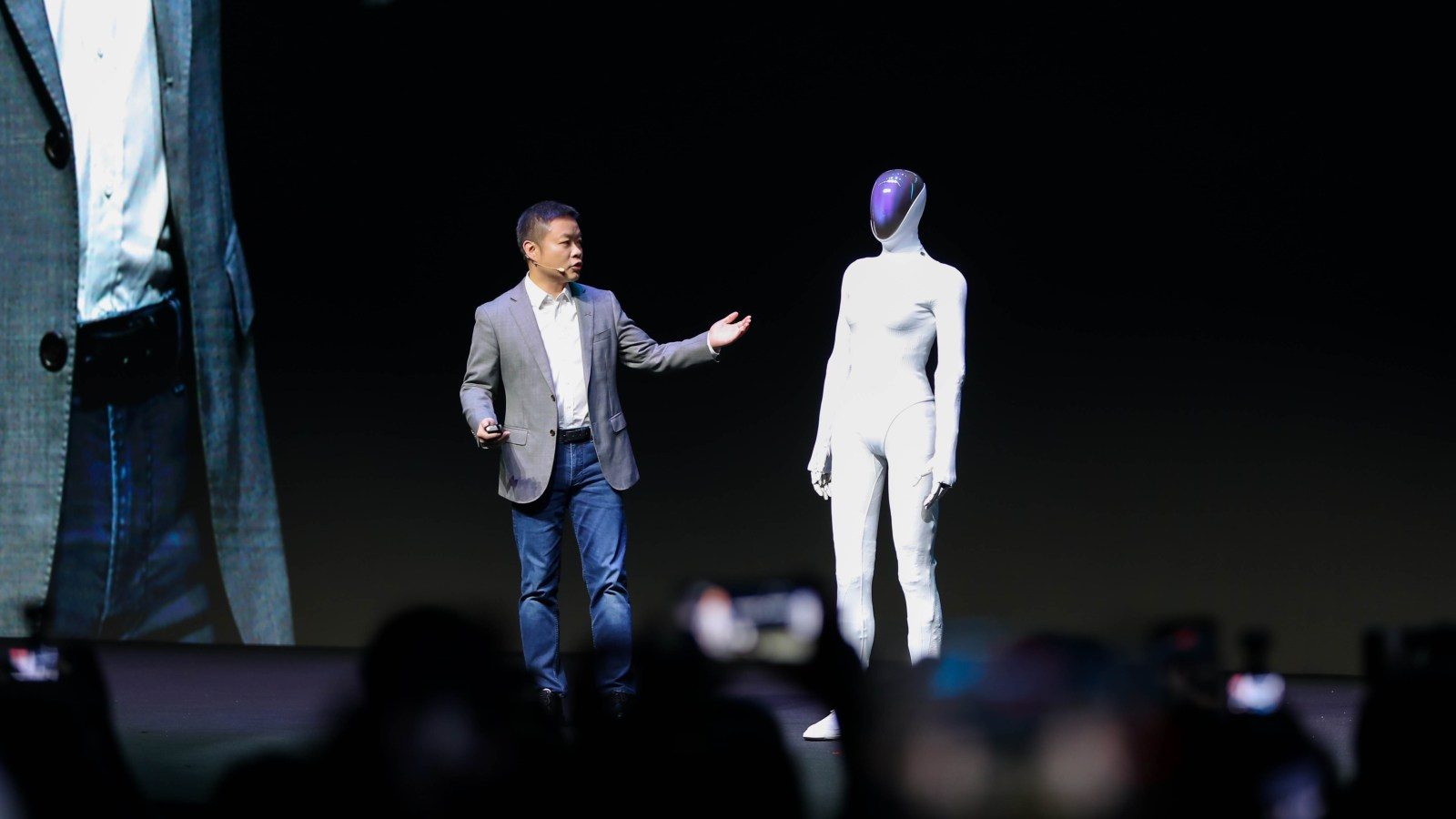

XPeng‘s founder and CEO He Xiaopeng said on Wednesday that the company is on track to achieve mass production of humanoid robots by the year end — with units expected to begin working as sales assistants in its retail stores during the first quarter of 2027.
The targets were confirmed during an internal meeting this week, where the founder signaled that the humanoid robot programme is entering the final stretch before mass production, Chinese platform Sina Tech reported.
Nearly 1,000 employees from across the company’s automotive, powertrain, manufacturing, testing, and general AI divisions attended the meeting.
The gathering officially marks the transition of XPeng‘s robotics business from validation into the final phase ahead of serial production.
Drawing a parallel with the automotive side of the business, He Xiaopeng told staff that “the stage we are at today is equivalent to where XPeng Auto was eight years ago.”
The period corresponds to the launch and first mass deliveries of XPeng‘s debut vehicle, the G3, in late 2018.
Robotics Timeline
The targets align with the “Physical AI + Globalization” strategy He Xiaopeng outlined in an internal letter at the start of the Chinese New Year working season.
There, the chief executive set a 2026 goal to mass-produce three AI-driven product lines — robots, flying cars, and robotaxis — in parallel.
The commercial-deployment timing is also consistent with previous statements from the CEO, who has defended the decision to deploy IRON in service applications before pursuing household rollout.
Speaking at XPeng’s 2025 AI Day last November, Xiaopeng downplayed the likelihood that humanoids would soon be usable in households, and argued it was too costly to deploy them in factories given the low price of labour in China.
During Wednesday’s meeting, He also referred to a full-stack positioning, telling employees that the company develops every major component of its robots in-house — from chips and operating systems to robotic joints and dexterous hands.
According to the CEO, this makes XPeng the only robotics company in China with a completely self-developed full-stack architecture.
He added that the company’s heavy early-stage investment will ultimately deliver higher quality, more visually appealing designs, and broader capabilities.
The current generation of IRON stands 1.73 metres tall and weighs around 70 kilograms.
It features more than 60 joints and 200 degrees of freedom, a humanoid spine, biomimetic muscles, fully wrapped flexible skin, a 3D curved display on its head, and dexterous hands with 22 degrees of freedom each.
He Xiaopeng has previously described it as containing what he called the industry’s first all-solid-state battery in a humanoid robot.
Manufacturing capacity is the operational milestone supporting the late-2026 target.
XPeng‘s humanoid robot mass-production base officially broke ground this February in Guangtang Sci-Tech Innovation City, in Guangzhou’s Tianhe District.
The site spans approximately 110,000 square metres and is designed to support large-scale, end-to-end production across the full supply chain — covering R&D validation, small-batch trial production and large-scale manufacturing.
XPeng is positioning the facility as the industry’s first “full-chain” humanoid robot mass production base, and it forms part of a strategic cooperation framework agreement signed with the Tianhe District government.
A Broader Physical AI Push
The robotics push is part of a broader strategic pivot that prompted the company to drop “Motors” from its Chinese name and reposition itself as XPeng Group earlier this year.
He Xiaopeng has argued that the group-based structure better reflects the company’s increasingly diversified business layout, as automobiles and robotics move toward deeper integration.
He Xiaopeng has also indicated he expects the humanoid programme to act as a technical accelerator for the rest of the business.
Speaking at the 2026 Xuanyuan Automotive Bluebook Forum in Guangzhou earlier this month, the CEO said that “breakthroughs in physical AI will likely happen first in robotics, which will then accelerate the development of autonomous driving.”
The CEO argued that “robots have lower safety requirements, whereas self-driving cars require extremely high reliability because even small failures can lead to frequent accidents.”
The framing places the late-2026 humanoid timeline ahead of the company’s targets for fully driverless robotaxi operation.
At the same forum, He Xiaopeng said the probability of achieving Level 4 autonomous driving software capabilities by 2028 is “extremely high,” and that an initial prototype of Level 5 autonomy could emerge around 2030 — a timeline he previously believed unachievable in his lifetime.
The CEO attributed the shift to a “flywheel effect” created by using data as fuel for autonomous driving development, which he said increased the evolution speed of XPeng‘s autonomous driving technology by roughly sixfold after the company restructured its AI R&D framework.
XPeng invested 9.5 billion yuan ($1.4 billion) in R&D throughout 2025, of which 4.5 billion yuan ($700 million) went to AI specifically.
The company plans to raise AI-related R&D spending to 7 billion yuan in 2026.
Robotaxi Milestones Run in Parallel
The mobilization conference comes just over a week after the automaker rolled the first mass-produced unit of its GX-based robotaxi off the production line in Guangzhou — the first time a Chinese carmaker has achieved mass production of a robotaxi developed entirely through full-stack, in-house technology.
The robotaxi is built on the GX platform, the same architecture underpinning XPeng‘s flagship six-seat SUV, which launched late last week with a lower-than-expected entry-level price of 269,800 yuan ($39,800), including a 10,000 yuan discount at launch.
Both vehicles share the same Level 4-capable hardware: four self-developed Turing AI chips delivering an effective on-board computing power of 3,000 TOPS, Bosch steer-by-wire, and a six-layer aviation-grade safety redundancy architecture.
XPeng has set the second half of 2026 for the start of manned pilot operations of the GX robotaxi, with fully driverless operation targeted for early 2027.
The company plans three robotaxi variants on the GX platform — a 5-seater, 6-seater and 7-seater.
The robotaxi runs on XPeng‘s second-generation VLA (vision-language-action) model, which the company says cuts system response time to under 80 milliseconds by removing the language translation step found in conventional three-stage autonomous driving architectures.
The same VLA 2.0 foundation also powers IRON and XPeng‘s flying car developed by its ARIDGE subsidiary, anchoring the company’s three 2026 mass-production targets to a single underlying AI stack.
XPeng aims to surpass Tesla’s Full Self-Driving capabilities in China by August, with He Xiaopeng arguing that VLA already outperforms FSD on narrow roads and in challenging driving situations.
Volkswagen has agreed to adopt VLA 2.0 for its China lineup, marking the first time a major Western automaker took up Chinese-developed autonomous driving software.
Sales Pressure
XPeng reported its first-ever quarterly net profit in the fourth quarter of 2025, with gross margin reaching a record 21.3%.
On Tuesday, XPeng‘s US-listed shares surged more than 7% after Deutsche Bank estimated that the company’s total new orders in May had climbed to about 50,000 units — a 40% jump from April and 10% above the same month last year.
Analyst Wang Bin’s team attributed the surge largely to the GX, whose aggressive pricing strategy is driving demand, while orders for the Mona M03, P7+, X9 and G6 held steady.
Through the first four months of 2026, XPeng has delivered 93,693 vehicles. The company has a full-year target of 550,000 to 600,000 units.
XPeng is scheduled to report its first-quarter earnings results on Thursday (May 28).