
RoboSense shipped more LiDAR sensors for robots than for cars in the first quarter, a crossover that marks how far the Chinese company has moved from the automotive business that built it.
The Shenzhen-based firm, listed in Hong Kong, sold 330,300 LiDAR units in the three months through March, up 204.1% from a year earlier, according to results released last week.
Of those, 185,500 went to robotics and other non-automotive uses, against 144,800 for automotive driver-assistance systems.
Robotics shipments soared over 1,458% year-on-year and accounted for about 56% of the total, the first quarter in which they exceeded the automotive figure.
Automotive ADAS shipments rose 49.7%.
The Robotics Shift
Founded in 2014 as a LiDAR supplier to carmakers, RoboSense counts automakers and Tier-1 suppliers among its largest customers, but robotics has become its fastest-growing segment.
The company shipped about 303,000 LiDAR units for robotics in 2025, more than 11 times the prior year’s total, generating revenue of 710 million yuan.
RoboSense said it ranked first in robotics-sector LiDAR shipments in 2025, citing the Gaogong Robot Industry Research Institute, and claimed the top position in LiDAR for robotic lawn mowers, autonomous delivery, humanoid robots, embodied intelligence and commercial cleaning.
Each ranking is drawn from a separate industry tally, and the claims have not been independently verified.
The clearest volume driver is the robotic lawn mower, the segment RoboSense identifies as the most commercially mature in the robotics market.
Global shipments of robotic lawn mowers reached 2.343 million units in the first half of 2025, up 327.2% year-on-year, according to IDC figures cited by the company.
RoboSense has tied itself to the largest players in that market.
In the first quarter, it secured what it described as a “deep partnership” with Roborock, the cleaning-robot maker, with deliveries due within the year.
It also supplies its solid-state E1R sensor to Navimow, the Segway-Ninebot lawn-mower brand that named RoboSense a 2026-2027 strategic partner, and booked a 1.2-million-unit order from Mammotion in 2025.
The company casts those wins as a tipping point that has accelerated its broader robotics growth.
Financial Performance
The robotics business carries higher margins than the automotive one, which has reshaped the company’s economics.
RoboSense‘s robotics division reported revenue of 709 million yuan in 2025 at a gross margin of 39.7%, compared with 19.1% for its automotive ADAS business, according to the company’s earnings report.
Full-year revenue rose about 17.7% to roughly 1.94 billion yuan.
Gross profit increased 81.3% to about 514 million yuan, and the gross margin widened to 26.5% from 17.2%.
In the fourth quarter of 2025, the company posted net profit of about 104 million yuan, its first profitable quarter since its founding, on revenue of about 751 million yuan.
Robotics generated about 347 million yuan in that quarter, roughly 49% of product-sales revenue, on shipments of about 221,200 units.
The company remained unprofitable for the full year, though the net loss narrowed.
That trajectory continued into the first quarter of 2026, when revenue reached 458.8 million yuan, up 39.9%, and the net loss narrowed 36% year-on-year to 64 million yuan.
The first quarter was not profitable; the operating loss widened after excluding one-off investment gains.
RoboSense projects total LiDAR deliveries of 2 million to 2.7 million units in 2026, two to three times the 2025 level.
The Chip Strategy
RoboSense has tied its competitive case to in-house chip development, which it says lowers unit costs and improves margins as volumes rise.
On April 21, the company introduced a chip architecture it calls EOCENE and two sensors, Phoenix and Peacock.
Phoenix is an automotive-grade monolithic chip that RoboSense says produces 2,160-beam image-grade output with a 600-meter range and AEC-Q100 certification, with five variants spanning 240 to 2,160 beams.
Designs based on it have won orders from automakers, with mass production scheduled for 2026.
Peacock, aimed at robotics and blind-spot detection, offers 640-by-480 resolution and is slated for mass production in the third quarter of 2026, with early deliveries under way.
The company previewed a color-depth sensor for release by the end of 2027.
The strategy dates to 2017 and has produced a 2D MEMS scanning chip in 2021, the first automotive-grade SPAD-SoC in 2022, and a RISC-V LiDAR processor in 2024.
The chip question moved to the center of the industry on May 28, when BYD used its Intelligence Strategy event to unveil the XUANJI A3, which it called China’s first self-developed 4nm automotive driving system-on-chip.
BYD said the chip natively supports Level 3 and Level 4 autonomy, that a three-chip configuration delivers more than 2,100 TOPS, and that it is already in mass production.
The carmaker also said its entire lineup can now be optionally equipped with a LiDAR version of its God’s Eye driver-assistance system, and pledged to invest more than 100 billion yuan in intelligent-driving research.
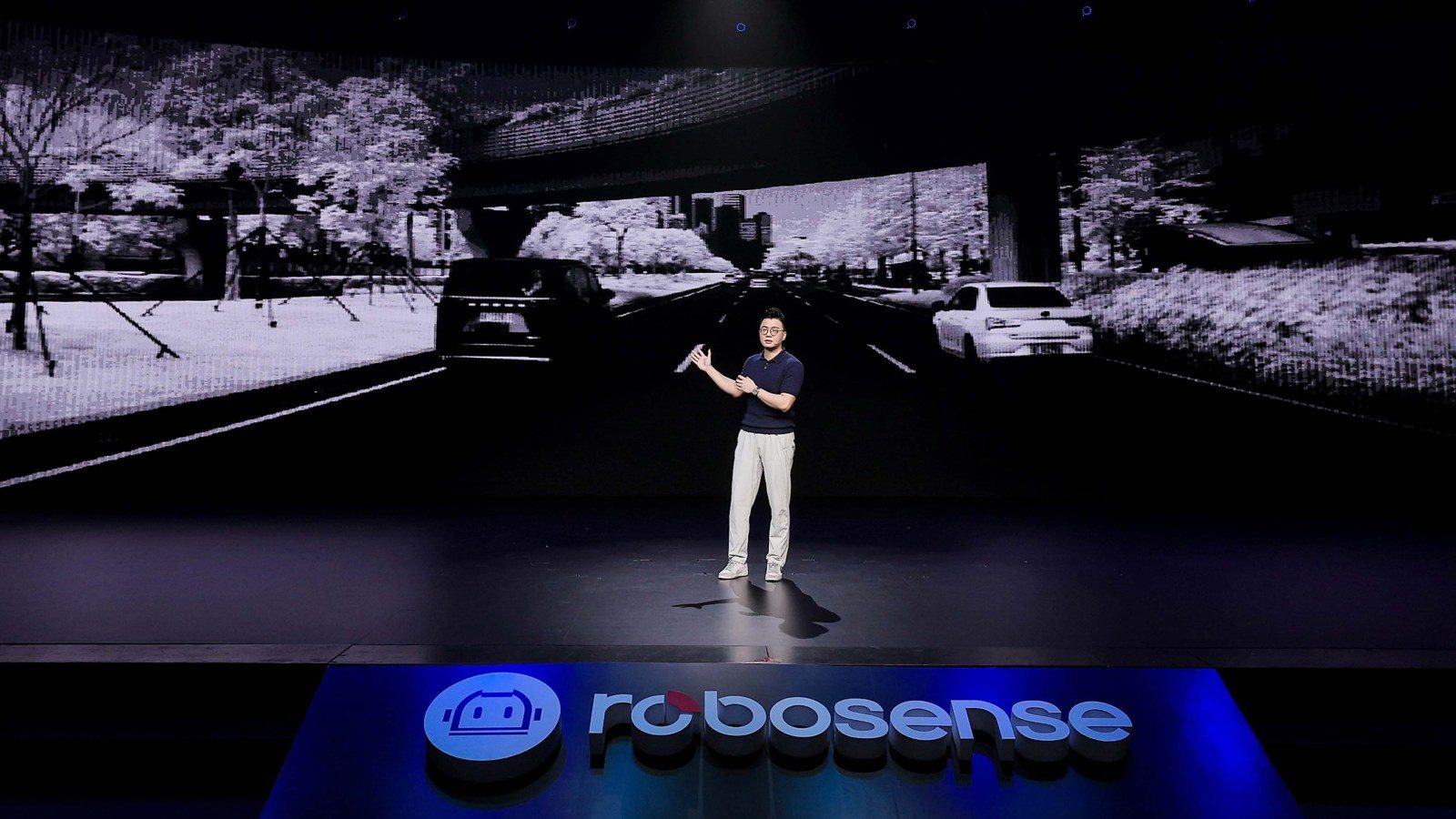
A LiDAR visualization BYD displayed on stage — a grayscale-and-point-cloud freeway scene under an overpass — closely resembles imagery RoboSense showed at its own April Tech Day, though BYD did not name a LiDAR supplier during the event.
Customers
RoboSense said it had accumulated design wins across 177 vehicle models from 36 automakers and Tier-1 suppliers as of March, with start of production reached for 69 models and an automotive order backlog exceeding 9 million units.
It named BYD, Geely, IM Motors and the Chinese joint ventures of Toyota, Nissan, Volkswagen and General Motors among its automotive customers, and was named Geely’s 2026 strategic partner during the quarter.
The company said its LiDAR appeared on 42.3% of LiDAR-equipped vehicles displayed at the Beijing auto show this year, citing the trade outlet ijiwei.com, and that it serves more than 40 brands across over 80 models.
On BYD, RoboSense said it had captured roughly 80% of the carmaker’s intelligent-driving LiDAR adoption by 2026 and serves as the exclusive supplier for several model launches, with vehicles across multiple BYD sub-brands carrying its sensors.
In robotaxis, RoboSense said its EM4 main sensor and E1 blind-spot unit had been adopted by more than 90% of leading global operators, including Didi, Baidu’s Apollo Go, WeRide and Pony.ai.
Its EM4 and E1 were selected for WeRide’s next-generation Robotaxi GXR, with 2,000 units due this year; WeRide’s GXR fleet stood at 1,023 vehicles in January.
The company also counts humanoid developers including Unitree, AgiBot and Galbot among its robotics customers, and has expanded beyond sensors into robot vision systems and dexterous hands.