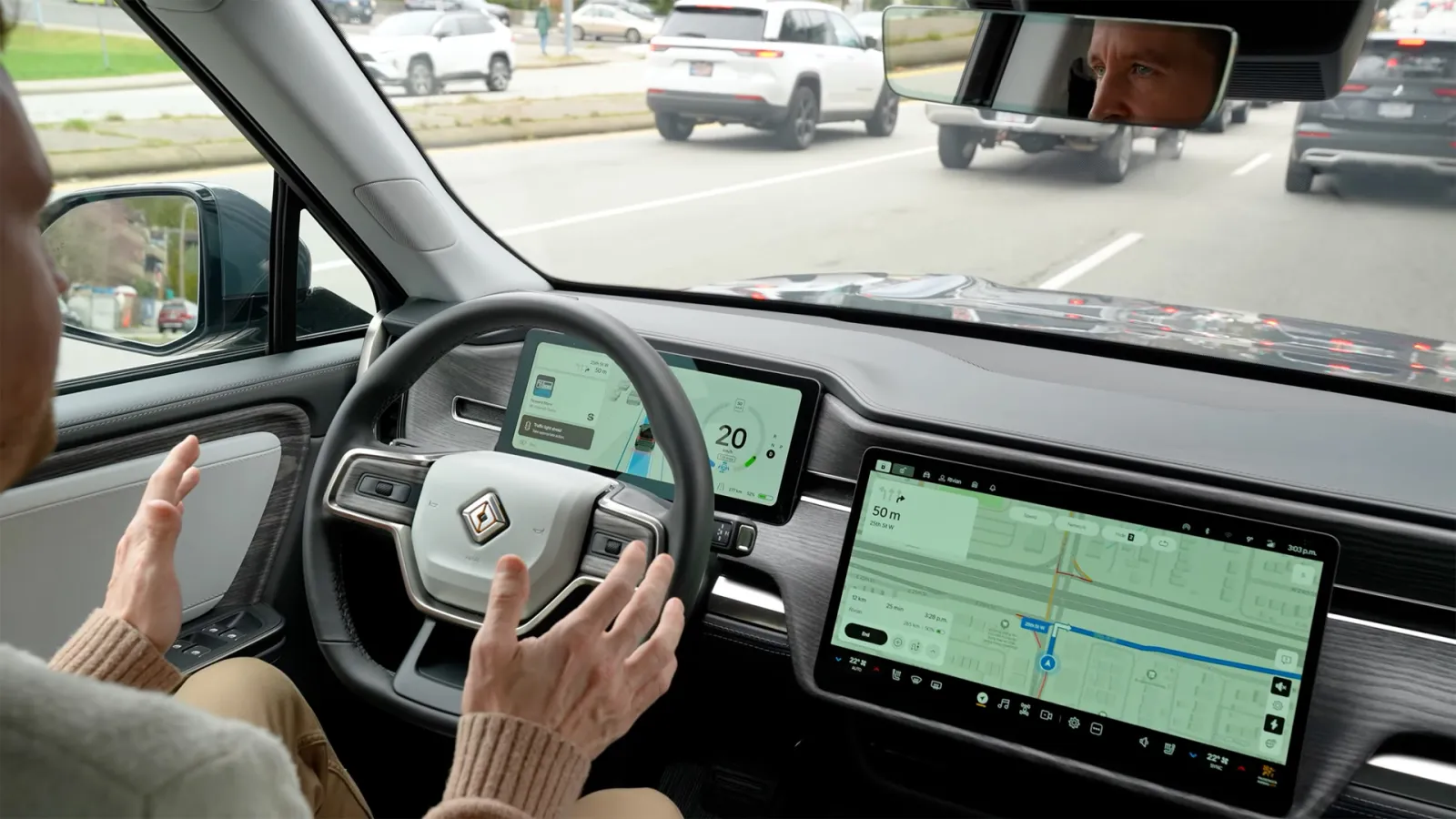
Rivian has told buyers that none of the vehicles currently available to order, including the R2 Launch Package, comes with LiDAR or its in-house RAP1 chip, and that it “has not announced specific customer availability dates for this hardware.”
The statements appear on a new support page titled “LiDAR and RAP1 Availability,” which Rivian owner Chris Hilbert shared on X on Wednesday.
The page also says that buying Autonomy+, choosing a vehicle package or taking a later delivery date “does not guarantee that your vehicle will include LiDAR or RAP1,” and that Rivian has no plans to retrofit LiDAR to existing vehicles.
The wording is more cautious than Rivian’s recent guidance. Vice President of Investor Relations Chip Newcom said on September 29 that the hardware would go into employee vehicles later this year “and then start rolling that out to customers next year.”
Its shares are down nearly 41% this year, and it reports third-quarter results after the market closes on Thursday. The stock is trading slightly lower in pre-market trading as of 07:41 New York time.
Rivian’s RAP1
Rivian presented RAP1, short for Rivian Autonomy Processor, at the December 11 event in Palo Alto, California.
The chip is made by TSMC on a 5-nanometer process and has a Rivian-designed neural network engine capable of 800 trillion operations per second (TOPS).
It uses a multi-chip module that packages the processor with memory to reach 205 gigabytes per second of bandwidth, which Rivian said simplifies the circuit board and cuts manufacturing and material costs.
Rivian said the design delivers four times the peak performance of its second-generation computer and improves power efficiency by a factor of 2.5. A custom interconnect called RivLink lets several chips work together.
Two RAP1s sit inside the third-generation Autonomy Compute Module, or ACM3, which Rivian rates at 1,600 sparse INT8 TOPS and says can process 5 billion pixels per second.
The full Gen 3 package pairs that computer with 11 cameras totaling 65 megapixels, five radars and one front-facing long-range LiDAR at the top of the windshield.
“Starting in late 2026, our Gen 3 autonomy platform will include 65 megapixels of cameras, a robust radar array, and a front-facing long-range LiDAR,” Scaringe said at the event.
Rajagopalan called the combination “the most powerful combination of sensors and inference compute in consumer vehicles in North America.”
What the Page Says That Is New
Rivian’s page states that “R1T, R1S, and R2 vehicles currently available to order do not include LiDAR or the Rivian Autonomy Processor (RAP1).” It adds, “This includes R2 Performance with Launch Package.”
It also addresses the R1. “Announcements about future R2 hardware do not establish availability for R1T or R1S,” the page says, adding that “availability may differ by vehicle model and configuration.”
Founder and CEO RJ Scaringe had said on the fourth-quarter call that the new hardware coming in 2027 “is for R2,” but the page is the first time Rivian has put the R1 caveat in writing.
Rivian goes further on timing. “No specific order date or delivery window guarantees LiDAR or RAP1,” it says, and until it “announces eligible configurations and customer availability,” it cannot confirm that a vehicle delivered in a given month will have the hardware.
The page says “internal testing milestones and autonomous vehicle partnership announcements” do not establish when the hardware will reach customer vehicles. Rivian has issued chip testing updates this year and signed a robotaxi agreement with Uber in March.
On eyes-off driving, the page says that “having LiDAR or RAP1 does not, by itself, mean an eyes-off driving feature is available,” because those features “also require supported software and approval for specific operating conditions.”
On retrofits, it says that “there are currently no plans to retrofit LiDAR hardware to existing Rivian vehicles” and that “an over-the-air software update cannot add physical sensors or replace an onboard processor.” That restates in writing what Scaringe said in February, when he called a retrofit “not something that’s contemplated or planned.”
Rivian says it will keep developing software for vehicles without LiDAR, but that “software updates do not change the installed hardware or guarantee access to features that require different hardware.”
The page was not listed among the related articles on Rivian’s Autonomy Early Access Program support page on Wednesday afternoon, but appeared there by early Thursday.
What Was Already Known
Several points were already on the record, and Rivian’s own timing has not been consistent.
On the fourth-quarter call on February 12, Scaringe was asked about retrofits for R2 buyers without the new hardware and for existing R1 owners. “In terms of a retrofit, this isn’t something that’s contemplated or planned,” he said, according to the transcript of the call. “In terms of hardware upgrades, those are not planned.”
On the same call, Scaringe said the hardware “talked about at our Autonomy and AI Day” was “gonna be on vehicles in the early part of 2027.” Asked whether that included the R1, he said, “This is for R2.”
CFO Claire McDonough gave a different date minutes earlier, saying Rivian’s 2026 guidance included spending to “deliver LiDAR, our first RAP1 chips, and limited point-to-point functionality for our customers by the end of the year.”
On April 30, an analyst asked Scaringe to confirm that the Gen 3 sensor suite would be available “later this year on the R2.” “That’s correct,” he said, describing RAP1 as “800 tops per chip,” with two chips per vehicle and “roughly a 4X increase relative to the NVIDIA-based platform.”
Newcom then said in September that customers would get the hardware only in 2027.
The R2s delivered since June carry Rivian’s second-generation hardware without LiDAR, and Senior Vice President of Electrical Hardware Vidya Rajagopalan said in September that Rivian had not announced when the new hardware would reach the R1.
Executives had also said the new hardware would matter only later. “What the RAP1 chip and LiDAR enable is really functionality at a later date. The eyes-off functionality we’ve talked of for later,” Rajagopalan said.
What the page adds is the absence of any customer date, the explicit exclusion of every vehicle now on order across R1 and R2, the warning that later delivery or Autonomy+ guarantees nothing, and the statement that testing milestones and partnerships do not set customer timing. The retrofit and R1 points were said before but had not appeared on a Rivian support page.
The hardware is meant to carry Rivian from supervised hands-free driving to eyes-off driving and personal Level 4 autonomy. It also underpins a robotaxi deal with Uber worth up to $1.25 billion in investment.
Inside the Chip
RAP1 combines an always-on secure-boot processor, a safety island rated to the ASIL-D automotive standard, 14 Arm Cortex-A720AE cores, an image signal processor, a general-purpose GPU and the in-house neural network engine, Mukund Chavan, Rivian’s Vice President of ASIC Design, said in a March interview.
Chavan, who helped bring Tesla’s HW3 self-driving computer into production before joining Rivian in 2021, said the project took about two and a half years from start to silicon.
“We went through a disciplined approach, looked at all the IPs available outside,” he said, before concluding that “we can add the most differentiation by designing our own neural network engine.”
Rivian designs the parts of RAP1 that work like a tensor processing unit and owns that intellectual property, while partners supply other blocks, Senior Vice President of Autonomy and AI James Philbin said in September.
Scaringe told Reuters in May that Rivian was committing “many hundreds of millions of dollars” to the chip program and planned a new chip “every couple of years,” with successors on more advanced processes than 5 nanometers.
Why Build Its Own
Rivian has framed the chip as a cost decision as much as a performance one. Building RAP1 lets it “eliminate the overhead and margins associated with an external silicon developer,” the company said in its shareholder letter.
Moving to its own silicon means Rivian is “no longer paying away that margin to our silicon provider,” Newcom said in September.
Rajagopalan said Gen 3 “will enable a few different performance points,” with “the lower performance point” cheaper than the current Gen 2 hardware and “the higher performance point” on par or slightly higher, at a Goldman Sachs conference on September 8. On a cost-per-TOPS basis, Gen 3 is cheaper across the board, she said.
Evercore ISI’s Chris McNally called the chip the biggest surprise of the December event, saying Rivian was “ditching NVIDIA in favor of a custom built, in-house chip.”
Scaringe said this month that rising memory prices were adding “many hundreds of dollars” to the cost of a highly capable vehicle.
A Timeline That Kept Shifting
Rivian’s shareholder materials have pointed to late 2026, while executives’ comments on calls have varied. In its February shareholder letter, it said it had received production RAP1 chips and was “in the final validation phases as we get ready for an expected production launch of this chip in R2 in late 2026.”
McDonough said at a UBS conference in June that the Gen 3 timeline remained on track. An R2 carrying a roof-edge LiDAR was photographed near Rivian’s headquarters in Irvine, California, at the end of June.
“At the end of 2026, we are targeting the launch of our third-generation autonomy hardware,” Scaringe said on the July 30 earnings call. “The development of our RAP1 chip is on track, and we’ve begun final testing phases of production silicon,” the company said in its second-quarter presentation.
Rajagopalan said in September that Rivian had had silicon in-house “for more than a year and a half,” that automotive-grade characterization testing was “pretty much wrapping up” and should be done “within the next month and a half.” She said released features were working on the new chip and performance met the “at least 4x” target, “as yet without fully optimized software.”
Three weeks later, Newcom gave the clearest split yet between staff and customers. “For employees, the plan is to start rolling out [RAP1], so our third-generation computer plus the LiDAR to go into the vehicle later this year for employees and then start rolling that out to customers next year,” he said at an Evercore ISI forum on September 29.
Rivian did not say whether the late-2026 date had always meant employee vehicles. Scaringe’s “early part of 2027” remark in February had already pointed to a customer launch next year. “Right now, the priority for [RAP1] is going to be going into the R2,” Newcom said.
The new support page goes a step further, saying Rivian “has not announced specific customer availability dates” at all.
Impact for Today’s Owners
Rivian says the gap between hardware generations will not show at first. Point-to-Point, its next hands-free feature, “will actually be available on Gen 2 and Gen 3,” Rajagopalan said. “What the RAP1 chip and LiDAR enable is really functionality at a later date. The eyes-off functionality we’ve talked of for later. There should be no difference at launch.”
Philbin has said LiDAR-equipped R2s will mainly serve as “ground-truthing” vehicles that improve the model for the whole fleet, and that he expects Gen 2 and Gen 3 capabilities to be comparable for several years.
Point-to-Point is now in an invite-only, NDA-bound early access program, and Rivian this week added a notice telling eligible owners who cannot see the sign-up tile to “check back shortly.”
Rajagopalan said in September that Rivian “haven’t actually announced” when Gen 3 reaches the R1. Rivian was granted a windshield-LiDAR patent on October 6 whose drawings show a pickup resembling the R1T.
The Supplier Rivian Won’t Name
Rivian has described its LiDAR partner only as “undisclosed.” Indicators in RoboSense’s customer disclosures through 2025 pointed to the Shenzhen-based maker, which supplies Chinese carmakers including Geely.
A Rivian spokesperson denied that in March. “While I don’t know what company RoboSense was referring to, it is not Rivian,” the spokesperson said, without naming the actual supplier.
Scaringe told Reuters in May that “all the real choices are coming out of China” for a sensor at the “low hundreds of dollars price point,” and that Rivian was weighing building LiDAR in the US with Chinese technology, possibly through a joint venture. “Think of it as finding a way to structurally ingest the technology,” he said.
McDonough later called reports of in-house LiDAR “more of an erroneous headline,” saying there were “no plans today to bring it in-house.”
The sourcing question sits inside a US-China dispute. The Pentagon lists Hesai, the other leading Chinese LiDAR maker, as a Chinese military company, a designation a federal judge upheld in July 2025 and that Hesai is appealing.
Newcom said the LiDAR will cost “on the order of a few hundred dollars” per vehicle and will sit in automotive cost of goods sold rather than being recovered through Autonomy+ pricing.
The Uber Clock
The Gen 3 platform is also the basis of Rivian’s Uber agreement, signed on March 19, under which Uber will invest up to $1.25 billion through 2031 and Uber or its fleet partners expect to buy 10,000 fully autonomous R2s, with an option on up to 40,000 more from 2030.
Rivian’s first-quarter presentation said the deal was built on RAP1, its camera, radar and LiDAR sensor suite and its AI-based Large Driving Model. Commercial service is planned to start in San Francisco and Miami in 2028.
Philbin said in September that the second milestone involves testing in San Francisco, Miami and Chicago by year-end. Newcom said Rivian expects to unlock that $250 million tranche in the fourth quarter.
Beyond Vehicles
Rajagopalan described RAP1 as “a very capable chip for physical AI” and invited outside interest. “If anybody out there is interested in using our chip for robots to reach out,” she said.
McDonough said in June that RAP1 licensing could extend beyond automotive. Chief Strategy Officer Dagan Mishoulam left this month to join Arm, the designer of the chip’s CPU cores, as Vice President of Strategy and Partnerships for Physical AI.
Rivian last week acquired Third Dimension AI, a startup that turns sensor data into editable 3D environments for training and validating driving software.
What Analysts Watch
Analysts tracked by Price Target, EV‘s sister publication that tracks Wall Street analyst ratings and price targets, have flagged the hardware as a near-term catalyst.
Cantor Fitzgerald, which rates the stock ‘Neutral’ with a $19 target, listed “RAP1 Chip Launch” among Rivian’s near-term catalysts and expected it in the second half of 2026, in an October 2 note.
Yorkville Ives, which started coverage at ‘Outperform’ with a $20 target, wrote that Rivian’s third-generation platform, “built around RAP1 (RIVN’s in-house autonomy chip) silicon and a camera, radar, and LiDAR sensor suite,” was expected to debut in the R2, in an October 7 note.
Rivian shares closed down 1.3% at $11.67 on Wednesday, down 40.8% from their 2025 close of $19.71.
What Comes Next
Rivian reports third-quarter results after the market closes on Thursday, with a call at 5:00 p.m. ET. It will be McDonough’s last as CFO before she leaves on October 30 to become Chief Financial Officer of GE Vernova.
It will hold its second Autonomy & AI Day on December 9 in San Francisco, where it has promised “brand new demos.”
Rivian has not said what share of R2 production will carry LiDAR, whether it will be standard or optional, or how much it will add to the price. Its new page says only that it will announce “eligible configurations and customer availability” later.