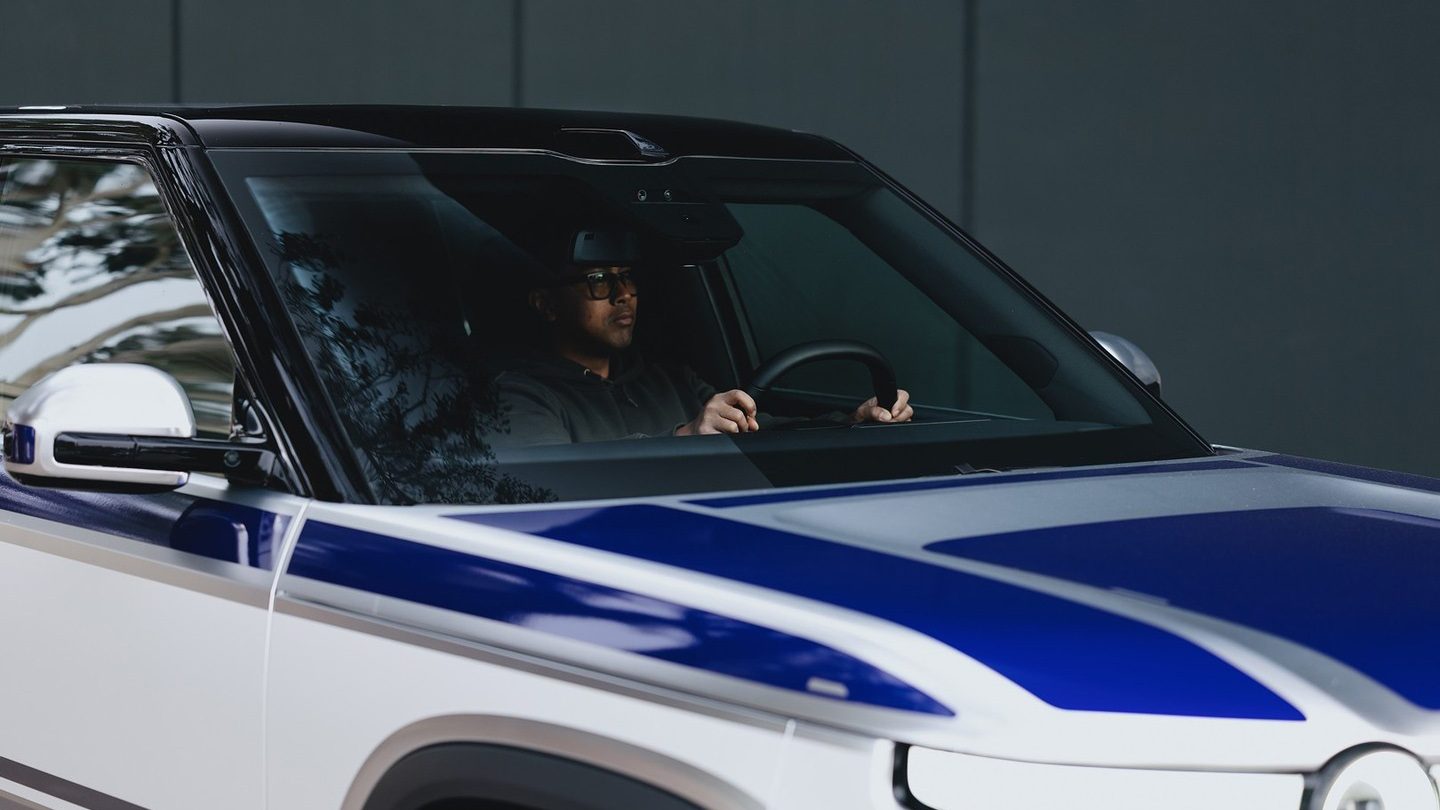

Rivian is building the autonomy system for its make-or-break R2 SUV around a LiDAR sensor it has been declining to name.
The supply base has narrowed to a few Chinese companies, one of them blacklisted by the Pentagon as a Chinese military firm and another that the company has publicly denied using.
The bind was thrown into sharp relief on Tuesday by a CNBC investigation showing that the blacklisted supplier, Hesai, is expanding its reach inside American self-driving systems through a partnership with Nvidia, despite a designation the US Department of Defense first imposed two years ago.
CNBC‘s piece focused on how dependent the US autonomy industry has become on Chinese sensors even as Washington moves to wall them off, and how little room automakers like Rivian have to source the technology anywhere else.
Rivian’s Undisclosed Supplier
Rivian confirmed in December that it would add a front-facing long-range LiDAR to the R2 from late 2026, part of a sensor suite of 11 cameras, five radars and one LiDAR run by its in-house RAP1 chip, but it has never said who makes the sensor.
The first R2s, which began reaching customers in June, ship without lidar, running on cameras and radar until the sensor arrives on later models.
An R2 fitted with lidar was recently spotted near Rivian’s Irvine headquarters, EV reported, a sign the company is already road-testing the hardware ahead of its planned late-2026 rollout.
EV reported that the evidence points to RoboSense, one of China’s largest LiDAR makers, after the company described an unnamed customer in terms that closely matched Rivian, escalating from “a leading emerging automaker in North America” to “a leading global manufacturer of SUVs and trucks.”
Rivian denied it, with a spokesperson telling EV “it is not Rivian,” while still declining to identify who supplies the sensor.
The affordable, compact lidar that mass-market cars need comes almost entirely from two Chinese firms, RoboSense and Hesai — with Hesai being the one the Pentagon has blacklisted.
RoboSense, which reported its first profitable quarter late last year and supplies more than 90% of the world’s major robotaxi operators, is not on the Pentagon’s list, which would give Rivian near-term cover if it is the supplier.
The regulatory direction, however, is one-way, and any tightening would land on whichever Chinese company sits inside the R2.
Expanding Despite the Ban
The CNBC report showed why the pressure is building.
Even after being designated a Chinese military company, Hesai’s footprint in American autonomous systems is growing, its sensors built into Amazon’s Zoox robotaxis, the autonomous trucking firms Waabi and Kodiak, the delivery-robot company Nuro and monitoring systems at New York’s Kennedy airport.
The company says it holds about a third of the global automotive LiDAR market, and it has become the industry’s dominant force, the first LiDAR maker to turn a full-year profit and the first to ship more than two million sensors.
Under the partnership with Nvidia, Hesai sensors are one of the options automakers can pick when building on Nvidia’s autonomous-driving platform.
Asked by CNBC whether it knew Hesai had been blacklisted and how the sensors’ data is secured, Nvidia did not answer the specific questions, saying automakers want “an open, vendor-agnostic reference architecture” so they can pick the best components.
Hesai’s co-founder and chief executive, David Li, rejected the security concerns, telling CNBC the sensors have no memory to store data and that its partners, not Hesai, control whatever information they collect.
Critics counter that US firms have embraced cheap Chinese technology before, from companies already blacklisted, only to spend billions ripping it out later, as happened with Huawei’s telecom gear.
The Blacklist, as Backdrop
The designation at the center of the scrutiny dates to January 2024, when the Defense Department added Hesai to its Section 1260H list of Chinese military companies.
Hesai sued, and in July 2025 a federal judge in Washington upheld the listing, finding the government’s conclusion that the company contributes “to the Chinese defense industrial base” was backed by substantial evidence, even as the court acknowledged no evidence that Hesai’s products had been used militarily.
Hesai appealed later that month, and the case is unresolved.
The listing bars the Pentagon from buying Hesai products but does not stop private US companies from using them, a commercial exemption at the heart of the debate, and one lawmakers have moved to close, introducing a bill late last year to phase out Chinese sensors in self-driving cars.
Hesai maintains its LiDARs are for civilian use only, with no military ties, and calls the designation baseless.
What Scaringe Has Said
Rivian Chief Executive RJ Scaringe has been candid about the corner automakers are in.
The affordable lidar they need, at the low hundreds of dollars a unit, comes overwhelmingly from China, he has said, telling Reuters that “all the real choices are coming out of China.”
Scaringe said Rivian is weighing building lidar in the US, possibly through a joint venture with a Chinese firm, describing the aim as absorbing the technology into a US-based operation.
Such an arrangement, licensing Chinese know-how to build sensors on American soil, would keep Rivian from being a direct customer of a Chinese supplier and insulate the R2 program from any future expansion of the Pentagon list.
The Broader Squeeze
The standoff captures a collision between the economics of autonomy and US-China security policy.
Chinese suppliers have driven the cost of LiDAR from more than $10,000 a unit to under $200, making the sensors viable for mass-market cars for the first time, which is why they now sit in so many American systems.
Washington is pushing the other way, tying blacklists to procurement bans, pressing for capital-market restrictions and weighing limits on Chinese sensors, even as no US maker has matched the Chinese suppliers on price.
For Rivian, building a self-driving program around hardware it will not name, from a country the government is trying to wall off, the question is not only who makes the lidar today, but whether that supplier will still be available tomorrow.