
Rivian will hold its second Autonomy & AI Day on December 9 in San Francisco, according to a save-the-date the company has begun sending out, moving the event from the Palo Alto offices where it was held last year.
The Save the Date was sent on Thursday and gives only the date and the city, and Rivian has not published an agenda, a venue or livestream details.
Founder and CEO RJ Scaringe described the purpose of the event last month, before the date was set.
“We’re going to announce the specific date, but we’re going to have an Autonomy and AI Day that we have near the end of this year, similar to what we did last year,” he said at Morgan Stanley’s Laguna Conference on September 15, calling it “an anchor point to then roll out some of these new features.”
The first feature he described was point-to-point driving, which Rivian has said will begin a limited rollout this year, though he did not say it would launch at the event.
2025 Edition
Rivian held its first Autonomy & AI Day on December 11, 2025, in Palo Alto, California.
Its main hardware announcement was the Rivian Autonomy Processor, or RAP1, a custom 5-nanometre chip designed to replace Nvidia technology in future vehicles, starting with the R2.
RAP1 powers a third-generation autonomy computer that Rivian said can process 5 billion pixels per second. Rivian also said it would add LiDAR to the R2, alongside 11 cameras and five radars.
“Starting in late 2026, our Gen 3 autonomy platform will include 65 megapixels of cameras, a robust radar array, and a front-facing long-range LiDAR,” Scaringe said on stage.
On software, Rivian introduced its Large Driving Model, which it described as a foundational driving model trained like a large language model.
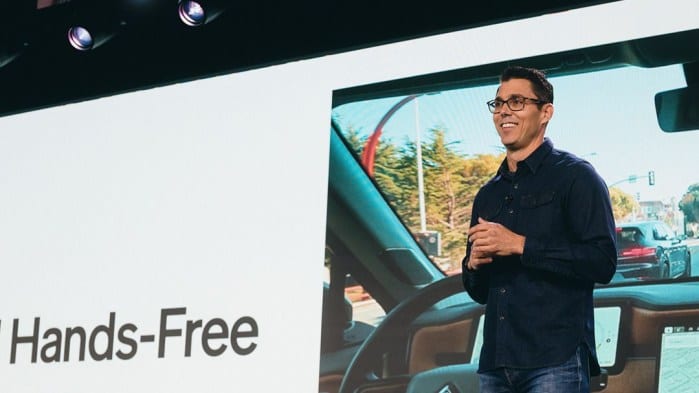
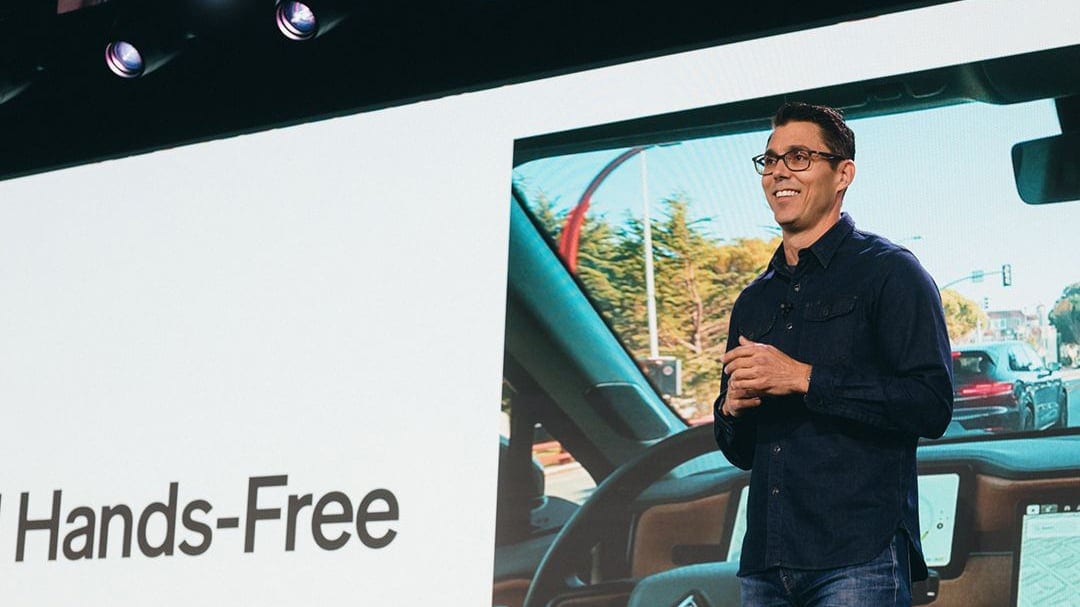
It announced Universal Hands-Free, which extended hands-free driving to 3.5 million miles of roads in the United States and Canada for second-generation R1 vehicles.
The EV maker also set the price of its Autonomy+ package at $2,500 as a one-time purchase or $49.99 a month, with a launch in early 2026.
Rivian described “a clear trajectory including point-to-point, eyes off and personal L4” in its press release that day, without attaching a date to any of the three.
The company also presented Rivian Unified Intelligence, a shared data platform, and a voice-based Rivian Assistant for early 2026.
Rivian’s shares fell more than 6% on the day of the event.
What Has Happened Since
Universal Hands-Free reached second-generation R1 owners in a software update on December 18, 2025, a week after the event.
The Rivian Assistant, promised for early 2026, arrived in a software update in May. Autonomy+ went on sale in early 2026 at the announced price, and Rivian has kept it at $2,500 on the 2027 R1.
Scaringe said on the second-quarter earnings call on July 30 that “there’s opportunity to grow pricing for our autonomous capabilities as we add those capabilities,” adding that it “needs to be earned through the expansion of the feature set and expansion of the capability.”
The point-to-point timeline has narrowed since the first event.
Scaringe said in August 2025 that “in 2026 we’ll be hands-free point-to-point,” but Rivian’s own materials have since June described a limited rollout this year and a widespread one in 2027.
“Later this year, we’ll have full supervised point-to-point, which will be very similar to Tesla’s FSD,” Scaringe said in June, adding that it would reach all second-generation vehicles and the R2.
The LiDAR date has also been qualified.
Newcom said on September 29 that the first R2s with RAP1 and LiDAR will go to employees later this year and to customers in 2027.
Rivian had not previously split the late-2026 date between staff and buyers.
“Within the next month and a half, we should be pretty much done in sort of the hardware characterization testing piece of it,” Senior VP of Electrical Hardware Vidya Rajagopalan said of RAP1 on September 8, referring to that test phase and not to production release.
That would put the end of characterisation testing in late October, about seven weeks before the event.
Why San Francisco
Rivian and Uber announced an agreement on March 19 for a robotaxi version of the R2, with San Francisco and Miami named as the launch cities for 2028.
Senior VP of Autonomy and AI James Philbin said in September that a milestone in that agreement “involves testing in three urban areas by the end of the year,” naming San Francisco, Miami and Chicago.
Passing that milestone unlocks $250 million, the second of five tranches in Uber’s $1.25 billion commitment, VP of Investor Relations Chip Newcom said at the same conference.
Rivian has not said whether the choice of city for the event is linked to the Uber programme.
Scaringe has described 2028 as “a really important year for us where we start to deploy the Level 4 version, which is this robotaxi version.”
What CEO Has Said to Expect
Scaringe has defined point-to-point as a supervised system. “You get into the vehicle, you type the address of your intended destination into the screen and say go,” he said in September.
“Your hands are off the wheel, but your eyes are still on the road most of the time,” he added.
Scaringe said on the July 30 call that hands-off, eyes-off capability was targeted for 2027.
“There’s only one model,” he said in September of the Large Driving Model, adding that Rivian does not build separate versions for supervised driving and Level 4.
Point-to-point is due on both the current second-generation hardware and the third, so R2s built without LiDAR are expected to receive it.
Rivian said this week it is also studying more autonomy for future commercial vans.