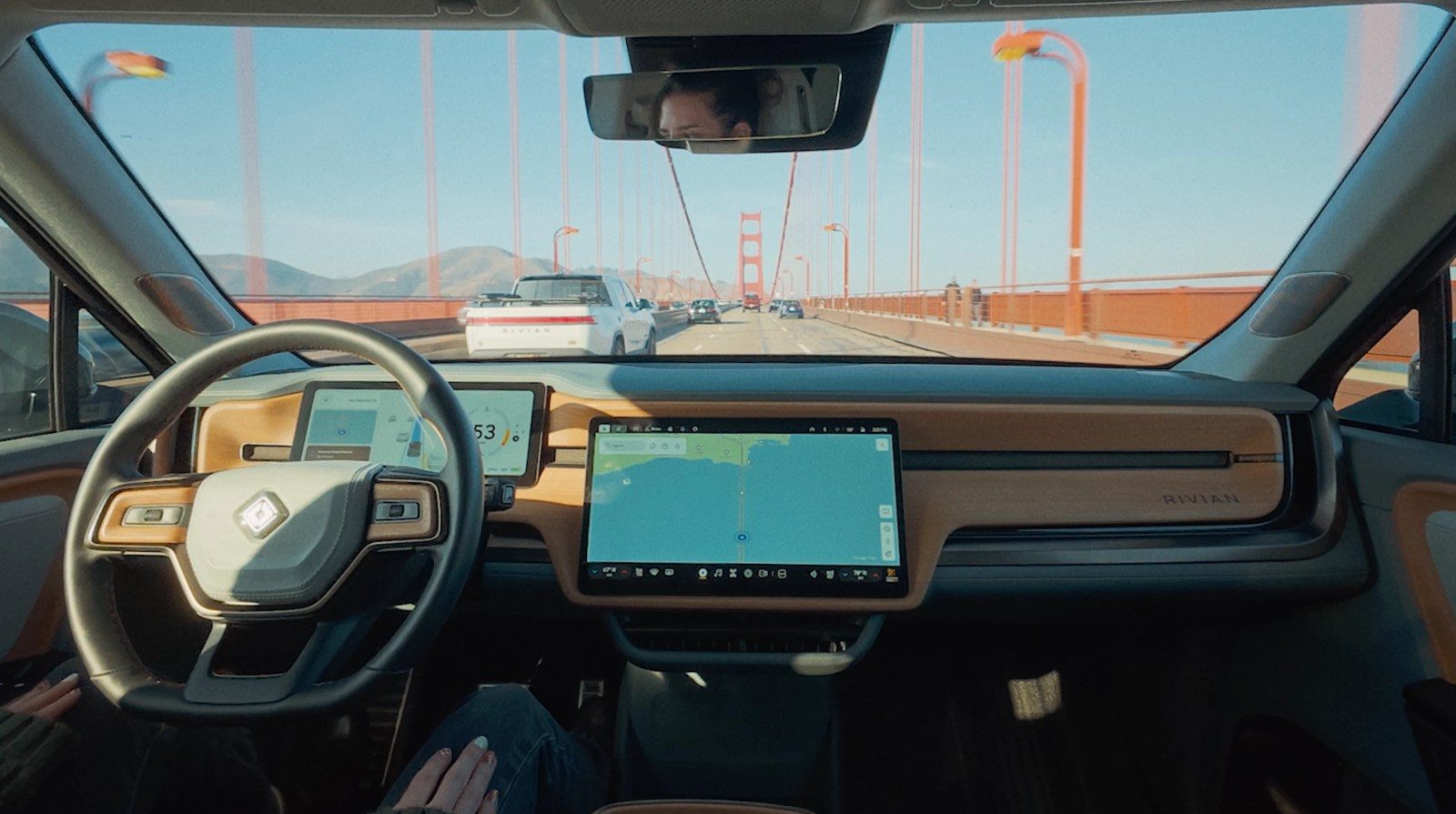

Rivian founder and CEO RJ Scaringe told analysts on Thursday that the company’s autonomy development remains on track, with point-to-point driving capabilities to begin rolling out to customers “by the end of this year.”
The comments, made during Rivian‘s second-quarter earnings call, reaffirm a timeline first laid out at the company’s inaugural Autonomy and AI Day in December.
The framing has been repeated across multiple public appearances in recent months — including a June event where Scaringe said the feature would be “very similar to Tesla’s FSD.”
Scaringe referred to the capability as a near-term step in a broader four-stage roadmap that stretches from the company’s current Universal Hands-Free system — which covers more than 3.5 million miles across the US and Canada — to a Level 4 robotaxi targeted for 2028.
Level 2++ Autonomy
Addressing a question by Wolfe Research analyst Shreyas Patil, Rivian‘s founder clarified that the upcoming version will operate as what he described as “Level 2++” autonomy.
“Initially, that will be a feature in which it’s like Level 2++, where your hands are off the wheel, but your eyes are still primarily on the road,” he explained.
According to Scaringe, that means one could “look away for short extended moments of time, but you’re not in a position to officially be reading a book or be responding to emails.”
The distinction matters because a fully hands-off, eyes-off capability — what Scaringe described as true Level 3 — is targeted for 2027, not this year.
“That’s really important because then not only is the vehicle fully driving itself and navigating to the address,” he noted, “but importantly, you’re able to truly get your time back without the vehicle dinging at you, say, to keep your eyes on the road, but actually be able to read a book, be on an iPad.”
Level 4 — in which no human needs to occupy the driver’s seat — is slated for 2028, the year Rivian plans to begin deploying robotaxi versions of the R2 in partnership with Uber, which agreed in March to invest up to $1.25 billion in a fleet of up to 50,000 autonomous vehicles across 25 cities.
R2 Data Flywheel
Scaringe highlighted Rivian‘s expanding vehicle fleet — accelerated by the R2 production ramp — will play a central role in the company’s push toward higher levels of autonomy.
“We believe our rapidly expanding car park with R2 will accelerate our data flywheel to enable delivering hands-off, eyes-off capabilities in 2027,” the Chief Executive explained, “and ultimately Level 4 capabilities in consumer and robotaxi variants of R2.”
Rivian has guided for 20,000 to 25,000 R2 deliveries in 2026, within a total delivery target of 65,000 to 70,000 units, as increased in early July.
The data flywheel concept mirrors the strategy employed by Tesla, which trains its Full Self-Driving neural networks on data collected from millions of vehicles in the field.
Rivian‘s fleet is considerably smaller, however the company has argued that the addition of LiDAR-equipped vehicles later this year will generate high-fidelity 3D ground truth data that benefits the entire fleet — including vehicles without LiDAR.
Autonomy+ Monetization
Rivian began charging for its Autonomy+ subscription in April, priced at $49.99 per month or $2,500 as a one-time purchase.
R2 Performance Launch Edition buyers receive lifetime access, as included in the $57,990 purchase price while the package is available.
Scaringe said take rates have “trended positively” since the paid launch, noting that the company believes “further feature releases will drive continued increased uptake of Autonomy+.”
The CEO did not disclose specific take rate figures, nor did he provide a breakdown of autonomy-related R&D spending for the second quarter.
In the first quarter, Rivian‘s autonomy efforts consumed what Scaringe described as the “vast majority” of the company’s $458 million R&D budget — implying more than $229 million directed toward self-driving development in that period alone.
Pricing Opportunity
Asked by Morgan Stanley analyst Andrew Percoco how Rivian is thinking about pricing as capabilities expand, the CEO sees room for the company to raise prices.
“We certainly believe there’s opportunity to grow pricing for our autonomous capabilities as we add those capabilities,” Scaringe said, however adding that “we believe very deeply that needs to be earned through the expansion of the feature set and expansion of the capability.”
The Chief Executive pointed to the transition from supervised to unsupervised driving as an inflection point for mainstream adoption.
“Early adopters, it’s fine to say you have to be hands-on or eyes on the road, but you can be hands off,” he said. “For the broad, full spectrum of customers, it’d be much easier to just say, ‘The car will drive itself. You don’t have to look at the road. You don’t have to touch the wheel.'”
Scaringe said mass adoption of hands-off, eyes-off driving would make the value proposition far easier to communicate and would drive demand beyond the existing customer base.
He described pricing potential as an active area of internal analysis.
“Ultimately, we believe it represents an opportunity to expand pricing beyond where we are today,” he said.
Gen 3 Hardware and Custom Silicon
Beyond the software timeline, Scaringe also confirmed that Rivian is targeting the launch of its third-generation autonomy hardware by the end of 2026.
The Gen 3 package includes RAP1 — the EV maker’s first in-house-designed silicon — and the integration of LiDAR.
The custom 5nm processor delivers 1,600 trillion operations per second of AI compute — a substantial leap from the 250 TOPS in the current Gen 2 system.
Scaringe added that RAP1 development is progressing through its final stages.
“The development of our RAP1 chip is on track, and we’ve begun final testing phases of production silicon,” he said.
The Gen 3 hardware is central to Rivian‘s long-term autonomy ambitions and to its commercial partnership with Uber, which is built around vehicles equipped with the more capable sensor suite.
SVP of Autonomy and AI James Philbin has previously said that LiDAR-equipped vehicles will serve as data collection tools for the broader fleet, framing them not as individually superior but as enablers for all Gen 2 and Gen 3 vehicles through improved training data for Rivian‘s Large Driving Model.
Philbin has also said the company does not expect a noticeable performance difference between LiDAR and non-LiDAR vehicles “for some time,” and that the two hardware generations are “architecturally similar, with the majority of feature development shared between the two platforms.”
Rivian first unveiled RAP1 during last December’s Autonomy & AI Day event, held at its Palo Alto offices.
During Thursday’s call, RJ Scaringe revealed that the company is preparing to host another Autonomy & AI Day later this year, where it plans to share further updates on the segment’s progress.