Ford‘s Model e electric vehicle division lost $1.06 billion in the third quarter, 25% less than a year earlier, as it sold fewer loss-making first-generation EVs and cut incentives, while spending more on its next-generation platform and a new battery storage business.
The loss compares with $1.41 billion a year earlier, an improvement of $352 million, according to the company’s results released on Wednesday. It widened from $919 million in the second quarter, however, the second straight quarter-on-quarter increase after a $777 million loss in the first.
The loss was smaller than the $1.17 billion analysts had expected, and revenue beat an estimate of $1.12 billion.
Ford kept its forecast for a Model e loss of about $4.0 billion in 2026, the figure it set in July. With $2.75 billion lost in the first nine months, that implies a fourth-quarter loss of about $1.25 billion, slightly more than the $1.22 billion the unit lost a year earlier.
The forecast includes “about $1 billion in incremental investment for UEV and Ford Energy,” which Chief Financial Officer Sherry House said in July would be “mostly weighted towards the second half of the year.”
The CFO also said then that Ford expected to improve first-generation EBIT “by approximately 40% year-over-year in 2026.”
Bigger Losses per Car
Model e wholesales fell 31% to 34,000 vehicles from 50,000, and segment revenue fell by the same rate to $1.2 billion from $1.8 billion.
Ford attributed the decline to the discontinuation of the F-150 Lightning and to “right-sizing of Mustang Mach-E production to customer demand.”
Measured against volume, the economics worsened. The division lost about $31,100 for each vehicle it wholesaled in the quarter, up about 10% from $28,200 a year earlier, based on Ford’s figures, which round wholesales to the nearest thousand. That was lower than the roughly $32,800 per vehicle in the second quarter.
The segment’s EBIT margin deteriorated by 7.4 percentage points to negative 86.5%, meaning it lost about 87 cents for every dollar of revenue.
For the first nine months, Model e lost $2.75 billion on revenue of $3.5 billion and wholesales of 97,000, against a $3.59 billion loss on $5.4 billion and 141,000 vehicles a year earlier.
What Drove the Improvement
Ford’s bridge for the quarter credits $0.2 billion of the $0.4 billion improvement to volume and mix, meaning fewer loss-making vehicles, and another $0.2 billion to net pricing, “primarily driven by lower incentive spend,” the presentation said.
Costs rose by $0.1 billion. Ford’s segment slide describes the gain as “loss optimized on Gen-1 products,” offset by “higher investment cost on next generation products and Ford Energy.”
The same “Gen-1” wording appeared in the second-quarter presentation and describes managing the decline of Ford’s existing lineup rather than growth.
Ford described the second quarter as the third straight period of year-over-year EBIT improvement at Model e, which makes the third quarter the fourth. Revenue rose from $1.0 billion in the second quarter, its first quarter-on-quarter increase after four straight declines.
US Sales
Model e wholesales rose 21% from 28,000 in the second quarter, while Ford’s US electric vehicle sales fell 38% over the same period to 6,047, including 5,574 Mustang Mach-Es and 289 F-150 Lightnings.
Wholesales count vehicles shipped to dealers and other customers worldwide, not retail sales, and Ford does not break out Model e wholesales by region, so the presentation does not show where the increase came from.
Ford’s company-wide figure tells a different story from Model e’s. The deck’s key metrics table shows total EV wholesales of 73,000 in the quarter, down 3% from 75,000 a year earlier and up 14% from 64,000 in the second quarter.
The gap with Model e’s 34,000 reflects how Ford splits its business. Model e covers retail EVs, while core commercial vehicles such as the Transit range stay in Ford Pro “regardless of powertrain,” according to Ford’s annual report.
On that basis, about 39,000 of the quarter’s EV wholesales were recorded outside Model e, up from about 25,000 a year earlier.
Ford built 7,559 Mustang Mach-Es at its Cuautitlan plant in Mexico in the quarter, which also supplies markets outside the United States.
Ford has made the larger battery standard on the 2027 Mustang Mach-E, which starts at $39,995 before destination, and has extended its Ford Power Promise offer on the 2026 model through the fourth quarter.
Special Items
Outside the segment results, Ford booked a further $0.2 billion of special-item charges in the quarter for EV program cancellations announced in December 2025, bringing the total for the year to $0.8 billion.
The nine-month special items also include a $3.6 billion charge on the disposition of the BlueOval SK battery joint venture, taken in the second quarter.
Ford Energy Moves Into View
Ford Energy, launched earlier this year, reports through Model e, Farley said on the second-quarter call, describing it as “a strategic business for us at Ford, but one with a very short payback.”
Its spending is now weighing on the segment’s results. In the second quarter, Ford’s Model e slide listed only the gain on first-generation products, and costs added $0.2 billion to the segment’s result rather than subtracting from it.
Ford is converting its former BlueOval SK battery plant in Kentucky to build battery energy storage systems for data centers, utilities and commercial customers, after assuming a $3.8 billion Department of Energy loan tied to the site.
The unit’s main product, the DC Block, is a 20-foot container built around lithium iron phosphate cells. Ford plans to spend about $2 billion over two years to retool the plant and expects to deploy at least 20 gigawatt-hours of storage a year by late 2027.
The UEV Bet
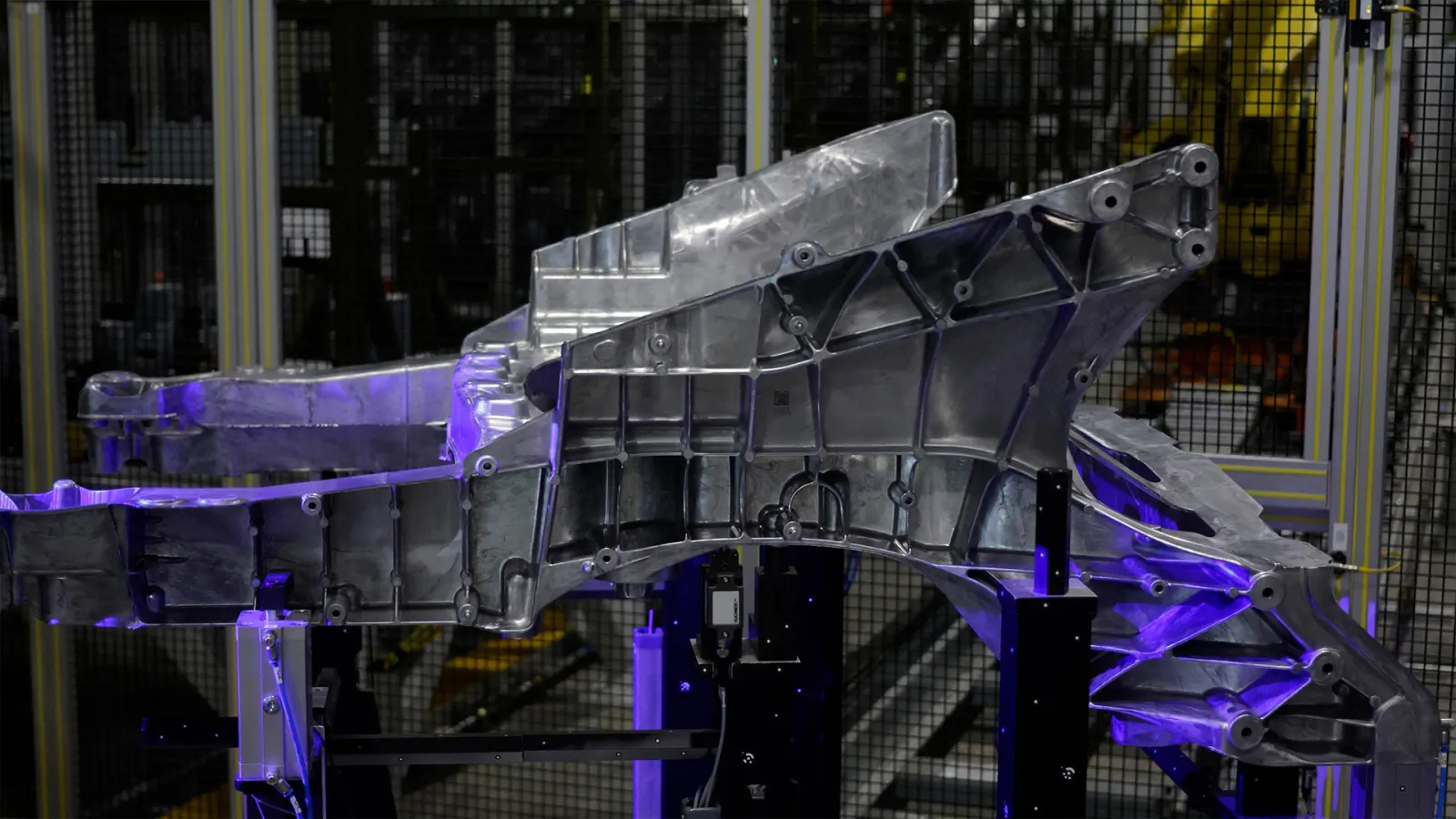
The other next-generation investment is the Universal EV platform, the low-cost architecture under the Fathom, a $28,350 midsize electric pickup due to be built at Ford’s Louisville Assembly Plant in Kentucky.
Ford has said it is spending about $5 billion on the program, and that pre-orders and the full reveal will come in early 2027, with deliveries later that year. The company said on Wednesday it had produced more than 5,000 unicastings for the truck.
The Fathom is Ford’s main bet for returning Model e to profit by 2029, a target Ford set in December 2025 when it announced a $19.5 billion write-down tied to its EV strategy. “It’s going to be a heck of an effort to launch this at scale, at cost, on time,” Chief Executive Officer Jim Farley said in September.
What Management Said
“Ford delivered a strong quarter as we’re entering a defining phase of the company’s transformation with the launch of our Universal Electric Vehicle platform, Ford Energy, an all-new F-150 and a new lineup of vehicles around the world over the next few years,” Farley said in the release.
CFO Sherry House said Ford was on track for its full-year targets, “which include achieving our warranty and material cost reduction objectives and improving year-over-year profitability in Ford Model e.”
Model e lost $4.8 billion in 2025, so the $4.0 billion forecast would mark an improvement of about $0.8 billion, nearly all of it already booked in the first nine months.
The Rest of Ford
Group revenue fell 2% to $49.5 billion, and net income fell to $2.0 billion from $2.4 billion. Adjusted EBIT rose to $2.7 billion from $2.6 billion, and adjusted earnings per share rose to 49 cents from 45 cents.
Ford raised the low end of its full-year adjusted EBIT forecast to $10.5 billion to $11 billion, from $10 billion to $11 billion, and kept its adjusted free cash flow forecast at $6 billion to $7 billion.
Ford Pro, its commercial unit, reported EBIT of $1.7 billion, down 16%, and Ford Blue, its gas and hybrid unit, reported $1.4 billion, down 10%. Ford now expects Ford Pro EBIT of about $7 billion this year, at the bottom of the $7 billion to $7.5 billion range it gave in July.
Adjusted earnings per share of 49 cents beat the 41 cents analysts had expected. House said she expected 2027 profit to be “roughly in line” with 2026, citing higher commodity, logistics and chip costs.
Rivals and Analysts
General Motors said last week that it still expects its EV losses to improve by $1 billion to $1.5 billion this year. It booked $238 million of EV-related charges in the third quarter and said such charges were “substantially completed.”
Several analysts trimmed their Ford targets ahead of the results, according to Price Target, EV‘s sister publication that tracks Wall Street analyst ratings and price targets.
JPMorgan cut its target to $16 from $17 and kept an ‘Overweight’ rating, forecasting third-quarter EBIT of $2.5 billion and saying it expected “preliminary 2027 outlook commentary is likely to present a cautious tone,” in an October 12 note.
UBS lowered its target to $15 from $17 with a ‘Buy’ rating on October 7, and Goldman Sachs cut its target to $14 from $16 with a ‘Neutral’ rating on October 6.
Ford shares closed up 2.1% at $11.95 on Wednesday before the results, then fell about 2% in after-hours trading. Management was due to discuss the results on a call at 5:00 p.m. ET.