
Rivian has been granted a US patent for a LiDAR mount built into the windshield, with drawings that show the sensor on its R1T, a model the company has not said will get the technology.
The patent was issued on Tuesday, October 6, to Rivian IP Holdings and was filed on November 8, 2023.
The details below come from the application as published on May 8, 2025, which carries the same title and application number and, like the grant, nine sheets of drawings.
The granted patent has 17 claims against 20 in the application, so the final claims may differ from those published last year. It was first reported by Rivian owner and content creator Chris Hilbert on X.
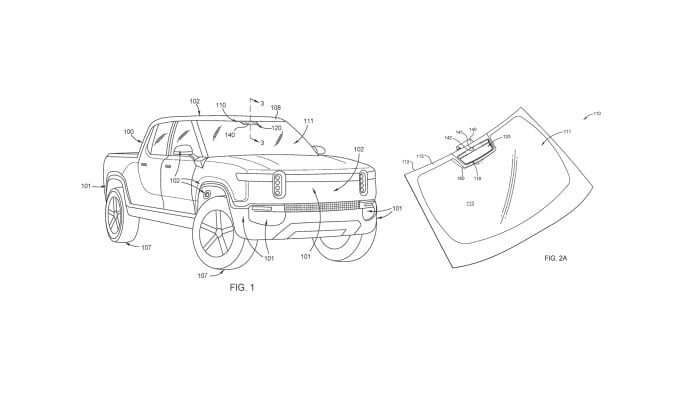
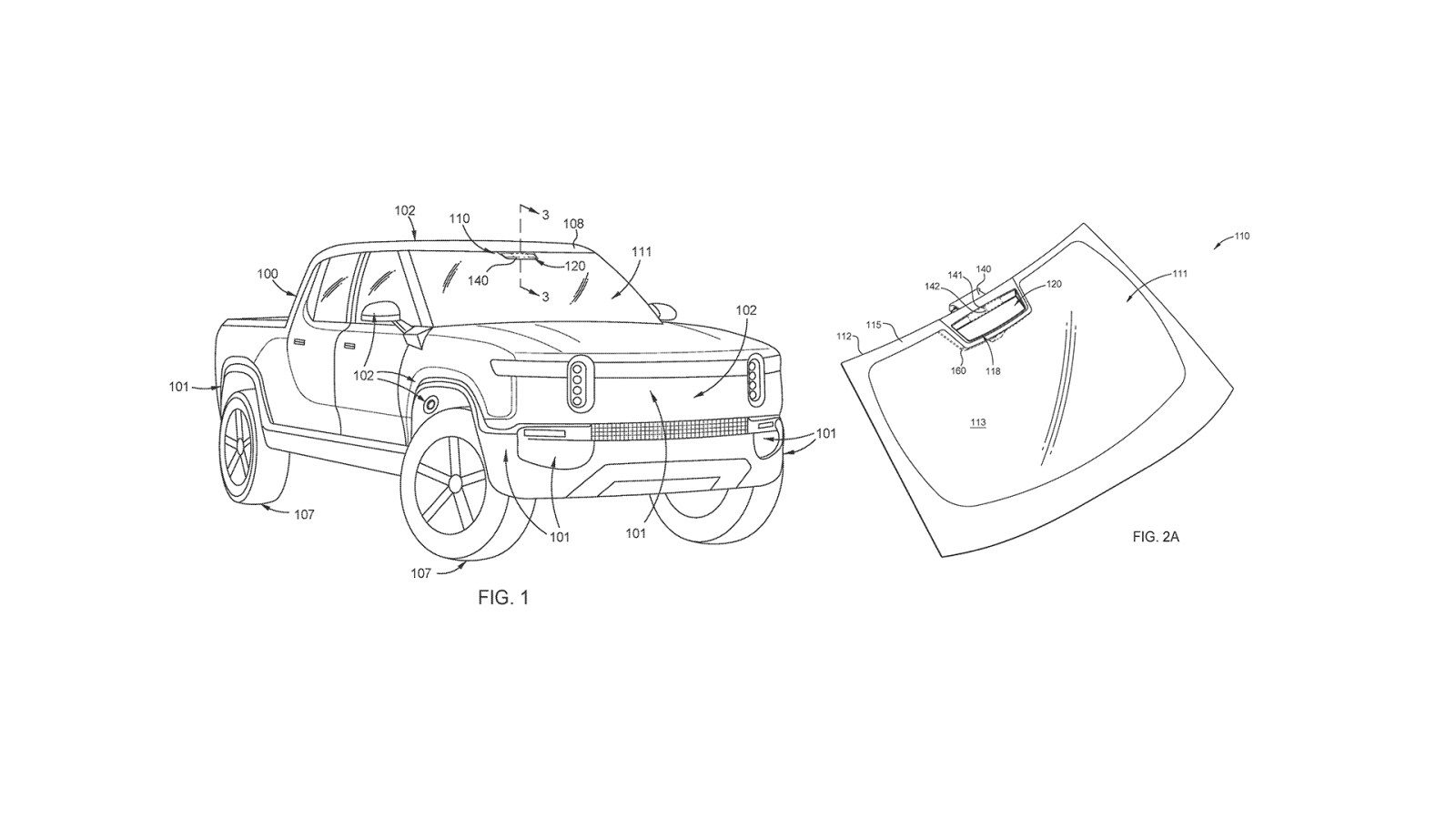
The first image shows a four-door pickup with two vertical oval headlamps and a horizontal light bar across its front. The patent does not name the R1T model and says only that “the vehicle 100 is a truck”.
A single lens assembly sits at the top centre of the windshield in the drawing, with a laser module behind it. The drawings are not new, having been public since the application was published over a year ago.
The text says the same design could be used on “any other type of vehicle”, and lists an electric truck, a SUV, and a service van as examples.
Rivian also sells fully electric commercial vans, with Amazon being one of its largest shareholders and customers.
Rivian has not named the supplier of its LiDAR, and Chief Financial Officer Claire McDonough said in June there were “no plans today to bring it in-house”.
A Lens Set Into the Glass
The patent describes cutting an opening into the edge of the windshield and fitting a separate lens into it.
The laser source and its sensor sit behind that lens, inside the cabin, and send and receive light through it instead of through the windshield glass.
The lens “has improved transmission characteristics with respect to light generated by the laser source as compared to the view panel,” the document says.
“Transmitting the light through the lens enables more reliable light detection and ranging (LiDAR) operations and simplifies calibration of the laser source,” it adds.
The lens is described as an infrared lens that can include quartz or borosilicate glass.
It is recessed from the outer surface of the windshield and has two angled faces, with the laser firing through one of them.
In one version, one or both of those faces are made of a composition that is at least 75% silicon dioxide.
A bracket attaches the lens to the inside of the glass and holds the laser module. A cover panel hides the assembly from the cabin, and the rear-view mirror or display attaches to that cover.
The windshield in the drawings is laminated glass, and the text says the lens could equally be fitted to a rear or side window.
Why Rivian Says It Matters
The patent sets out the problem in its opening lines.
“Mounting a light-based device on an outer side of a vehicle can make vehicle assembly difficult and time-consuming, and can undermine aesthetic appeal of the vehicle,” it says.
It adds that vehicle components “can interfere with light transmission paths, which may hinder operation and calibration”.
Rivian lists the benefits of its design as faster mounting, better looks, reliable light paths and easier calibration.
“Electrical wiring need not be passed through to an exterior of the vehicle to connect to the laser module,” the document says.
The references cited on the patent include a web page for Super Cruise, the hands-free driving system of General Motors‘ Cadillac brand, and a Chinese patent.
LiDAR Plans
Rivian’s announced LiDAR rollout covers the R2, its smaller sport utility vehicle, and not the R1T or the R1S.
“Starting in late 2026, our Gen 3 autonomy platform will include 65 megapixels of cameras, a robust radar array, and a front-facing long-range LiDAR,” Founder and Chief Executive Officer RJ Scaringe said at the company’s first Autonomy & AI Day in December 2025.
The company said last week that employees will get LiDAR-equipped R2s later this year and customers in 2027.
An R2 photographed near Rivian’s Irvine headquarters in July carried the sensor at the forward edge of the roof, just above the windshield, a position similar to the one in the patent drawings.
The patent does not mention the R2, and Rivian has not said whether the production design uses the patented mount.
An R1T photographed in Italy the same month carried a roof-mounted sensor array and was a test vehicle gathering data ahead of Rivian’s European launch.
Rivian “would not disclose or discuss when, or if, lidar will be added to the R1,” The Drive reported in December 2025.
The patent says nothing about production plans or timing.
The application was filed on November 8, 2023, four months before Rivian unveiled the R2 on March 7, 2024, and about two years before it announced LiDAR for that model.
A patent does not commit a company to building what it describes.
Rivian is due to hold its second Autonomy & AI Day on December 9 in San Francisco.