Rivian is promising “brand new demos” at its second Autonomy & AI Day on December 9, which it will hold at its Fell Street space in San Francisco, according to an invitation seen by EV.
“Expect brand new demos and presentations from leadership unveiling progress and the path forward,” the invitation says.
It does not name any feature or technology that will be shown.
The invitation asks recipients to save Wednesday, December 9, “when you’ll get to see where Rivian’s technology is taking us next”.
The choice of venue moves the event from a company office to a street-level site that is open to the public.
Rivian had disclosed the date and the city last week without naming a venue.
The invitation gives no start time, agenda or livestream details, and says more information will follow.
A Restored Garage in Hayes Valley
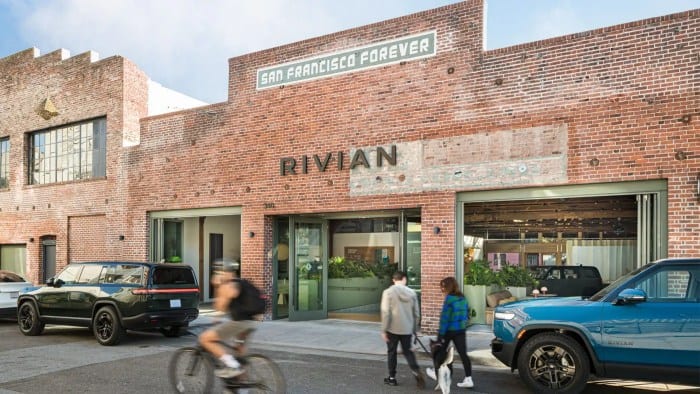
The Fell Street space is at 340 Fell Street in the Hayes Valley neighbourhood, according to Rivian’s website.
The EV maker describes it as its San Francisco flagship, housed in a restored auto body shop that had been in operation since the 1920s.
“Think playground, not showroom,” the company’s page for the site says. The restoration took four years, the company said when the space opened in January 2025.
Original factory windows and the brick and timber structure were kept, and the space includes a gear shop, a library, a community table and an express service center, according to Rivian.
It opens onto the street through folding doors.
San Francisco’s Planning Commission unanimously approved the project in September 2021, allowing Rivian to combine three tenant spaces at the address for a vehicle service center with accessory sales.
Plans reported at the time covered two brick-fronted garage buildings at 340 and 362 Fell Street totalling about 19,500 square feet.
The space is open daily from 9 a.m. to 6 p.m. and offers demo drives by booking.
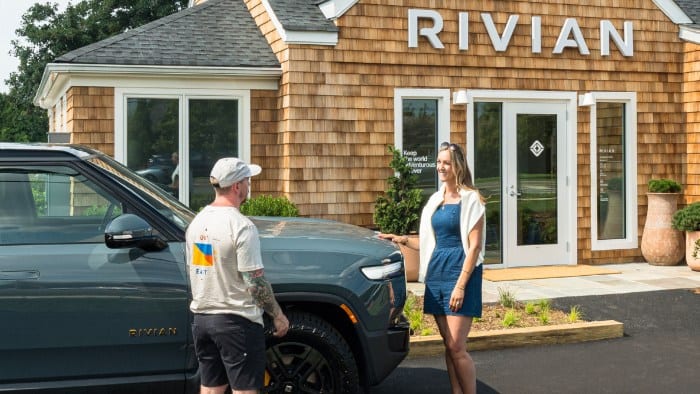
Rivian also lets visitors use it as a free place to work.
“Each of our spaces is designed to become part of the local community,” Tony Caravano, then Rivian’s head of community engagement, told local outlet Gazetteer SF at the opening.
“You come in with a laptop, and you work for three hours,” Chief Executive Officer RJ Scaringe told The San Francisco Standard last year, saying the aim was to avoid “a high-pressure sales situation”.
From Palo Alto to the City
Last year’s Autonomy & AI Day was held on December 11 at Rivian’s offices in Palo Alto.
There the company introduced its in-house Rivian Autonomy Processor, a new driving model and Universal Hands-Free, and priced its Autonomy+ package at $2,500 or $49.99 a month.
Rivian shares fell more than 6% that day.
The invitation does not say where the demonstrations will take place or whether any will be on public roads.
What Rivian Has Signalled
Scaringe said in September that the event would be “an anchor point to then roll out some of these new features”.
He was describing point-to-point driving, a supervised system in which the driver enters a destination and the vehicle handles the route.
“Your hands are off the wheel, but your eyes are still on the road most of the time,” he said at a Morgan Stanley conference on September 15.
Rivian’s own roadmap, published on August 14, is more measured.
“A limited rollout begins later this year, with a widespread customer rollout targeted for 2027,” it says of point-to-point.
Scaringe had said in June that the feature would be “very similar to Tesla’s FSD” and would reach all second-generation vehicles and the R2.
“We’re very much on track there for initial rollout towards the end of this year,” James Philbin, Senior Vice President of Autonomy and AI, said at an Evercore ISI conference on September 29.
He said the first version would go to early adopter customers, with the full Autonomy+ fleet following next year.
Rivian’s website still lists two other features, Auto Parking and On-Ramp to Off-Ramp, as coming in 2026.
Its current hands-free system does not stop or slow for traffic lights or stop signs, according to the same page.
The invitation does not mention point-to-point or any specific feature.
It has also said the first R2 vehicles with LiDAR will go to employees this year and to customers in 2027.
SF and the Robotaxi Plan
San Francisco is also central to Rivian’s driverless plans. The EV maker has test fleets operating in San Francisco, Chicago and Miami, Philbin said at the Evercore conference.
Under an agreement announced in March, Uber or its fleet partners are expected to purchase 10,000 fully autonomous R2 robotaxis, with service planned to begin in San Francisco and Miami in 2028.
Uber’s investment of up to $1.25 billion is tied to milestones.
Rivian still expects to unlock a second tranche of $250 million in the fourth quarter by “achieving certain technical milestones”, Vice President of Investor Relations Chip Newcom said at the same event.
Neither executive linked those milestones to the December event.
Philbin said a robotaxi is likely to come before driverless capability in customer-owned vehicles, “just because it will have more operational constraints”.
Eyes-off driving for owners also depends on regulation, which he called “a complete patchwork” across US states.