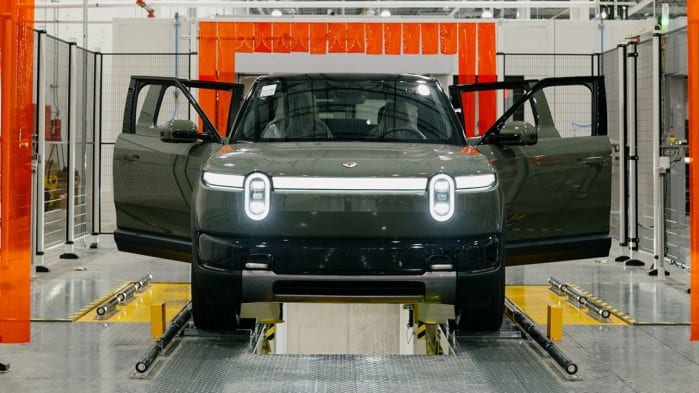
Rivian will fit its first R2 SUVs with LiDAR and its in-house autonomy computer for employees at the end of this year and will start rolling them out to customers only in 2027, Vice President of Investor Relations Chip Newcom said on Tuesday.
“For employees, the plan is to start rolling out [RAP1], so our third-generation computer plus the LiDAR to go into the vehicle later this year for employees and then start rolling that out to customers next year,” Newcom said at Evercore ISI’s ADAS, AV & AI Forum in New York.
It was the first time a Rivian executive has split the end-2026 date for the hardware between staff and paying customers.
Rivian did not say whether it had always meant the late-2026 date to cover employee vehicles only.
A Date With No Split
Rivian first set the timeline at its Autonomy and AI Day on December 11, 2025.
“Starting in late 2026, our Gen 3 autonomy platform will include 65 megapixels of cameras, a robust radar array, and a front-facing long-range LiDAR,” founder and Chief Executive Officer RJ Scaringe said at the event.
In March, Scaringe said the R2 would ship with LiDAR “late this year,” in an interview with Matthew Berman.
“At the end of 2026, we are targeting the launch of our third-generation autonomy hardware. This includes RAP1, our first in-house design silicon, and the addition of LiDAR,” he said on the July 30 earnings call.
Senior VP of Electrical Hardware Vidya Rajagopalan said on September 8 that the third-generation hardware remained on schedule for late 2026.
A week later, Scaringe said Rivian would “soon” launch a LiDAR sensor that turns every equipped vehicle into part of a ground-truth data fleet.
None of those statements said whether the first units would go to staff or to buyers.
Rivian followed the same sequence with the R2 itself.
Chief Software Officer Wassym Bensaid said in March that employees would have the first R2s “for a few months” before the first customer handovers at the end of spring.
Customer deliveries began in June.
Timing language on the R2 has been contested before.
In July, Rivian told EV its R2 Premium trim remained on track for late 2026 after comments on the earnings call pointed to early 2027, saying “available” covered the start of customer orders and initial deliveries.
R2 Gets the Chip First
Newcom was answering a question about initial production capacity for RAP1 and whether Rivian would supply the chip to others.
“Right now, the priority for [RAP1] is going to be going into the R2,” he said.
The LiDAR will add cost to each vehicle, and that cost will sit in automotive cost of goods sold rather than being offset through Autonomy+ pricing, Newcom said.
“The cost of LiDARs has come down significantly. You are talking on the order of a few hundred dollars, versus if you went back several years ago, where it was thousands or even tens of thousands of dollars,” he said.
Moving to its own silicon means Rivian is “no longer paying away that margin to our silicon provider,” he added.
Rajagopalan said in September that the third-generation hardware will come in several performance points, with the lower one cheaper than the current second-generation hardware.
Rivian designs the TPU-like parts of RAP1 in-house and owns that intellectual property, while partners provide other IP on the chip, Senior Vice President of Autonomy and AI James Philbin said on Tuesday.
Launch Buyers Keep Gen 2
The R2s delivered since June carry Rivian’s second-generation autonomy hardware, without LiDAR.
Scaringe said on the fourth-quarter 2025 earnings call that hardware upgrades are not planned for Launch Edition vehicles, EV reported.
Everyone buying an R2 with the Launch Edition package gets Autonomy+ as part of the purchase, Newcom said on Tuesday.
Autonomy+ otherwise costs $2,500 as a one-time purchase or $49.99 a month.
Philbin said point-to-point driving, Rivian’s next assisted-driving step, would not depend on the new hardware.
“We will begin the rollout of point-to-point at the end of the year to probably our early adopter customers, and then we will continue that rollout into next year, with the aim of having it rolled out to the full Autonomy+ customer fleet a little later next year,” he said.
The first release will cover “the whole R1 Gen 2 and R2” fleets, he said.
That matches the timeline Rivian published in August of a limited rollout this year and a widespread one in 2027.
Some features, such as driving in parking lots, will probably be outside the first version and added later, Philbin said.
“What the RAP1 chip and LiDAR enable is really functionality at a later date. The eyes-off functionality we’ve talked of for later,” Rajagopalan said in September.
Scaringe has targeted eyes-off driving for 2027 and said in June that it will require later hardware, according to WIRED.
Philbin said on Tuesday that regulation is one of three hurdles for eyes-off driving, alongside model performance and validation.
“Currently, it is a complete patchwork in the U.S., so a lot of states view eyes off essentially in the same bucket as L4,” he said.
In some states there is no pathway at present, he said, naming New York.
Why LiDAR
Philbin said a camera-only system matching human perception would not be enough for widespread autonomy.
“We think that the societal bar will almost certainly be better than human level for widespread autonomy,” he said.
“When we have radars with cameras, it actually makes the system that much better. When we add LiDAR, it makes it better again.”
Rivian has never named its LiDAR supplier.
EV reported in January that the evidence pointed to China’s RoboSense, and Rivian denied that RoboSense is the R2 supplier in March without naming an alternative.
Washington has been reviewing the security of Chinese-made LiDAR sensors.
Robotaxi Timetable Unchanged
The R2 is also the base for Rivian’s robotaxi program with Uber, which agreed in March to invest up to $1.25 billion and expects to buy 10,000 fully autonomous R2s in a first phase.
“Our expectation remains that we’ll be able to unlock the second trigger for the $250 million investment here in the fourth quarter,” Newcom said.
Uber would need Rivian to reach an L4-capable service before buying the first 10,000 vehicles, and the goal is to have the service available by late 2028, he said.
Philbin said the robotaxi would likely come before personal Level 4 driving, with one “relatively close in time to the other.”
Rivian has not said what share of R2 production will carry LiDAR in 2027, whether it will be standard or optional, or how much it will add to the price.
Scaringe has said Rivian will hold a second Autonomy and AI Day near the end of the year.