
Rivian has received a $1 billion, 10-year loan from Volkswagen Group at a fixed rate of 6.03%, secured by its half of the EV maker’s software joint venture, a regulatory filing showed on Wednesday.
The funding is the largest remaining payment under a partnership worth up to $5.8 billion and leaves $460 million still to come.
Shares of the US EV maker were trading slightly lower at $14.32 after the 8-K filing, below the $14.34 close.
The loan is non-recourse to Rivian Automotive and is not guaranteed by the company, according to the filing with the US Securities and Exchange Commission (SEC).
“The sole recourse for any event of default under the Loan B Agreement is to the collateral, and the Company does not have any liability thereunder,” the electric vehicle maker said.
Rivian said it intends to use the proceeds for general corporate purposes.
A Two-Step Structure
The money did not pass directly from Volkswagen to Rivian.
A Volkswagen entity, Volkswagen Specter LLC, lent $1 billion to the joint venture, Rivian and Volkswagen Group Technologies, at a fixed rate of 5.93%.
The joint venture then lent the same amount to Rivian JV SPC, a wholly owned Rivian subsidiary, at 6.03%.
That subsidiary distributed the proceeds to its parent.
Both loans were funded on October 7 and mature on October 7, 2036. The loan to the joint venture is secured by all of the venture’s assets.
The loan to Rivian’s subsidiary is secured only by the subsidiary’s 50% equity interest in the venture.
The difference between the two rates is 0.10 percentage points, according to EV calculations.
Rivian said payments made by its subsidiary are expected to be used by the joint venture to service the Volkswagen loan and for general corporate purposes.
No Cash Payments for 2 Years
Interest is payable twice a year, with the first payment due on the second anniversary of the funding date.
At 6.03%, interest on the full $1 billion amounts to about $60.3 million a year, EV calculations show.
Principal repayments begin on the third anniversary, at $100 million a year in two installments of $50 million.
The remaining balance is due at maturity.
Rivian’s subsidiary can prepay its loan without penalty, in which case the joint venture must prepay the Volkswagen loan by the same amount.
The loan carries covenants that Rivian said are generally consistent with those in its senior secured asset-based revolving credit facility.
The loan agreements were signed in November 2024, when the joint venture was formed, and allowed a single draw between October 1 and October 30 this year.
What Volkswagen Has Paid
Volkswagen committed up to $5.8 billion to Rivian and the joint venture.
It has now paid about $5.3 billion of that, according to EV calculations based on Rivian’s filings.
The payments began with a $1 billion convertible note in June 2024.
Volkswagen paid a further $1.295 billion when the venture was formed in November 2024, which Rivian records as consideration for a license to its technology.
The companies said at the time that about $1.3 billion covered intellectual property licenses and Volkswagen’s 50% stake in the venture.
A $1 billion equity investment followed in June 2025, and another $1 billion in April after the venture completed winter testing of Volkswagen Group vehicles.
Chief Financial Officer Claire McDonough said earlier this year that Rivian expected $2 billion from Volkswagen in 2026, split between that equity investment and the loan.
The final $460 million is due at the earlier of the start of production of the first Volkswagen Group vehicle using the venture’s technology or January 3, 2028, according to Rivian’s quarterly report.
It consists of $250 million of Rivian shares and a $210 million payment.
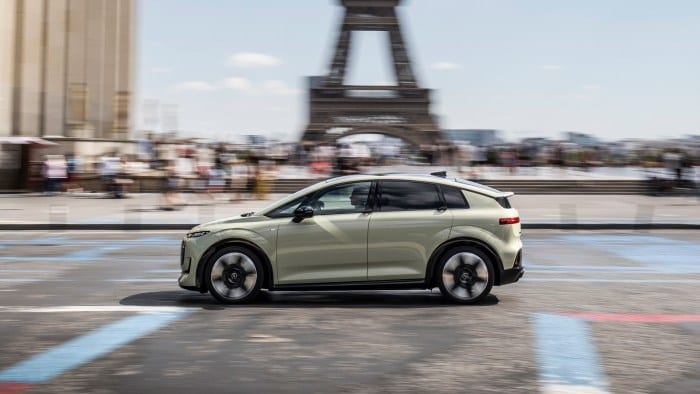
Volkswagen has said the ID.EVERY1 city car, planned for 2027, will be its first model with the architecture.
Shareholder and Customer
Volkswagen became Rivian’s largest shareholder in May, with 15.9% after the April investment.
Rivian has since issued 86.25 million new shares in a July public offering, which reduced the percentage held by existing shareholders.
The venture began operating in November 2024 and had more than 1,500 employees a year later, according to Volkswagen.
Its technology went into production with Rivian’s R2, deliveries of which began in June.
The joint venture is also Rivian’s largest source of software revenue.
It accounted for $308 million of the $515 million in software and services revenue that Rivian reported for the second quarter.
Rivian had $1.45 billion of deferred revenue from Volkswagen at the end of June, which it expects to recognize through about mid-2028.
Pledging its half of the venture puts that stake behind the loan.
Cash Position
Rivian ended June with $5.31 billion in cash, cash equivalents and short-term investments.
The July share sale added about $1.32 billion in net proceeds.
The company has guided for an adjusted loss before interest, taxes, depreciation and amortization of $1.8 billion to $2.0 billion this year, and for capital spending of $1.7 billion to $1.8 billion.
It expects to deliver 65,000 to 70,000 vehicles.
Rivian has also said it expects a $250 million equity investment from Uber this year, subject to conditions.
Separately, a senior director at the joint venture said on Wednesday he had left for General Motors, in a post on LinkedIn.