
Nio is pitching its cars to companies in China with a tax guide that puts the corporate income tax deduction on its ET9 flagship sedan at up to 169,900 yuan ($25,300), as the Shanghai-based EV maker looks for buyers in the final quarter of the year.
The poster, titled “How much can a company save by buying a Nio? The 2026 tax deduction plan in one chart”, lists three tax items for nine Nio-brand models for “corporate users” that buy before the last day of 2026.
It was shared on Weibo on Sunday morning by a user named ‘NIO蔚来FL戴胜张’. FL stands for Fellow, the title Nio gives its frontline sales advisers.
Three Tax Items
The chart shows, for each model, the starting price, the maximum value-added tax (VAT) a company can deduct, the maximum corporate income tax it can deduct and the vehicle purchase tax it saves.
The ET5 sedan and ET5 Touring wagon start at 298,000 yuan ($44,500), with up to 34,300 yuan ($5,200) in deductible VAT, 65,900 yuan ($9,800) in deductible corporate income tax and 13,200 yuan ($2,000) in purchase tax savings.
The entry level SUV ES6 (marketed as EL6 in Europe) starts at 338,000 yuan ($50,500), with figures of 38,900 yuan, 74,800 yuan and 14,900 yuan.
Deliveries of the model plunged by about 66% year on year in August to 992 units, CPCA data showed.
The EC6 coupe SUV starts at 358,000 yuan ($53,400), with 41,200 yuan, 79,200 yuan and 15,000 yuan. In August, the brand delivered 322 EC6 units, according to CPCA data, marking year over year decline of approximately 72%.
The ES8 is listed from 382,800 yuan ($57,100), the price of its five-seat version, with 44,000 yuan, 84,700 yuan and 15,000 yuan.
The ET7 sedan starts at 428,000 yuan ($63,800), with 49,200 yuan, 94,700 yuan and 15,000 yuan, and the EC7 at 458,000 yuan ($68,300), with 52,700 yuan, 101,300 yuan and 15,000 yuan.
The ES9 flagship SUV, launched earlier this year, starts at 498,000 yuan ($74,500), with 57,300 yuan, 110,200 yuan and 15,000 yuan.
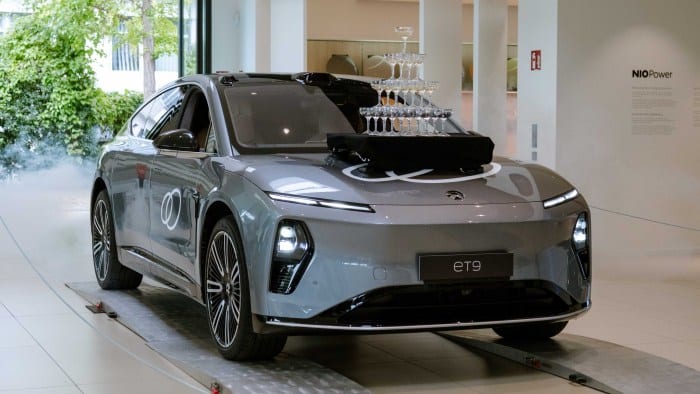
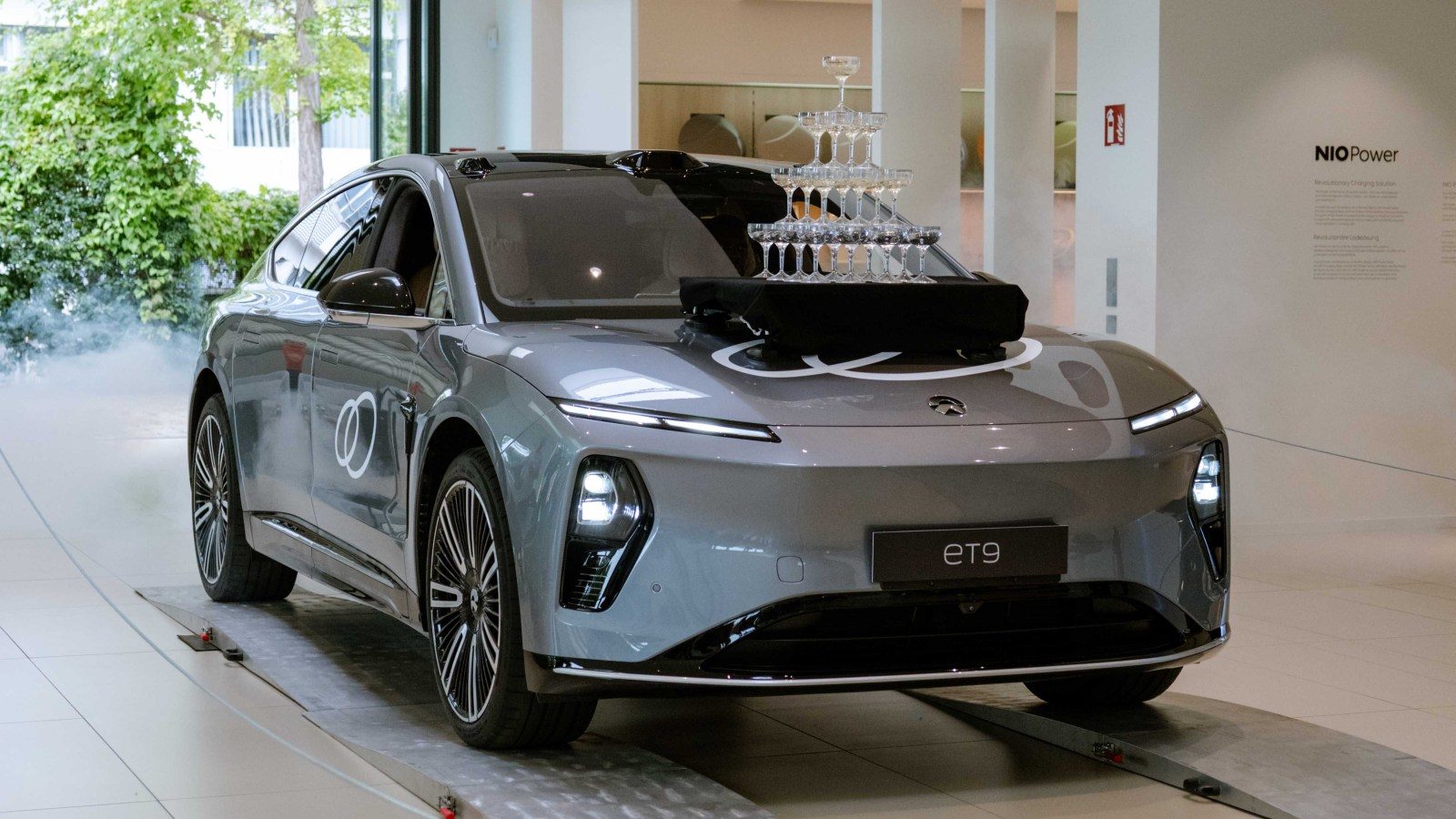
The ET9 starts at 768,000 yuan ($114,800), with 88,400 yuan ($13,200) in deductible VAT, 169,900 yuan in deductible corporate income tax and 15,000 yuan ($2,200) in purchase tax savings.
The prices are for buying the car outright with its battery, not for Nio’s battery-as-a-service (BaaS) rental plan, which lowers the purchase price.
How the Numbers Are Built
Every figure on the poster matches the formulas in its footnotes, with one small rounding difference, EV’s recalculation shows.
The VAT figure is the price divided by 1.13 and multiplied by 13%, the VAT a company that is a general VAT taxpayer can reclaim when it holds the unified motor vehicle sales invoice, according to the first footnote.
The corporate income tax figure is 25% of the price excluding VAT, the amount a company can deduct if it books the car as a fixed asset and writes it off in one year under accelerated depreciation, the second footnote says.
That one-year write-off comes from a national rule that lets companies deduct equipment worth up to 5 million yuan bought between 2024 and the end of 2027 in a single year, according to the policy text.
The purchase tax figure is half the 10% tax on the price excluding VAT, capped at 15,000 yuan a vehicle, reflecting the halving of the tax on new energy vehicles bought in 2026 and 2027 under a 2023 joint announcement by China’s finance ministry, tax authority and industry ministry.
That cap binds for every model priced above 339,000 yuan, so the saving is the same 15,000 yuan for the EC6 as for the ET9.
To qualify, a model must meet technical requirements for new energy vehicles set by the industry ministry with the finance ministry and tax authority, the announcement says.
The ES6 figure of 14,900 yuan appears to be truncated rather than rounded, as the formula gives 14,956 yuan.
What the Chart Does Not Say
The poster does not add the three columns together, and they are not equivalent savings. Reclaimed VAT lowers the company’s cost of the car, and the purchase tax saving is a tax not paid.
The corporate income tax figure is largely a question of timing, because a company that does not take the one-year write-off still deducts the car’s cost through depreciation over at least four years, the minimum period for vehicles under China’s corporate income tax rules.
The deduction is only worth anything to a company with taxable profit to offset.
The 25% figure also assumes the standard corporate income tax rate.
Small low-profit enterprises pay an effective 5% under a policy that runs until the end of 2027, according to the finance ministry and tax authority, which would reduce the ET5’s deduction to about 13,200 yuan ($2,000).
Companies that are small-scale VAT taxpayers rather than general taxpayers cannot reclaim input VAT.
The poster also sets a deadline of December 31, 2026, though the purchase tax halving and the one-year write-off both run until the end of 2027.
A Push for Volume
The pitch comes as Nio tries to lift sales of its older models.
The Nio brand delivered 21,318 vehicles in September, up 55.3% from a year earlier and 0.7% from August, but below its 2026 monthly high of 21,908 in June, according to the company.
It delivered 62,500 in the third quarter, up 69.2%, and 181,988 in the first nine months, up 63.4%.
Two of the nine models on the poster account for most of the brand’s sales.
The ES8 delivered 10,542 vehicles in September, 49.5% of the brand’s total.
The ES9 recorded 6,474 retail sales in August, its latest monthly figure from the China Passenger Car Association (CPCA).
The older models have slowed, with the EC6 selling 322 units in August, down 71.9% from a year earlier, according to the CPCA.
Nio has added special editions and design packages to several of its models in recent weeks, including an EC6 Aura Edition launched on September 22, to draw attention to models whose sales have fallen sharply.
The Nio brand has not announced a new model for the rest of 2026.
Its next models will come from the cheaper 5 and 6 series in 2027, Founder and Chief Executive Officer William Li said on September 1.
The tax pitch covers almost all of the brand’s market.
The Nio brand exported 306 vehicles in the first eight months of 2026, according to CPCA data, about 0.2% of its 160,670 deliveries in that period, by EV’s calculation.
China’s purchase tax exemption for new energy vehicles, capped at 30,000 yuan a vehicle in 2024 and 2025, was halved from January 1 with a lower cap of 15,000 yuan.
Li said in August 2025 that Nio would cover the purchase tax benefit for buyers who locked in orders that year.
The ES8, which Nio relaunched in September 2025, reached its 150,000th delivery in a year.