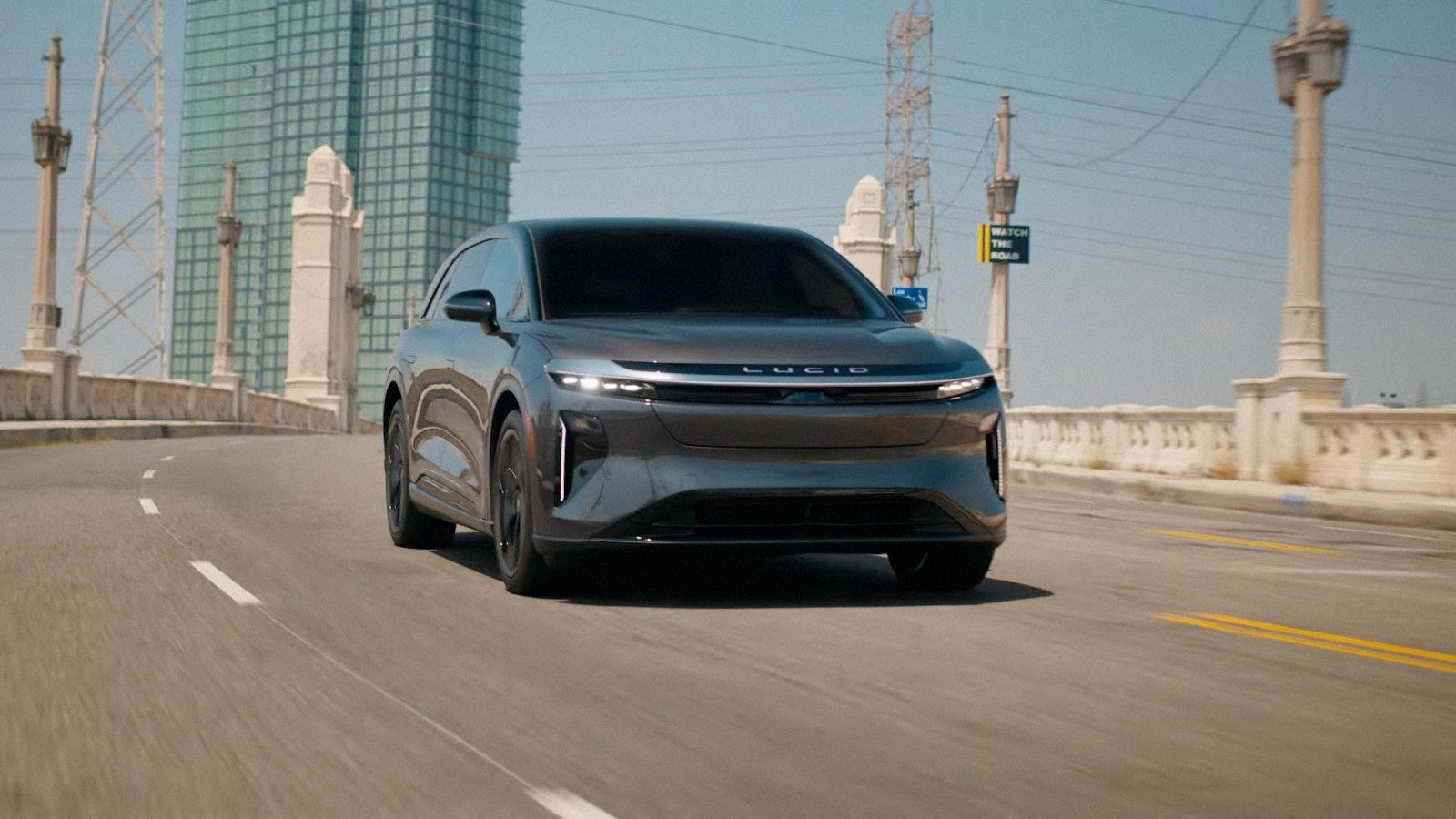

Lucid would need to more than double its delivery pace in the second half of the year to reach the 22,295 vehicles Cantor Fitzgerald models for 2026, according to EV calculations on estimates contained in a note first obtained by the Wall Street research note archive PriceTarget.
Analyst Andres Sheppard cut the full-year estimate from 23,185 vehicles, writing “we want to remain conservative” — with the total “led by Gravity,” in his words.
In a new client note sent a day before the second-quarter earnings report, the analyst kept a Neutral rating and an $8 price target on a stock that closed Friday at $7.38.
As of publication time, shares were edging 0.14% higher at $7.39 during Monday’s pre-market session.
The arithmetic behind the number is demanding, per calculations by EV.
Lucid delivered 3,093 vehicles in the first quarter and 3,953 in the second, a first-half total of 7,046.
Reaching Cantor’s estimate therefore requires 15,249 deliveries across the final six months — 2.2 times the first-half volume, or an average of roughly 7,600 vehicles a quarter.
The note itself does not spell out the half-on-half implication.
A Step-Up Lucid Has Never Produced
No half in the company’s history approaches that acceleration, an EV analysis of Lucid’s delivery record shows.
In 2025, Lucid delivered 6,418 vehicles in the first half and 9,423 in the second — a step-up of 1.5 times, its best to date — on the way to a full-year 15,841.
Cantor’s estimate implies half again as much seasonal acceleration as the company has ever achieved, in a year when the second AMP-1 production shift has been eliminated and the Air is running at multi-year demand lows.
Set against prior years, the estimate also extends a growth slowdown. Deliveries rose 70.7% in 2024, to 10,241 from 6,001, and 54.7% in 2025. Cantor’s 22,295 works out to 40.7% growth — a third consecutive year of deceleration, per EV calculations, arriving in the year the Gravity reached full availability and the midsize platform is scheduled to launch.
The figure also sits 2,705 vehicles below the floor of Lucid’s own suspended production guidance of 25,000 to 27,000, and Sheppard writes that Cantor will “look for an updated production target on the Q2 call.”
The company had also guided full-year capital expenditure of $1.2 billion to $1.4 billion before new management pulled the outlook.
One further implication follows from the timeline Cantor itself lays out: with the midsize “currently on-track for 2H26” in the bank’s assessment, any launch adds token volume inside the year, leaving the Gravity — and an Air in decline — to carry the near-doubling the estimate requires.
What Cantor Expects on Tuesday
The 3,953 second-quarter deliveries already fell short of the Visible Alpha consensus of 4,618 units, Sheppard notes, though they rose 19.5% from 3,309 a year earlier. Production of 4,774 landed in line with Cantor’s 4,689 estimate.
For the print, the Visible Alpha consensus expects revenue of about $404.2 million, a GAAP gross margin of negative 59.5%, adjusted EBITDA of roughly negative $690.8 million, a net loss near $889.2 million and a non-GAAP diluted loss of $2.25 per share.
Cantor sits below the Street on the top line. Sheppard models revenue of about $346.7 million — cut from a prior $454.3 million after the delivery pre-announcement — alongside a gross margin of roughly negative 75%, a narrower per-share loss of $1.74 and free cash flow of about negative $981 million, against the consensus expectation of roughly negative $854 million.
Cantor’s full-year revenue estimate falls to $1,956.4 million from $2,035.8 million with the delivery cut.
On the call, the analyst expects to hear “new management’s strategy towards accelerating Lucid’s path to profitability” along with its restructuring plans.
The report will be the first under chief executive Silvio Napoli, who arrived from Schindler Group in June, and the last with Taoufiq Boussaid as CFO before Alexander De Bock, most recently CFO of TI Automotive, takes over following the transition.
The Trail the Estimates Sit On
The projections land against a first quarter that missed on every headline line.
Revenue of $282.5 million grew 20.2% year over year but fell 21% short of consensus, while the $3.46 loss per share missed by 31% — extending a record of seven earnings misses in the past nine quarters. February handovers were disrupted by a seat-supplier defect that forced a 29-day halt to Gravity deliveries — first reported by EV — resolved during the quarter.
Gross margin deteriorated to negative 110.4% from negative 80.7% in the fourth quarter, weighed by more than $200 million of inventory impairments against an inventory balance near $1.47 billion.
Operating expenses ran about $678 million, split between $336 million of research and development and $304 million of selling, general and administrative costs, taking the net loss to roughly $1.1 billion.
The cash consumption shows most starkly in the liquidity sequence Cantor traces: total liquidity fell from about $4.6 billion at the end of 2025 to $3.2 billion at the end of March — roughly $1.4 billion consumed in a single quarter — with cash and equivalents near $700 million before the subsequent raise.
Against the year-ago base of 3,309 deliveries and roughly $260 million of revenue implied by the consensus growth rate — a derivation by EV, not a figure in the note — the consensus for Tuesday would represent Lucid’s fastest top-line growth in years, a mix effect from the Gravity rather than volume.
The consensus margin of negative 59.5% would mark a roughly 51-point sequential improvement from the impairment-laden first quarter.
Alwaleed Stake Read as a PIF Signal
Sheppard highlights a filing from last week disclosing that Saudi Prince Alwaleed has taken a roughly 5% ownership stake in Lucid — a disclosure that sent the shares up about 22% on the day against a roughly flat S&P 500.
The stake “more importantly reaffirms the PIF’s commitment to the company, in our view,” the analyst writes.
Saudi Arabia’s Public Investment Fund remains Lucid’s largest holder with a roughly 45% stake, according to Bloomberg data cited in the note, and the company holds an agreement with the Saudi government to deliver 50,000 vehicles, with an option for 50,000 more — deliveries Sheppard expects the midsize to dominate, followed by the Gravity.
The note lands three weeks after EV exclusively reported that Lucid was weighing going private or a Chapter 11 filing as an adviser reported to the board — a sequence that halted the shares three times as they crashed more than 51% to a record low. Sheppard recalls that Lucid denied the claims in a filing as “completely false,” adding it has “sufficient liquidity to carry its operations well into next year” — the company’s formal response that also confirmed its work with AlixPartners, before shares jumped over 27% as Napoli personally rejected the claims.
Cantor’s liquidity accounting: the first-quarter $3.2 billion included a $2.0 billion unsecured delayed-draw term loan, a $468 million asset-backed revolving credit facility and a $2 million Gulf International Bank facility.
The subsequent $1.05 billion raise — $550 million in convertible preferred from PIF affiliate Ayar Third Investment Company, $200 million from Uber and a $300 million registered offering — lifts pro forma liquidity to about $4.7 billion, which management has affirmed is sufficient to fund the company “well into next year,” per the note.
Lucid announced on July 6 that it drew $800 million on the term loan facility.
The Midsize Carries the Out-Years
The delivery model’s real weight sits beyond 2026.
Sheppard frames the midsize launch as “the most material catalyst” for the stock, with the platform spanning three models — the Cosmos, the Earth and a third yet to be disclosed — targeting a starting price below $50,000, which the analyst says Cantor finds “encouraging.”
The cost architecture draws his strongest language.
Lucid is targeting up to 70% lower unit cost from the platform, which he calls “perhaps an underappreciated aspect” of the midsize preview — “yet material, in our view” — with the vehicles expected to carry between half and two-thirds fewer components than the Gravity, and the Cosmos and Earth sharing about 95% of their parts.
By 2028, the note adds, Lucid targets the midsize at roughly 75% of total deliveries — the inversion of a delivery base the Gravity leads today.
On Tuesday’s call the bank looks for an updated midsize start-of-production timeline, delivery expectations, a status report on the AMP-2 plant in Saudi Arabia — whose completion Cantor places between the fourth quarter of 2026 and the first half of 2027 — and the new management’s strategy roadmap.
Catalysts and Valuation
“We expect several potential material catalysts over the next twelve months,” Sheppard writes, running through the robotaxi launch with Uber and Nuro in the fourth quarter, hands-free highway and city driving in the second half, the AMP-2 completion, the midsize launch at the end of 2026 or early 2027, and a DreamDrive Pro autonomy subscription in the first half of 2027.
The Uber robotaxi partnership has expanded to more than 35,000 vehicles from a prior 20,000, starting with the Gravity, and the companies “remain on track for commercial robotaxi launch in late 2026,” per the analyst.
Lucid reports second-quarter results on Tuesday, August 4, with the call at 5:30 p.m. ET.