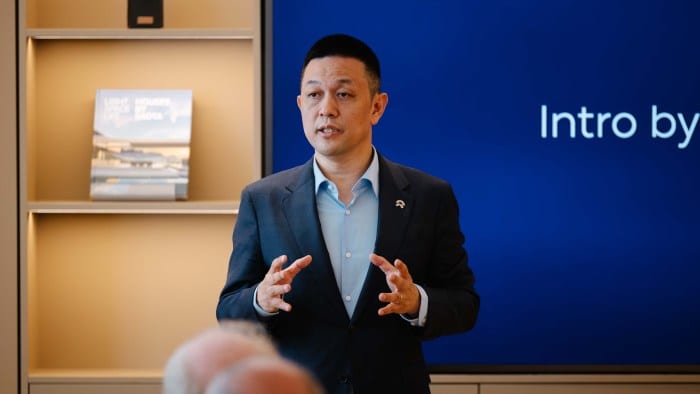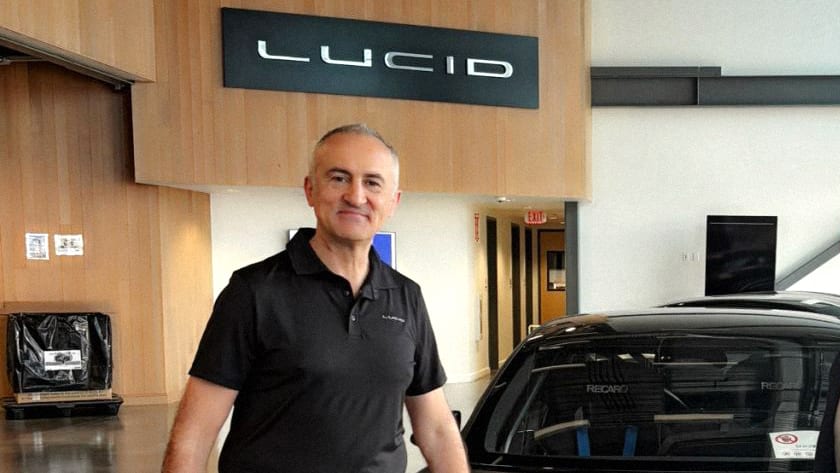

The question Lucid‘s shareholders most want answered on Tuesday is whether their company is stable — and they will put it, with 307 votes and 245,100 shares behind it, directly to a chief executive taking his first earnings call, seated beside a finance chief taking his last.
The board that decides what Silvio Napoli and Taoufiq Boussaid are asked closes at 5:30 p.m. ET on Monday, exactly 24 hours before the call, locking in a final docket of 144 questions from 605 participants representing over half a million shares.
Companies using the ‘Say Technologies’ platform — the same system Tesla deployed at its own earnings call last month, and one Lucid has used before — do not commit to answer the most-voted questions, and management may skip any it chooses.
The Question That Leads Everything
The top question, from the retail holder identified as John R., carries 307 votes representing 245,100 shares — the largest backing on the board by both measures, and more votes than the second and third questions hold individually by wide margins.
“Thanks for stepping in as a legit CEO, Mr. Napoli,” writes the retail holder identified as John R., asking how confident the team is in “bringing Lucid Motors to a stable company” — and what message Napoli would deliver to people who love and remain loyal to the brand.
Napoli was named permanent chief executive in April after a 14-month search that began when founder Peter Rawlinson transitioned to a new role within the Saudi-backed EV maker, and formally assumed the role on June 1 following a work-authorization wait.
Chief Operating Officer Marc Winterhoff served as interim CEO through the search, returned to the COO role under Napoli, and was recently ousted, as exclusively reported by EV and confirmed by Lucid hours later, with the COO role eliminated in the new chief executive’s flattened structure.
On July 14, EV exclusively reported that restructuring adviser AlixPartners had outlined scenarios to the board including a take-private deal or Chapter 11.
The shares plunged as much as 57% intraday, were halted three times for volatility, and closed 16.2% lower at a then-record $4.62.
Lucid called the report “completely false” in a statement to EV from Chief Communications Officer Nick Twork — confirming for the first time on the record that AlixPartners is working with the company, assisting with execution and operations only, with no bankruptcy recommendation made.
AlixPartners followed with its own statement days later.
The stock jumped over 27% as Napoli personally rejected the claims and nearly tripled from the crash low inside a week, with Napoli promising a full update on the August 4 call — making Tuesday the stock’s next real test by the chief executive’s own framing.
“We work with outside advisors to improve operational performance and execution,” Napoli wrote on LinkedIn. “They are not advising Lucid on a take-private transaction or bankruptcy, and any suggestion that they have recommended either course of action to management or the Board is false.”
Ranked second, with 195 votes and 201,700 shares, is the question of how the restructuring of expenses, manufacturing and software is progressing under the new leadership.
(Only) a Carmaker
The third-ranked question asks whether Lucid is ready to become “more than just a car company” by branching into energy-storage systems — explicitly invoking Saudi Arabia’s 2030 goals — with 169 votes and 184,100 shares behind it.
A companion question on expanding beyond cars to maximize the technology advantage holds 121 votes, and a third, on actively selling drivetrain and battery technology to legacy and niche automakers while capitalizing on what the questioner calls a rich patent portfolio, carries 73.
Taken together, three of the ten most-supported questions ask management to make money from something other than selling Lucid-badged vehicles — a retail-investor verdict on the core business delivered before the quarter’s numbers are out.
The company’s one signed external program remains the Aston Martin technology partnership, valued above $450 million.
Meanwhile, the Uber and Nuro robotaxi partnership — now covering at least 35,000 vehicles, with production validation builds underway at the Arizona plant, launch-vehicle production due to begin early in the fourth quarter and commercial operation targeted for late 2026.
The Midsize and Software
Product questions cluster around the car that matters most and the code that frustrates most.
The midsize-unveil question — when the sub-$50,000 model will be officially revealed and how soon customers can order — carries 95 votes.
The reveal has been promised for this summer since March and remains unannounced as of publication, with production targeted by year-end.
A companion question invokes the Gravity’s glitch-marred unveiling to ask what different strategy the new SUV’s rollout will get, backed by 126 votes.
An Air Touring owner who says he loves driving the car daily asks, with 48 votes behind him, what the plan is to improve software quality — and whether the brand’s name can stop being tarnished by bugs.
The Financial Questions
The board’s financial questions read like an analyst’s model translated into plain English — one asking directly for the plan on profitability, factory utilization and cost of goods sold (74 votes), another for the top three actions to eliminate future dilution, cut operating expenses, lift margins and diversify revenue until the business is self-funding (83 votes, 63,600 shares).
Every theme maps to a figure in the company’s own first-quarter presentation. Revenue of $282.5 million, up 20%, on 3,093 deliveries against 5,500 produced.
A GAAP gross margin of negative 110%, a net loss of $1.03 billion, and free cash flow of negative $1.44 billion in the single quarter.
A balance sheet showing $714 million of cash and investments at March 31, with stockholders’ equity negative at minus $351.4 million.
Total liquidity of $3.2 billion — $4.7 billion pro forma for April’s $1.05 billion raise from Uber, a public offering and Saudi Arabia’s PIF, plus a $500 million credit-line increase — which the company says funds operations “well into 2027.”
The quarter since has added its own weight: 3,953 second-quarter deliveries against consensus near 4,618, a second $800 million draw this year on the Saudi-backed credit line this month, and zero-percent financing running across the lineup to move 2026 stock.
And one number the call must replace is the one that vanished: the 25,000-to-27,000 production guidance, suspended since May, with the updated outlook promised for Tuesday.
Voting continues until the 5:30 p.m. ET deadline.
A day later, Napoli opens his first call, and the CFO Boussaid closes his last.