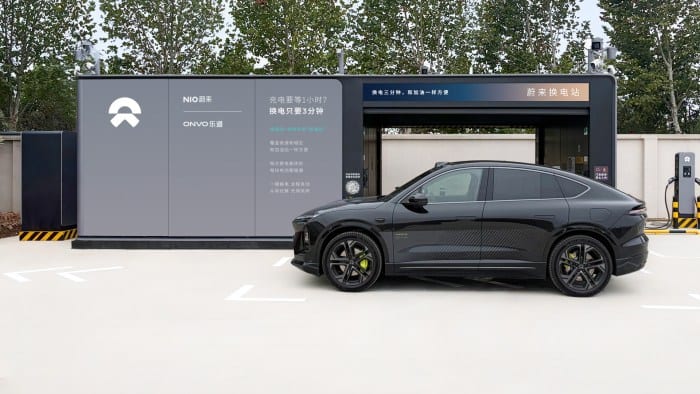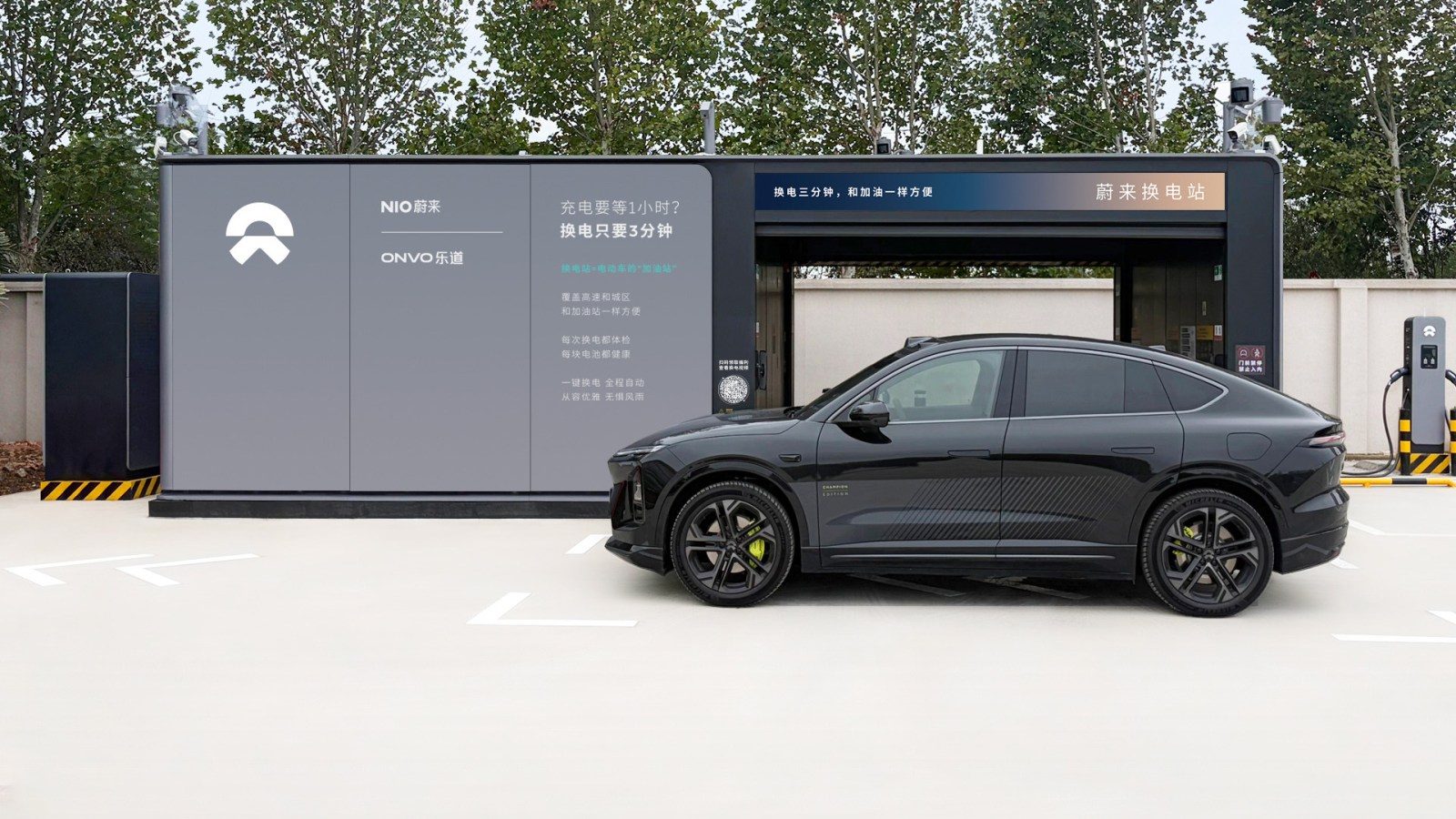

Nio completed 183,664 battery swaps on October 5, breaking the single-day record it had set four days earlier, as the Shanghai-headquartered EV maker ramps up the rollout of the fifth-generation stations across China.
The total is 195 swaps, or 0.1%, above the 183,469 recorded on October 1, the first day of China’s National Day holiday.
The new record equates to one car completing a swap every 0.47 seconds across the Nio, Onvo and Firefly brands, the company said in a post on Weibo.
“For long-distance driving, swapping is the first choice,” the company said, repeating the line it used for the earlier record.
The new figure is 4.4% above the 175,976 swaps of February 21, during the Lunar New Year holiday, and 7.7% above the 170,585 recorded on May 1.
All four of those peaks fell on national holidays, when owners drive long distances and rely on highway stations.
Busiest Stations
The busiest station on October 5 was again at the Rizhao service area on the G15 Shenyang–Haikou highway in Shandong province, with 188 swaps.
That is 23 fewer than the 211 the same station handled on October 1, even though the network total was higher.
The Dahuai service area on the G15 in Jiangmen, Guangdong, ranked second among highway stations with 176 swaps.
Two Jiangsu stations tied for third with 171 each, at the Jiangdu service area on the G2 Beijing–Shanghai highway and the Hongze Lake service area on the G25 Changchun–Shenzhen highway.
Nio also listed its busiest urban stations, led by sites in Shaoguan, Guangdong, and at a Sinopec fuel station in Shanghai, with 147 swaps each. A station in Yiwu, Zhejiang, followed with 143.
Across the network, the day’s total works out to about 44 swaps per station, the same average as on October 1.
Network at 4,165 Stations
Nio’s live network map showed 4,165 battery swap stations in China on Wednesday, of which 1,072 are on highways.
That is seven more swap stations, and two more highway stations, than the map showed on October 2.
The map showed 5,376 charging stations with 31,005 charging piles, for a total of 9,541 sites.
Cumulative swaps stood at 127,253,386, about 847,000 more than five days earlier.
Charging sessions reached 100,534,658, passing 100 million for the first time since EV’s previous reading of 99.9 million on October 2.
The swap count reached 100 million on February 6, so the network has added about 27.3 million swaps since then, an average of about 112,000 a day.
October 5’s total was 64% above that average.
Nio has also connected 1,772,345 third-party charging piles, and drivers of other brands account for 86.7% of the energy delivered by its own chargers, according to the map.
The company said its highway network links more than 550 cities and that a driver can reach every provincial-level region of mainland China using swap stations alone.
It again described battery swapping as “a mainstream solution” for recharging new energy vehicles in China and “an important driver” of its sales growth.
The record came during a holiday in which China’s highway chargers also delivered a record amount of electricity, according to the National Energy Administration.
Build Target Still Distant
Nio has added 489 swap stations this year, from 3,676 at the end of 2025, based on the map’s count.
Its target is to add 1,000 in 2026, which leaves 511 to open before the end of December.
That would take about 5.9 new stations a day through December 31, more than three times its pace in the first nine months.
Nio opened 19 stations on September 30, the eve of the holiday, and the map shows seven more since October 2.
The build-out is increasingly meant to be funded by partners.
Geely Holding Group agreed last month to take a 30% stake in Nio Power, the charging and swapping unit, in a deal valuing the business at about 16 billion yuan ($2.4 billion).
Nio is targeting 10,000 swap stations by 2030, which would require about 1,400 new stations a year, a pace it has never reached.
Its best year was 2023, when it added 1,011 stations.