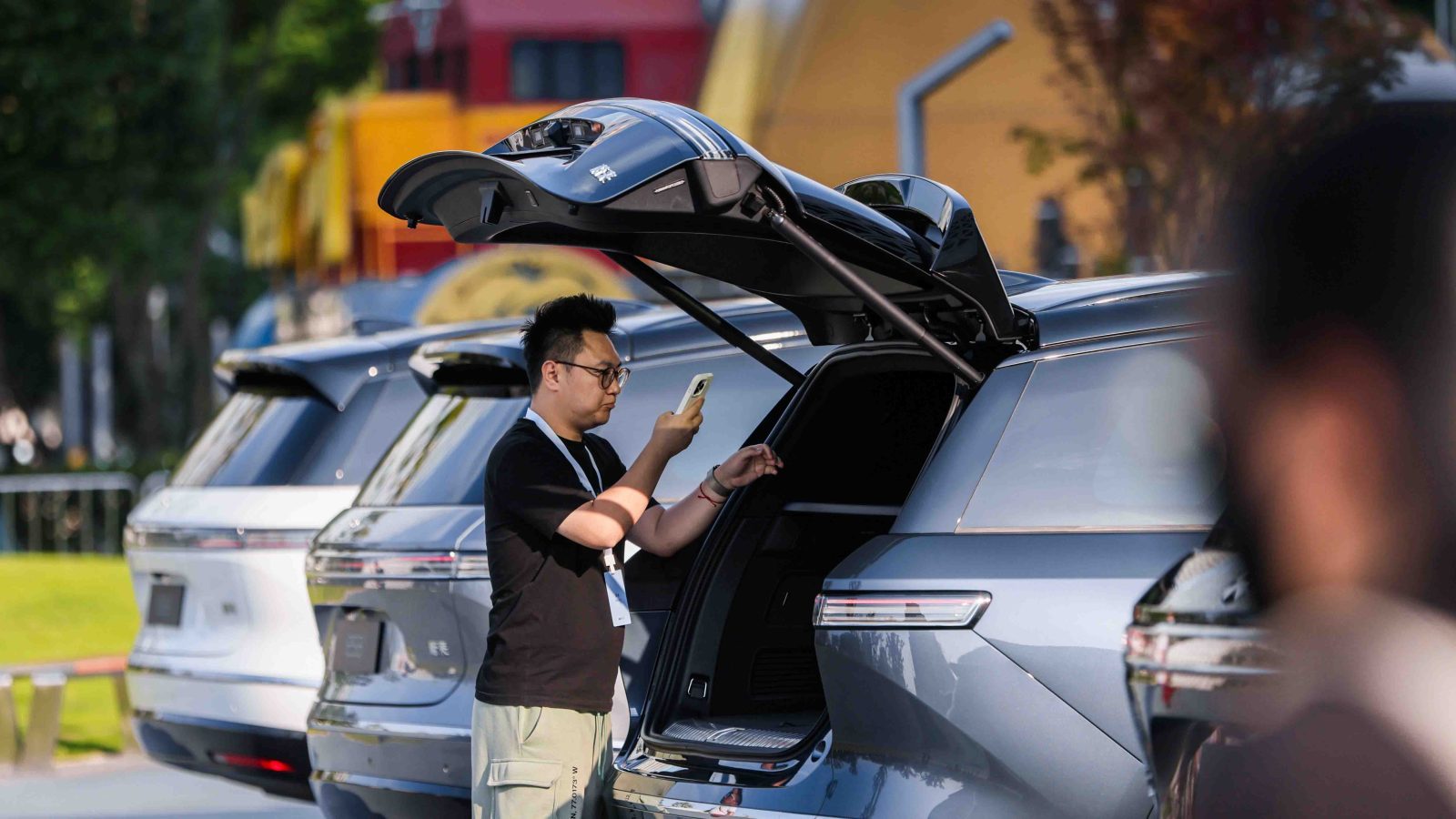

Nio delivered the 150,000th third-generation ES8 on Sunday, exactly one year after the large electric SUV went on sale, closing the model’s first twelve months at a pace that has held at approximately 10,000 a month since the summer.
Co-founder and President Qin Lihong handed the car to its owner in Beijing.
The Shanghai-headquartered brand said the ES8 ranks first in cumulative sales since launch in China’s large SUV market “regardless of energy type, price range or seat count,” and in the 400,000-yuan class “regardless of energy type, vehicle segment or body style,” calling it a sales record for a premium battery-electric model at that price.
“Thank you to 150,000 pioneers for choosing us and travelling with us,” Nio wrote on Weibo.
The Ladder
The third-generation ES8 launched on September 20, 2025, with deliveries from the following day, at 406,800 yuan ($60,700) with the battery or 298,800 yuan under Nio’s battery-leasing scheme.
The first 10,000 took 41 days, to October 31. The next 10,000 took 29 days, then 19, then 11, with the 40,000th car delivered on December 29 as year-end volume peaked. Nio has marked every 10,000-unit step since.
The 50,000th came on January 18, the 60,000th on January 31, and the 70,000th on February 27, the slowest interval of the winter at 27 days after production was disrupted in February.
The pace recovered through spring, with the 80,000th on March 20, the 90,000th on April 3 and the 100,000th on April 23, 215 days in, handed over by founder and Chief Executive Officer William Li the day before the Beijing show.
Since then the rhythm has been metronomic with 30 days between milestones.
The 110,000th on May 23, the 120,000th on June 22, the 130,000th on July 22, the 140,000th on August 21 at the Chengdu show and the 150,000th on September 20, each 30 days apart.
The Monthly Series
Nio’s monthly ES8 deliveries ran 2,812 in September 2025, 6,716 in October, 10,705 in November and 22,258 in December, the model’s peak month.
In 2026 the series reads 17,658 in January, 11,271 in February, 16,255 in March, 13,028 in April, 11,475 in May, 8,969 in June, 10,288 in July and 10,999 in August.
That is 99,943 for the first eight months, and 45,184 in the first quarter against group deliveries Nio had guided at 80,000 to 83,000.
June was the exception. Deliveries fell below 10,000 for the only month since November as buyers waited for the five-seat version, which launched on July 9 at 382,800 yuan ($57,100) and reached customers the next day, and as a 10,000-yuan purchase-tax subsidy introduced in March ran off.
The comparison with the outgoing car is stark. The second-generation ES8 sold 446 in January 2025 and 87 in August 2025, its last full month before the replacement.
What the Fleet Has Done
Nio used the anniversary to publish usage data from the 150,000 cars.
Owners have driven more than 500 million kilometres on the company’s assisted-driving systems, used automated parking more than 17 million times, opened the front trunk nearly 33 million times, triggered the all-round safety monitoring function 457,000 times and swapped batteries 1.84 million times.
Trade-ins account for half of buyers, and 41.7% of those came from luxury brands, according to a first-half brand study by Jielanlu that gave the ES8 a Net Promoter Score of 85.3, the highest of any fully electric model.
Very Important Model
The ES8 is the car behind the company’s first quarterly profit in the fourth quarter of 2025, and it has carried the Nio brand since. In June the brand’s average transaction price reached 443,000 yuan ($66,000), which Nio says put it above the traditional luxury marques in China.
The company’s broader claim is that the model tipped its segment. Battery-electric large three-row SUVs have outsold range-extended ones in every month since September 2025, and battery-electric penetration of the large SUV market reached 44% in August, up 23.1 points on a year earlier.
The dependency cuts both ways. The ES8 is about six in ten Nio-brand deliveries this year, which is why the five-seat variant arrived when it did, and why the ES9, launched in May at 498,000 yuan ($74,200), sits above it.
Li told the second-quarter call on September 1 that the 150,000th car would come in September.