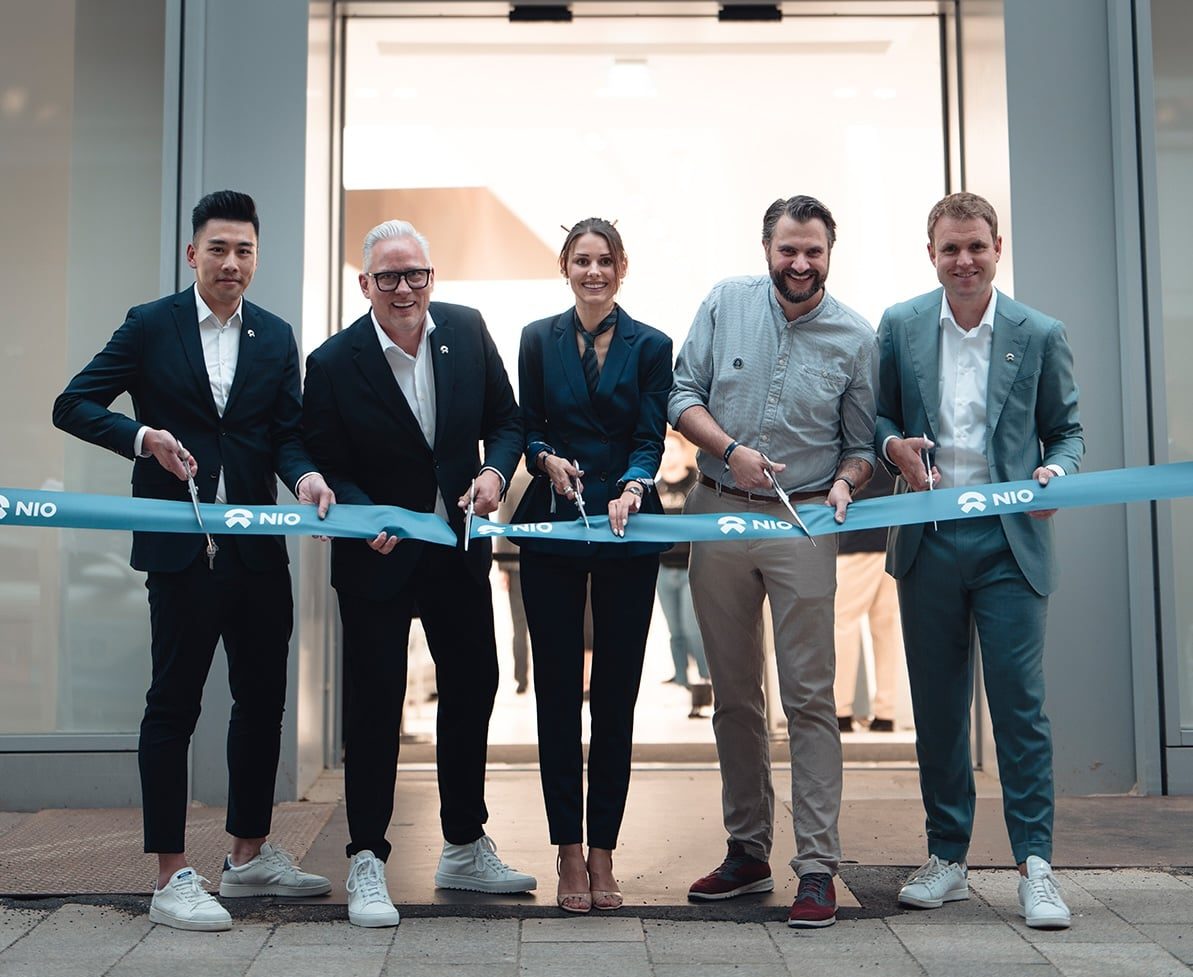

Nio has decided to close its ‘Nio House’ in Hamburg, shutting one of its flagship brand showrooms in Europe for the first time on record as the Chinese premium EV marque continues to face weak demand in the region.
The company confirmed the closure to the German outlet Elektroauto News, which said it had first learned of the move from two independent sources close to the company.
Nio, which was founded by William Li in 2014, has not announced the closure through its own channels as of Saturday.
The central Hamburg location, which opened only two years ago, will shut for good on July 20.
A Market Retreat and a Building Site
Nio gave two reasons.
The first was the state of the wider car market.
Citing current conditions in the industry, a company spokesperson told Elektroauto News that Nio was “streamlining its business activities in the European market,” and framed the Hamburg decision as part of that broader restructuring.
The second was a specific local problem: major construction work directly outside the building that, the company said, disrupts traffic, safety and the visitor experience and is expected to last at least five years.
The spokesperson said the works brought noise and disruption that kept Nio from offering the premium experience it wants, and that a general review of its German presence had then tipped the decision toward closure.
A Two-Year-Old Flagship
Nio opened the Hamburg Nio House in June 2024, its fourth in Germany after Berlin, Frankfurt and Düsseldorf.
The launch drew around 170 guests, and the 1,294-square-metre space, spread over two floors, was designed by the studio 1zu33 around a harbour theme meant to echo Hamburg’s maritime character.
The showroom followed the template the company has used worldwide: not merely a place to view EVs but a community space with a café, lounge, library, meeting rooms and a programme of art, music and lifestyle events.
That format, which the company calls a ‘Nio House’, sits at the centre of its attempt to establish itself as a premium name in Europe
Nio first brought the concept to Europe in 2021, opening its debut overseas Nio House in Oslo before expanding into Germany, the Netherlands, Denmark and Sweden from late 2022.
Two years after opening the Hamburg house with a launch party and a bespoke cocktail, the company is closing it without public fanfare.
Nio’s European Retreat
Sales in Germany have collapsed.
After registering 1,263 vehicles in 2023, Nio sold 398 in 2024, 325 in 2025 and only 15 in the first half of this year, down 87.6% from 121 a year earlier and an average of about 2.5 registrations a month, against roughly 20 before.
Its weakest months, January and April, brought a single car each; in June it registered three, and across eight European markets it managed 77, a total propped up largely by its cheaper Firefly brand.
The collapse looks specific to Nio rather than to the market conditions it cites.
In June, as Nio sold three cars in Germany, Tesla registered 7,768 there, BYD 6,259, Leapmotor 2,662 and XPeng a record 922 — the Chinese brands among them more than tripling year on year, according to figures from the KBA, Germany’s motor-transport authority.
Even Lucid, a loss-making premium arrival, registered 31 units — ten times Nio‘s total.
Nio‘s figures carry a caveat.
As EV reported in March, its subscription model registers each car only once, however many customers later use it, and has distorted its European data since 2022, so the near-zero recent tallies partly reflect an existing fleet already counted and now cycling between users.
Even so, they point to a near-total halt in fresh intake: every Nio on sale in Germany is a 2023 or 2024 model built on the older NT 2.0 platform, and its signature battery-swapping has struggled to scale against fast-moving rivals.
Since late 2024, the brand faces total duties of 30.7% on its China-built vehicles — a 20.7% countervailing levy on top of the standard 10.0% import tariff.
Leadership in Germany
The German operation has also churned through leadership.
Nio launched in the country under Ralph Kranz, a former Volvo executive who opened its first German Nio Houses, before handing the role to Marius Hayler, its Norway boss, in November 2023.
Hayler left for Polestar after eight months, and his successor, David Sultzer, was dismissed in February after the single-car month — since when the post has stood empty.
The company now runs its European operations with a single general manager, An Ho, based in Norway — its strongest market and the one that sits outside the EU’s tariffs on China-built cars — leaving Germany and its other markets without a country head.
Senior executives have conceded strategic errors; vice-president Mark Zhou has said European staff “kept telling us, our cars are too big.”
Nio has meanwhile broken up its directly run European operations and shifted to a distributor model in its first-wave markets — Germany, Norway, the Netherlands and Sweden — so local dealers rather than company-leased showrooms now carry sales, stripping out the fixed costs that spaces such as the Hamburg Nio House represent.
A Network Already Shrinking
The retreat in Hamburg fits a global trend the company has said little about.
Nio‘s worldwide Nio House count fell for the first time in 2025, dropping from 180 at the end of 2024 to 171 a year later, according to data compiled by EV — the first annual decline since the first such showroom opened in Beijing in 2017, and down from a peak of 187 in April 2025.
Because Nio does not disclose which individual locations it closes, quiet European shutdowns cannot be ruled out; Hamburg is, however, the first the company has confirmed on the continent.
The belt-tightening is deliberate.
After posting its first-ever quarterly profit in late 2025, Nio made cost discipline a priority as it chases its first full year in profit, cutting fourth-quarter research spending by 44.3% and administrative costs by 27.5% year on year, and folding sales into shared, multi-brand stores that house Nio, Onvo and Firefly under one roof.
The premium showrooms, with their prime addresses and event programming, are among the costliest parts of that retail model, making them an obvious target as the company puts margins ahead of reach.
What Remains
For now, Nio says it will keep the rest of its German footprint — Nio Houses in Berlin, Frankfurt and Düsseldorf — and run sales and service through those sites, its smaller Nio Hubs and a partner network for repairs.
Nio has publicly rejected the idea that it is retreating from Europe.
Its Norwegian unit said in June that recent coverage gave an unnuanced picture, recasting the changes as a shift from rapid expansion to profitability, with Ho describing the pullback as a matter of “prioritising correctly to build long-term value.”
The company singled out Norway — its strongest European market, where it has just added a battery-swap station — as a top priority, and the Hamburg spokesperson likewise said Germany remained an important part of its strategy.
Weeks after that reassurance, Nio is closing one of its European flagships.
The company left open whether other locations could follow, and earlier reports have flagged several city-centre houses as under review because of high rents in premium districts.
The contrast is stark.
Even as founder and chief executive William Li targets a steep increase in global deliveries this year — the group accumulated roughly 294,000 orders through mid-July, according to Goldman Sachs.