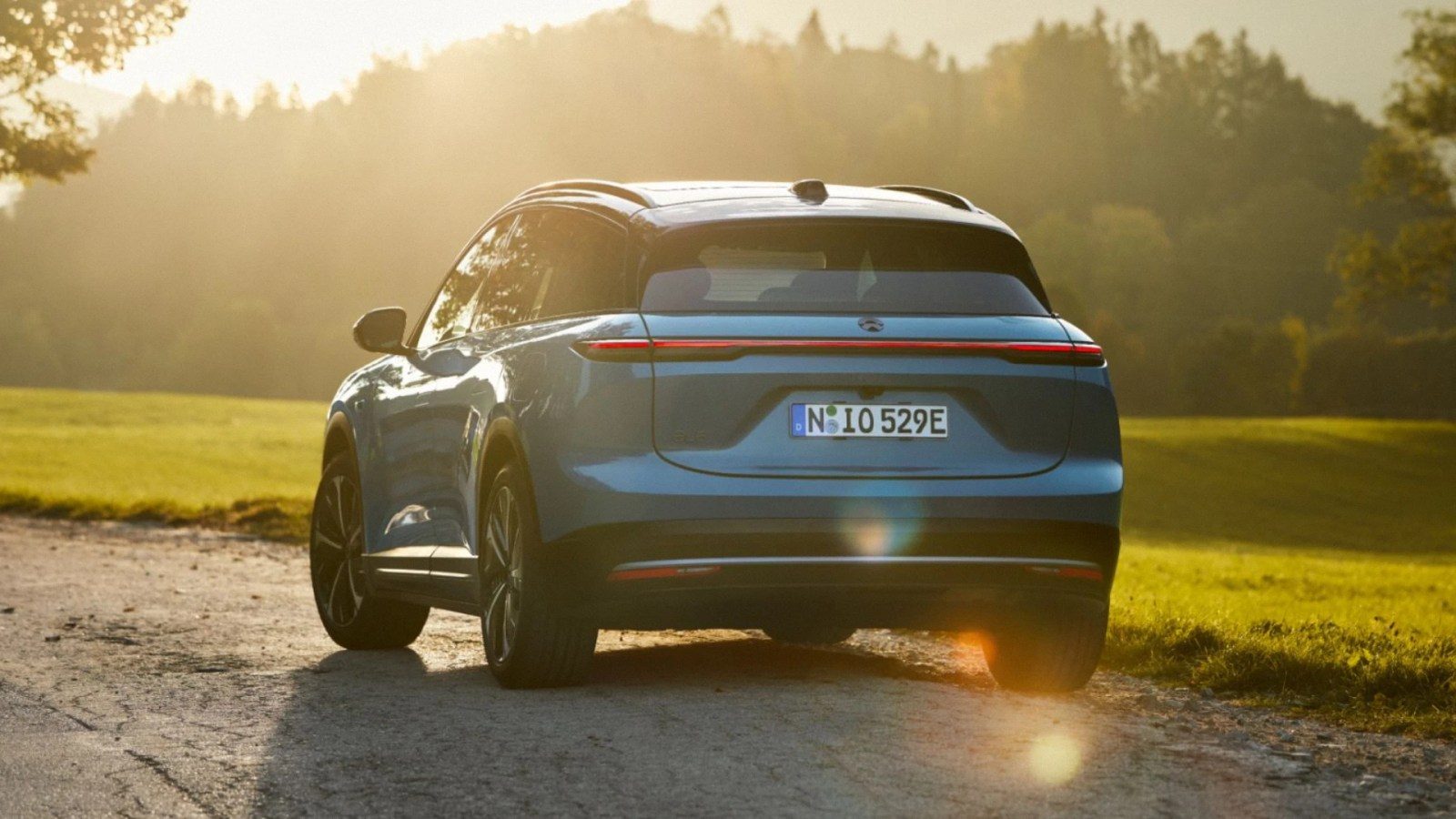

Chinese EV maker Nio has been struggling with demand in the German market since the beginning of the year.
Once one of its two strongest markets in Europe — alongside Norway — the company registered just three vehicles in Germany last month.
The figure represents a 19-unit drop from May 2025, when Nio sold 22 units, and a two-unit increase from April, when only one vehicle was registered.
Year-to-date, Nio has registered 12 vehicles in Germany — a 88.6% decline from the 105 EVs sold between January and May 2025, when deliveries averaged 21 units per month.
In the first quarter alone, Nio registered just eight vehicles in Europe’s largest auto market — an 87% plunge year-over-year.
Despite broader EV market share growth in Germany last year, Nio sold a total of 325 vehicles in 2024, an 18.3% decline from the prior year.
European Restructuring
EV learned earlier this year that Nio has broken up its European operations and moved sales in its original entry markets to distributor models — mirroring the approach it took for new market entries late last year.
Nio Europe — previously a single top-level department overseeing all of the company’s operations on the continent — has been broken into six units, according to an internal email seen by EV.
The most consequential change is the creation of Europe Sales & Network Development, tasked with expanding sales channels through general distributors or dealerships across Europe, excluding Norway.
The shift came alongside a broader freeze on product investment in the region.
As EV exclusively reported, Nio told its European partners that no model updates would arrive until late 2027 and that no new battery swap stations would be built.
Vehicles currently available in Europe were built in 2023 and 2024 under Nio‘s NT 2.0 platform, while the company has already moved on to its third-generation architecture in China.
Nio‘s Vice President Mark Zhou admitted in late February that the company made “fundamental miscalculations” in its European expansion, including bringing vehicles that were too large for local preferences and underestimating regulatory complexities.
German Business Overhaul
As EV exclusively reported, Nio Germany chief David Sultzer was ousted by management earlier this year following what was then the brand’s weakest sales month since entering the country — a low that repeated itself in April.
Sultzer’s departure made him the fourth executive to hold the top operational role in Germany since Nio entered the market in October 2022. The pace of leadership turnover has mirrored the brand’s inability to gain traction.
Ralph Kranz, former Director of Commercial Operations at Volvo Germany, was hired in March 2022 to build the business from scratch.
He exited the company in early 2024 after registrations failed to scale. Nio registered 1,263 vehicles in 2023 — Kranz’s only full year in the role.
Marius Hayler, who had led Nio‘s entry into Norway as the brand’s first European country manager after joining from Jaguar Land Rover Norway in March 2021, was moved to Germany in October 2023 to replace Kranz.
He lasted eight months before departing in June 2024 to join Polestar as Director for the Nordic countries and managing director of the Norwegian market.
German Footprint
Nio currently operates four flagship showrooms in Germany — in Berlin, Frankfurt, Düsseldorf, and Hamburg.
Named “Nio Houses,” the spaces are located in city centers and designed as community-oriented venues, mirroring the network built in China where customers gather on weekends with their families for workshops and events.
The company has also begun renting out co-working areas inside its European showrooms to third parties, charging up to €20 per hour for meeting rooms and €50 per hour for podcast studios.
According to a Manager Magazin report, Nio is looking for sub-tenants for all four German showrooms.
The Nio Deutschland GmbH 2023 annual report, first reported by Manager Magazin and covered by EV, disclosed a net loss exceeding €58 million on gross revenue of approximately €9.4 million.
Negative equity widened from roughly €22.3 million to nearly €80.4 million in a single year. The filing was completed on January 16, 2026 — well past the legal deadline.
Nio Deutschland warned in the report that 2024 and 2025 would bring a “sharp decline in revenue” and that annual losses would likely exceed the 2023 figure.
Lineup
The brand currently lets customers configure the entry-level EL6 SUV, which is priced from €53,500 ($62,300).
Nio‘s German lineup includes the ET5 sedan and the ET5 Touring, alongside the second-generation EL8 SUV (named ‘ES8’ in China).
These models were upgraded in China in 2025, and more upgrades have been promised for next year.
The company is still selling vehicles produced in 2023 and 2024 across Europe — with European management having now confirmed last month that the newer versions won’t be available soon.
The four models are available under Nio‘s Subscription offer, which allows customers to rent the vehicle for a monthly fee.
The ET7 sedan and EL7 SUV are also available within the same program.
A source familiar with the matter told EV earlier this year that the subscription programme has been distorting vehicle registration data for the brand in Europe since it began in 2022.
As of Tuesday, Nio’s German inventory listed only a limited number of ET5 Touring and EL6 vehicles.
Nio has been running financing promotions on its German inventory since the first quarter, offering 0% interest on 48-month terms for the ET5, ET5 Touring, and EL6.
The offers apply exclusively to vehicles with short-term registrations of up to 24 months — indicating pre-registered or demo stock rather than factory-fresh units.
The EL8 is listed separately at a 4.12% fixed rate for “existing vehicles.”
The promotion was initially set to expire on March 31 but has since been extended to June 30.
Unlike other European markets — such as Norway and the Netherlands, and all the markets the company has entered last year — Nio does not offer its more affordable Firefly EV there.
German Market
Germany registered 239,448 new passenger cars in May 2026. Among those, battery electric vehicles (BEV) continued to gain ground.
A total of 59,969 BEVs were registered during the month, up 39.3% from May 2025 — lifting the electric share to 25.0%.
Hybrid registrations reached 95,466 units for a 39.9% share, with plug-in hybrids accounting for 27,921 of those (11.7% share, up 10.9%).
According to the KBA, Tesla posted the largest gain among import brands, surging 322.4% to claim a 2.1% registration share.
BYD followed with a 232.1% increase, reaching a 2.6% share — higher than Tesla‘s. The Chinese giant sells both fully electric and plug-in hybrid (PHEV) vehicles.
Domestic brand Volkswagen remained the overall market leader with a 19.0% share despite an 8.9% decline, while Mercedes and BMW posted drops of 8.9% and 3.4%, respectively.