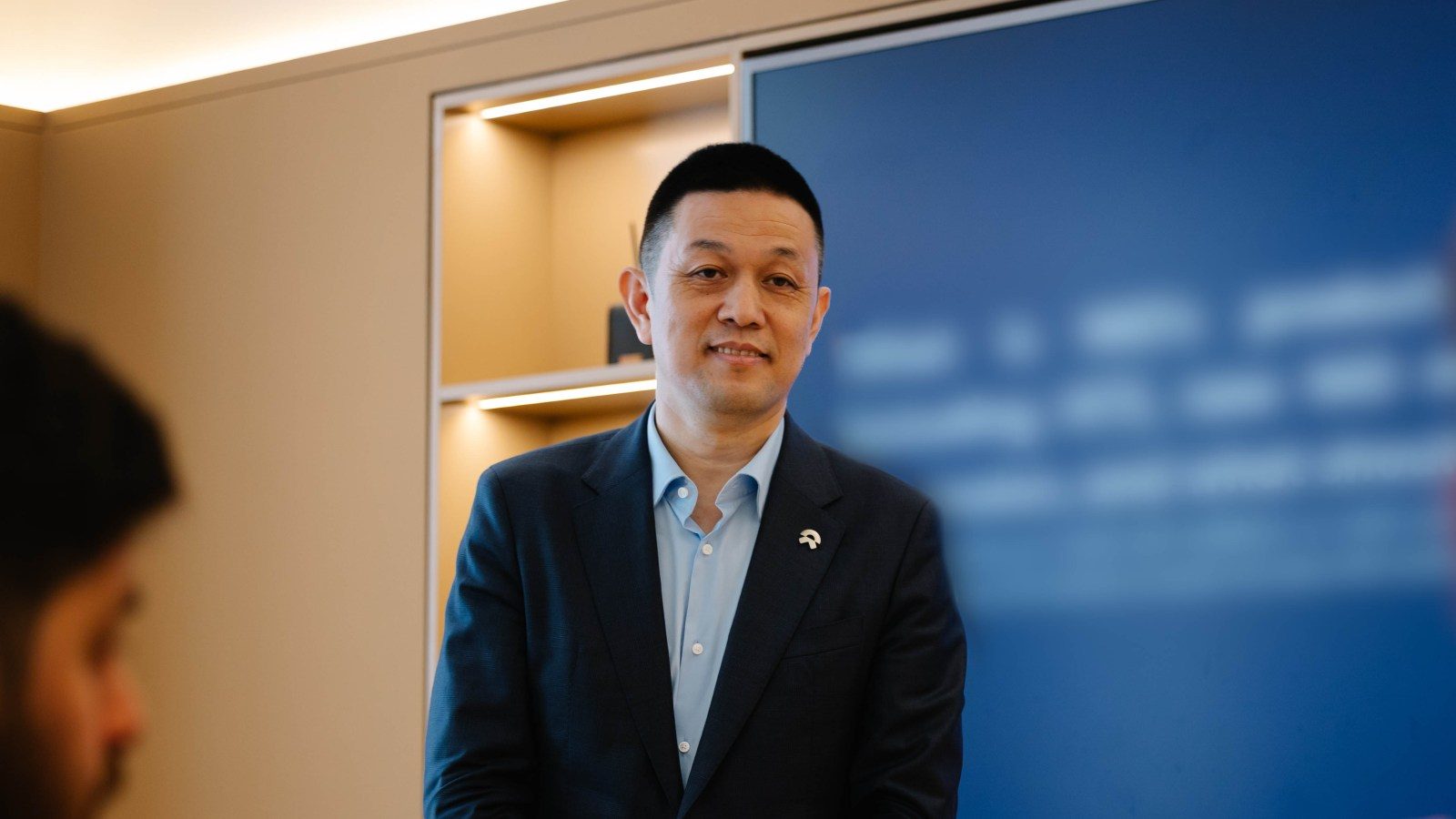

Nio Inc. founder and Chief Executive Officer William Li closed his European trip with a LinkedIn post saying the company will take a “more focused approach” to the region and will neither copy its Chinese playbook nor grow for the sake of growing.
“We will not simply replicate what works in China, and we will not pursue expansion for its own sake,” Li wrote on Friday. “Our focus is on creating the right conditions for sustainable and competitive development.”
The phrase is not new.
A media briefing Nio sent to EV and other outlets earlier this week used it twice, once in a quote attributed to Li and once in the company’s own text. The same briefing pushed the European launch of its Onvo brand to 2028 or 2029.
In the quote, Li said Nio would take its next steps in Europe “at a pace that enables sustainable growth, rather than pursuing expansion for its own sake.”
The briefing’s own text described “a disciplined approach to international development, matching products, markets and investment models more closely to local market conditions rather than pursuing expansion for its own sake.”
Li told a media briefing in May that Nio was slowing overseas expansion to concentrate on the domestic market and profitability.
Chinese giants BYD, Geely and Chery have been betting on the overseas market to reach their 2026 sales targets as domestic demand trails last year’s levels.
Nio Inc.’s founder’s internal letter in January, by contrast, set a target of a cumulative presence in 40 countries and regions by the end of 2026, a number that will be hard to square with a European strategy now defined by what the company will not do.
What the Trip Covered
The trip was Li’s first visit to Europe since November 2025.
He gave a keynote at the World Trade Organization in Geneva on Monday and met owners at the Nio House in Amsterdam on Tuesday.
The briefing described the meetings as a chance to discuss Nio’s new direction in Europe directly with users, partners and European teams.
CATL said on Friday that Li had also met its founder, Chairman and Chief Executive Officer Robin Zeng in Germany, in a post that promised to expand cooperation without disclosing details.
The photographs attached to Friday’s post include a group shot at Nio’s design centre in Munich with Nio Europe’s Hui Zhang and Kris Tomasson, who has led the company’s design team there since 2015, alongside local staff.
Nio set up the Munich studio six years before it delivered its first vehicle in Europe.
The Amsterdam session produced the week’s other headline.
Marnix Billiau, a Belgian member of Nio’s European User Advisory Board, wrote on X the next day that Li had ruled out a share buyback at the meeting, a comment that surfaced as Nio’s shares hit a fresh 52-week low.
The Hong Kong shares rose about 4% to around HK$29.10 ($3.71) on Friday, leaving them down about 30% this year and roughly 5% above their 52-week low of HK$27.62 ($3.52).
What “Focused” Means in Practice
Three concrete changes sit behind the language.
The first is Onvo. Li himself set a 2027 European launch date during his November visit. This week’s briefing moved it to 2028 or 2029.
Li expects Onvo to account for 55% of group volume in the long run, against 35% for the Nio brand and 10% for Firefly, so a delay of one to two years to its European debut pushes the bulk of the group’s volume story in the region toward the end of the decade.
The second is the operating model.
In February, Nio split its European management into six departments and moved sales toward distributors and dealers in every market except Norway.
In June, the company opened its first Greek Nio House, in the Athens suburb of Kifissia, built jointly with local distributor Motodynamics.
The briefing said the European model “will continue to combine direct operations in selected markets with local distributor partnerships,” without naming the markets that stay direct, and that the changes “do not represent an exit from Europe.”
The briefing also said Nio had spent the past year reshaping its European organization, physical footprint and operating model, calling these “not isolated adjustments.”
In Germany, Manager Magazin reported in April that Nio was seeking subtenants for its four flagship showrooms, in Berlin, Frankfurt, Düsseldorf and Hamburg.
The third is infrastructure.
At a session with owners in the Netherlands in May, Chris Chen, who heads Nio’s Global Business department, said the company would build no new swap stations or charging infrastructure in the region, according to an attendee’s account. That leaves the network at about 60 sites after the closure of the only Danish station, in Slagelse, in November. In China, the network reached nearly 4,100 stations.
Nio has added more than 400 this year against a target of more than 1,000, and Chief Financial Officer Stanley Qu has said partners, including more than 40 local state-owned platforms and financial institutions, are expected to fund essentially all of this year’s new infrastructure.
Existing Owners
“Being a user enterprise means being there not only when we sell a car,” Li wrote on LinkedIn. “We’ll continue to support them throughout the entire ownership journey.”
That sentence is aimed at existing European owners, a group that has spent the past year absorbing software delays, service complaints and now a retreat from direct operations.
The briefing, not the post, spelled out what that support covers. Nio “will continue to support existing vehicles through service, warranty, parts and connected services in line with its lifecycle commitments,” the briefing said. T
The May session in the Netherlands was called largely in response to anger over software, according to the attendee, who said owners also described waiting up to two months for spare parts.
The attendee said software updates would fall to one or two a year under current budgets and that, when owners asked about bug fixes, the company indicated there was no budget for them.
The briefing also called Nio’s services and community business an important part of its long-term business model globally.
Li told reporters in Shanghai on September 4 that the business generated more than 10 billion yuan ($1.5 billion) in revenue last year and is profitable.
The China Business
Nio has now reported two straight quarters of adjusted net profit.
The company delivered 107,658 vehicles in the second quarter, up 49.4% year on year, and posted an adjusted net profit of 26.1 million yuan ($3.9 million) on a GAAP net loss of 528 million yuan ($78.8 million).
Deliveries through August reached 262,893, up 57.9% year on year.
Nothing in the post names a market, a model, a volume or a date, and apart from the Onvo window, neither does the briefing. There was also no commitment on the swap network regarding new stations on the Old Continent.