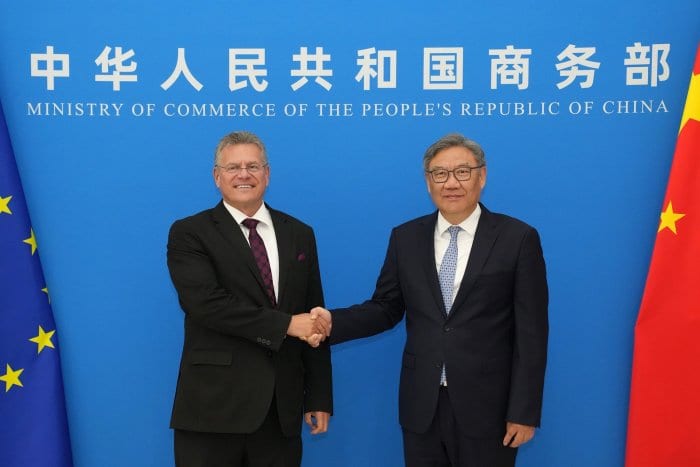

CATL said Friday that its founder and Chief Executive Officer Robin Zeng held talks with Nio founder and CEO William Li on “strategy for the next stage,” in a Weibo post accompanied by a photograph of the two founders.
The two sides will “further expand their cooperation, deepen coordination and continue to raise their standards and requirements on quality,” the battery maker wrote, adding two hashtags: cooperation takes another step forward, and quality moves up a level.
The meeting took place during the German international motor show for automobiles and smart mobility, which this week means IAA Transportation in Hannover, where CATL unveiled its TECTRANS II heavy-truck battery platform on September 14.
It is the fourth time in nine months that the two companies have publicly advertised their closeness, after a working meeting with Hefei officials in December, the five-year agreement signed in Hefei and announced on January 6, and CATL’s April media roundtable in Beijing.
It also arrives with both share prices near their lows for the year.
Market Pressure
CATL was quoted at 301.95 yuan in Shenzhen on Friday afternoon, down 20.01% year to date on market data from its Shenzhen listing.
Measured against the 468.75 yuan high it set in May, the shares are down about 36%. Market capitalisation stands at 1.44 trillion yuan ($215 billion).
The slide has accelerated this month.
The shares fell 6.16% on September 15 and a further 3.44% on September 16 on reports that carmakers are shifting to other battery suppliers, and Chinese financial media reported that CATL would address the speculation shortly.
Nio’s Hong Kong shares traded at HK$29.10 on Friday afternoon, down 29.57% year to date.
The company is valued at HK$71.63 billion ($9.13 billion). Li has reportedly ruled out a buyback as the stock set a 52-week low this week, according to an attendee at a closed-door owners’ meeting in Amsterdam.
CATL-Nio’s Relationship
Three separate relationships run between the two companies, and they are routinely collapsed into one in coverage.
The first is supply. CATL has been Nio’s principal cell supplier since the original ES8 entered production in 2018, and Yang Jun, CATL’s General Manager of Battery Swap Business, told EV in April that 93% of the battery cells Nio sources come from CATL.
That figure has been rising, not falling. Nio spent two years adding CALB, FinDreams and WeLion to reduce its exposure, then reversed course.
36Kr reported in December that Nio had ended battery supply cooperation with BYD’s FinDreams unit for the Onvo L60 because volumes could not sustain multiple suppliers, switched the Nio brand’s 100 kWh pack from CALB to CATL, and made CATL the primary supplier for Onvo’s 85 kWh pack.
The second is the battery bank. Wuhan Weineng Battery Asset Co., known internationally as Mirattery, was founded on August 18, 2020 by Nio, CATL, Guotai Junan International and Hubei Science and Technology Investment with registered capital of 800 million yuan ($119 million) and a clean 25% split.
CATL paid 200 million yuan ($30 million) for its quarter and a board seat. After repeated capital increases, Nio Holding is the largest shareholder at 19.4%.
CATL holds about 8.9%, according to Tianyancha filings.
The third is the station network, and it is the one that has never closed. In March 2025 the two signed a strategic partnership in Ningde under which CATL was “advancing” an investment capped at 2.5 billion yuan ($373 million at Friday’s rate of 6.7076 yuan to the dollar) in Nio Power.
Reuters reported the following month that CATL was in talks for a controlling stake. Eighteen months later there is no announced completion, no disclosed shareholding and no closing date.
Nio’s public line has been that it is bringing in multiple investors, CATL among them.
The Money Moving
What the two companies do not discuss in public posts is the balance sheet running between them.
Nio’s second-quarter accounts show amounts due from related parties of 14.99 billion yuan ($2.21 billion at Nio’s own rate of 6.7851) as of June 30, down from 16.08 billion yuan at the end of December.
CFO Stanley Qu attributed the decline on the earnings call to the battery asset management company, saying the amount owed had fallen from over 16 billion yuan earlier in the year to under 15 billion yuan by the end of the quarter even as the user base and the business grew.
Mirattery is paying Nio down while getting larger, and it is doing so on capital raised in the bond market rather than from its shareholders.
It has issued at least 4.5 billion yuan ($671 million) of asset-backed paper this year.
Equity has come from local government as well. Mirattery closed a 1 billion yuan C3 round on February 13 that brought in the Hefei state platforms Hefei Jiantou and Hefei Jingkai, taking its Series C to RMB 2 billion and total funding above 3 billion yuan.
The asset pool behind that paper has grown from more than 6 GWh in March 2022 to more than 51 GWh serving over 650,000 users by early June.
CATL supplied many of the cells inside those packs, owns a slice of the company that holds them, and benefits from every financing that lets that company buy more.
Singapore’s sovereign wealth fund GIC has sued Nio in the United States alleging the company inflated revenue by more than $600 million through Mirattery, echoing a 2022 short-seller report that Nio has denied for four years.
Two Networks
The scoreboard is the clearest evidence that “dual-network” means two businesses rather than one.
Nio publishes a live counter. Its own Power page and daily site-opening posts put the China network at more than 4,080 swap stations, alongside over 5,300 charging stations and more than 30,400 proprietary piles.
About 60 stations sit in Europe, where the network is seeing little increase in the last 18 months.
The company passed 120 million cumulative swaps on August 7, the same morning it opened its 4,000th China station and the first fifth-generation site in Quanzhou.
Nio0s full-year target is more than 1,000 additions and a year-end network above 4,600.
Qu told analysts that essentially all of this year’s new infrastructure is expected to be funded by partners, more than 40 state-owned platforms and financial institutions across 25 provinces, under a model where the partner owns the asset and Nio operates it.
Nio has never reported the swap business as independently profitable.
The fifth generation is where the group’s three brands finally converge. Forty-two gen-5 stations were live across 33 cities and 15 provinces by mid-September, and Firefly, which gen-4 stations cannot serve, recorded 10,000 swaps in 39 days on them, about 256 a day.
CATL publishes no live counter, only milestones.
Its last hard print is 2,000 Choco-Swap stations across 180 cities and 31 provinces as of June 30, up from 1,020 in 45 cities at the end of 2025, with more than 200 added a month in the second quarter.
The targets are more than 3,000 passenger stations by year-end, more than 4,000 including Qiji heavy-truck sites, around 1,000 highway locations signed by the end of 2026 and built during 2027, and 30,000 in the long run through franchising.
Qiji stood at 305 truck stations at the end of 2025 with 900 targeted this year.
The hardware differs as much as the disclosure. Nio’s gen-4 stations hold 23 packs and complete a swap in about two and a half minutes with the driver in the car, and gen-5 raises vault capacity by roughly a fifth while accommodating wheelbases long enough for every brand.
CATL advertises a 99-second swap, vaults of 14 to 30 packs, up to 600 swaps a day and Shenxing fast chargers built into every site. Those are company claims, not independently measured throughput.
The two counters are not additive. Nio’s stations serve Nio, Onvo and Firefly. CATL’s serve GAC Aion, BAIC Arcfox, Changan, Chery, FAW and fleet operators, and cannot take a Nio pack.
The Firefly Plan
The March 2025 agreement promised unified standards and Firefly models on Choco-Swap. Firefly launched a month later on Nio’s own fifth-generation plan instead, and the Choco commitment was narrowed to future models. Eighteen months on, no Firefly runs on a CATL station.
Li used the Quanzhou event on August 7 to explain the underlying logic from Nio’s side.
The company is on a ternary system, he said, and a 120 kWh pack will fit the same standard pack envelope and work across every model. That is the strategy that binds the two companies.
The mechanical envelope stays fixed, the chemistry inside it changes, and CATL supplies the chemistry.
Why the Timing Is Not Neutral
The pressure on CATL is not abstract.
Li Auto has already moved several models onto in-house and joint-venture packs, with the new Mega and i9 starting on CATL 5C cells and switching as in-house capacity comes online. Xiaomi has added CALB and Sunwoda alongside CATL and FinDreams.
And by June, CATL’s customer ranking told the story from the other side: Geely at 8.2% of its shipments, Changan at 8.0%, Xiaomi and Li Auto at 6.8%, and Nio fifth at 6.2% despite outselling both of the companies above it, because Firefly’s Sunwoda pack is the only significant non-CATL battery left in the group.