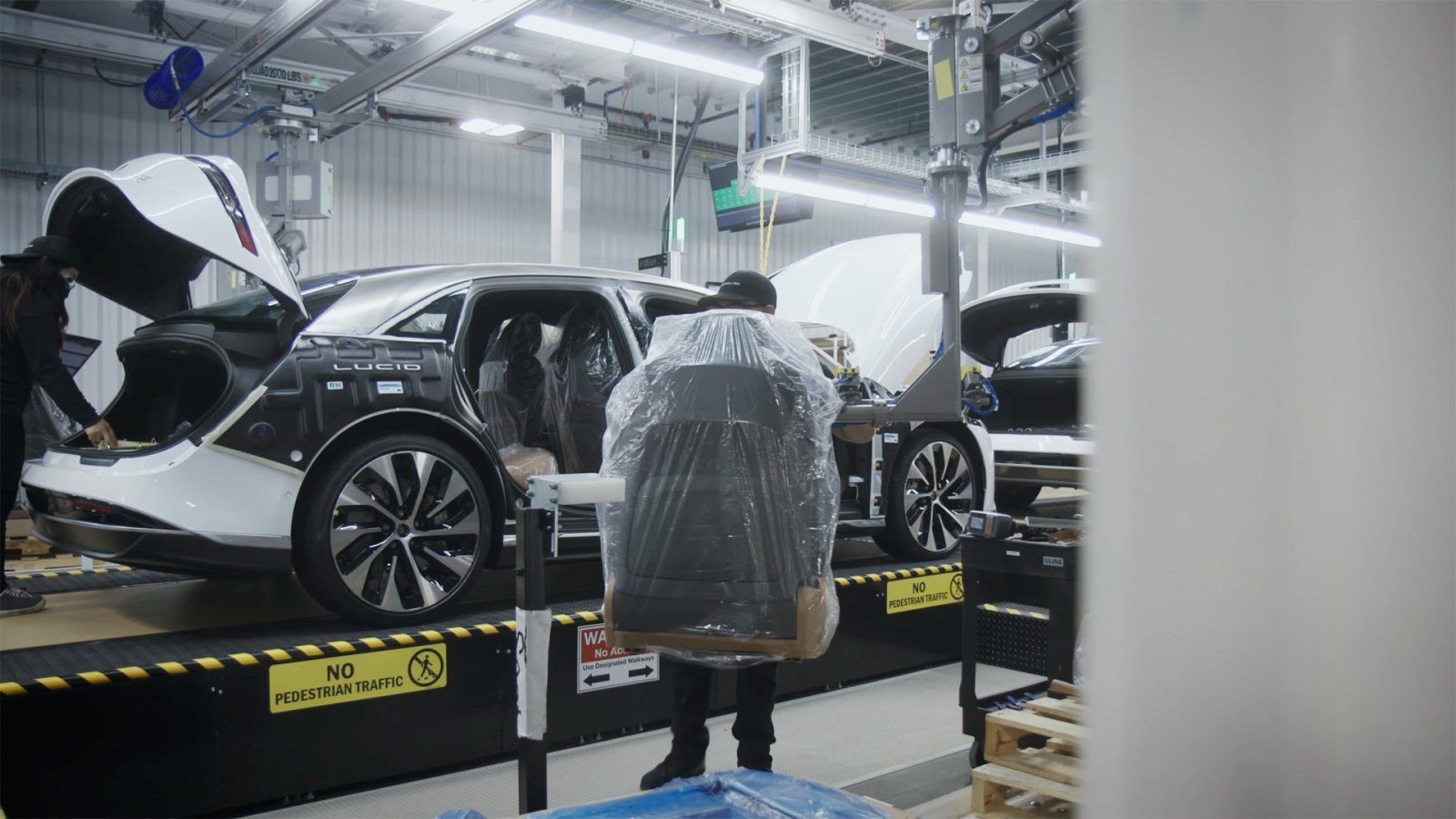

Lucid Motors‘ new chief executive has pushed back on the idea of building the Cosmos at its underused Arizona factory, telling analysts the plant’s design rules out an efficient third production line — even as the facility operates at roughly a fifth of its installed capacity.
Silvio Napoli addressed the question directly for the first time on Tuesday’s second-quarter earnings call, after Morgan Stanley analyst Andrew Percoco noted the company is “right now running AMP-1 at a pretty low utilization rate” while still ramping the Saudi site.
“I’m just kind of curious what your philosophy or your strategy is in terms of potentially consolidating Midsize production into AMP-1 and maybe mothballing AMP-2,” the analyst asked, pressing management on “trying to be maybe a little bit more capital efficient and running a higher utilization rate to optimize that fixed cost structure while demand is relatively de minimis in the near term.”
Napoli said he raised the same issue when he joined the company — and defended the original call.
“In essence, this is part of what we’re looking at now as part of our strategic planning. But to be clear, I asked the same question coming in, but the fact is today the AMP-1 factory is meant to design to produce Air and especially Gravity,” the chief executive said.
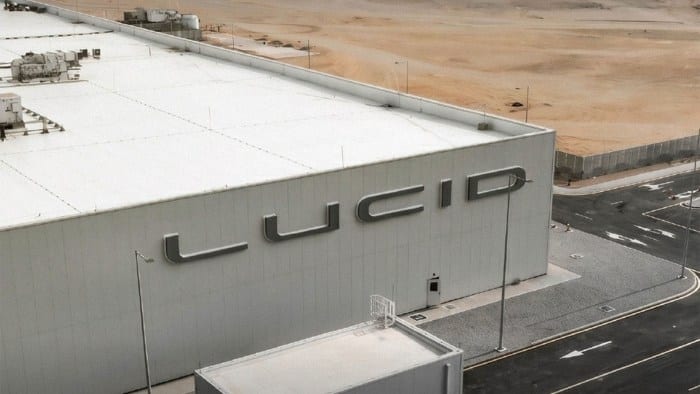
“The way the factory is designed, introducing a new line will create inefficiencies on the other models. That’s why the decision was taken to put this factory with a new platform in Saudi Arabia with AMP-2,” Napoli added. “So going forward, clearly, our job is to make sure we ramp it up with quality on both sides.”
The Schindler veteran, who formally took over on June 1, stopped short of closing the door entirely.
“For now, that’s all we can say, but I think it’s a very understandable question and one that is — we cannot answer for now, but still a key to our profitability going forward,” Napoli said.
A Fifth of Capacity
Casa Grande has been able to build 90,000 vehicles a year since January 2024, when Lucid commissioned a 2.85 million-square-foot expansion that nearly tripled the plant’s original 34,000-unit capacity.
Output has never come close.
Second-quarter production of 4,774 vehicles annualizes to about 19,100 units — a utilization rate of 21.2%, according to EV calculations.
Full-year 2025 production of 17,840 vehicles, the plant’s best result to date, equates to 19.8% of capacity and roughly half of what the factory could build before the expansion opened.
The rate is set to fall further. Management said second-half production will run below the second-quarter pace after Lucideliminated the plant’s second shift in June, a move that affected more than 700 employees and about 400 contracted workers in Casa Grande.
The second shift itself lasted roughly eight months. Lucid started the additional shift in late 2025 to support the Gravity ramp, as EV exclusively reported at the time — a push that lifted fourth-quarter output to a record 7,874 vehicles and, with demand lagging, built the inventory the company is now drawing down.
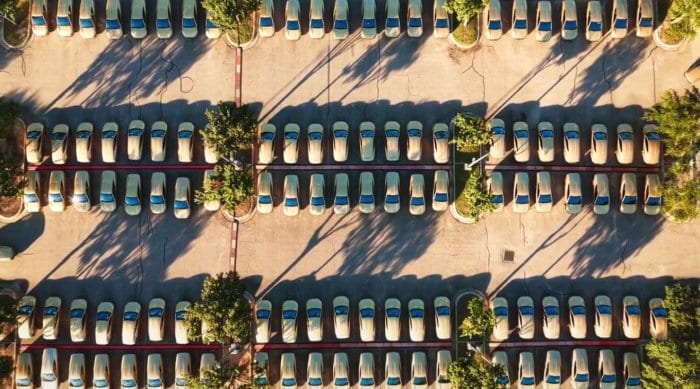
A July drone flyover of the plant showed staging lots still full of unsold Gravity units.
By the thresholds Tesla chief Elon Musk described in March — commenting on reports that BYD was running below half capacity — factories perform well above 80% utilization, become marginal at 60% and face “mega pain below 50%.”
Casa Grande operates at less than half of Musk’s pain threshold.
A Question Left Unanswered in February
Tuesday’s exchange resolved a question management had previously avoided. On the February earnings call, a shareholder asked whether Lucid intended to use AMP-1’s existing capacity for midsize production before pursuing further expansion — and management did not address it.
The Saudi-first plan also reverses the company’s original blueprint.
Former chief executive Peter Rawlinson said in January 2024 that the midsize vehicle was expected to be built at Casa Grande within the plant’s “90,000 units per annum” capacity.
Financial logic has since hardened the Saudi case.
Producing the midsize platform at AMP-2 lets Lucid source components from China without US tariffs, former finance chief Taoufiq Boussaid said in December — a duty burden of about 45% on parts imported to the US facility, including the high-voltage battery pack.
The plant will also serve a Saudi government commitment to buy more than 4,000 vehicles annually through 2032.
The Robotaxi Math
Napoli pointed to a different source of volume for Casa Grande’s idle lines.
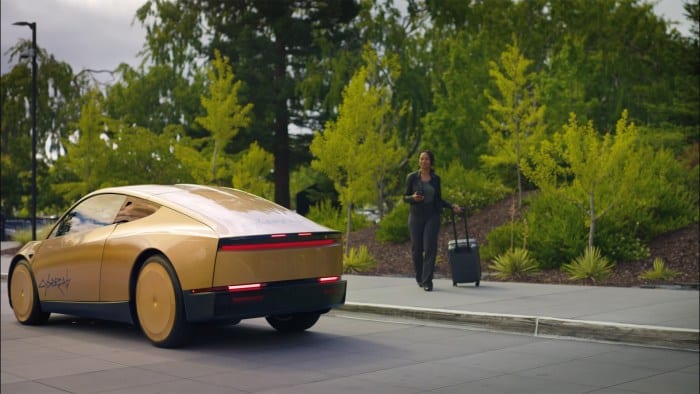
“Let’s not forget that now we have a new source of volume, which is the robotaxi,” the CEO said.
“So our plan is to optimize capacity utilization by also looking at these volumes and others that may come going forward, first of all by traditional business, but also by others that Lucid Technologies might generate,” Napoli added.
In his prepared remarks, the new chief said the program is “deep into the testing and validation phase with an active engineering fleet of nearly 100 vehicles across the San Francisco Bay Area and Houston.”
The fleet figure, however, has barely moved in five months.
Nuro first disclosed the “nearly 100” count in March, the same month then-interim chief executive Marc Winterhoff told Investor Day attendees that all engineering test vehicles for the program had been delivered.
On the first-quarter call in May, Lucid‘s management put the precise number at 75 engineering vehicles delivered to Nuro and Uber — a quarter below the round figure Nuro had been citing.
The partners repeated “nearly 100” in the June announcement of the Houston expansion, and Napoli used the same characterization on Tuesday — nearly 11 months after the first engineering prototype was handed to Nuro in September 2025.
A fleet of 100 vehicles equals less than half a day of Casa Grande’s output at full 90,000-unit capacity, according to EV calculations.
The Cosmos itself slipped again on Tuesday.
AMP-2, where a 30-year Ford veteran now runs operations, will be ready for production in early 2027, with prototypes off the Saudi line from early next year and series output in the second half of 2027 — pushed back from the prior late-2026 target.
Under earlier guidance, US production of the model was expected to follow six to 12 months after the Saudi start; the company did not say on Tuesday whether that sequencing still holds.