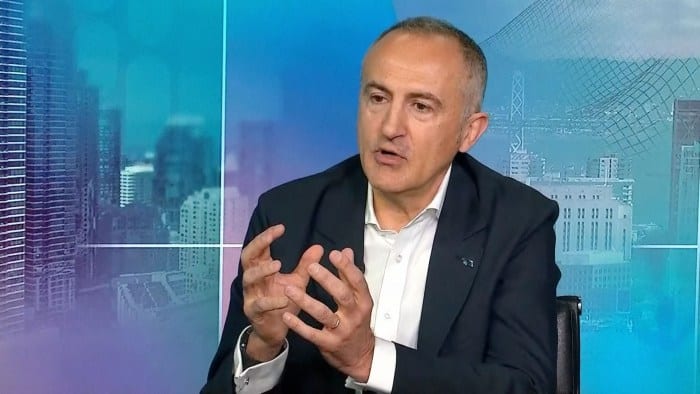

Lucid will not restore annual guidance this year — and its chief executive went further, telling analysts on Tuesday’s call that their models are stale and that production and deliveries “are expected to come in below current consensus estimates.”
Silvio Napoli said the company is “not yet in the position to provide detailed guidance” and will set formal targets only after the leadership team completes its strategic planning process.
At the third-quarter results in November, Lucid will report progress on the $1.4 billion cash plan including a liquidity update, on the Uber-Nuro robotaxi program and on AMP-2 factory readiness.
At the year-end results, the company said that it will issue “guidance for 2027, as well as a mid-term plan and targets.”
The 2026 range withdrawn in June, in the same week as the 18% US workforce reduction, will never be replaced, and the year ends unguided.
A Warning
What Napoli offered instead was directional, and it pointed down.
Current consensus estimates, he said, “are based on operating models that no longer reflect the figures we anticipate today.”
The claim had already been demonstrated an hour earlier: second-quarter revenue of $405.3 million came in 4.0% below the roughly $422 million analysts had penciled in before the report — the models were running high before the warning was issued.
Output in both the third and fourth quarters is expected to run below the second quarter’s 4,774 vehicles, reflecting AMP-1’s transition “from two shifts to a single shift configuration through year end.”
The arithmetic that follows buries the old target without ceremony: with 10,274 vehicles produced in the first half and two quarters capped below 4,774, full-year production cannot reach 19,900 — at most 79.3% of the withdrawn range’s 25,000 floor.
The shift change carries its own history: the second shift at the Casa Grande plant was added only in the third quarter of 2025, celebrated then as evidence of the Gravity ramp. It lasted about a year.
Deliveries carry the opposite sign.
As inventory exists to sell down, deliveries “should be above” the deliberately reduced production, the CFO Bousaid stated.
In his last call as finance chief, the executive said that second-half deliveries supported by recent product and service announcements and showing sequential growth from the second quarter’s 3,953 “broadly consistent with a typical seasonal increase” — though more moderate than a year earlier, a period he noted was flattered by pulled-forward demand and the Gravity ramp.
The demand evidence entering the half cuts both ways.
California’s MyFirstEV rebate adds $3,500 per first-time buyer in Lucid’s home market, uncapped for the company under the state’s in-state carve-out — while Motor Intelligence‘s July estimate put US retail at roughly 860 vehicles, down 3.4% in the most-incentivized month Lucid has run.
Last year’s second-to-third-quarter increase was 23.2%, from 3,309 to 4,078 deliveries; growth above 3,953 but below that pace implies a third quarter somewhere under roughly 4,870 vehicles.
Lucid committed to no figure inside that bracket — the bracket is what “moderate seasonal growth” means when applied to the numbers.
The shape matches the balance sheet.
The model-year-2026 stock that filled dealer lots fell $90.2 million in the second quarter, marking the inventory line’s first decline of the year.
The July incentive stack, the $10,000 credit with zero-percent financing on Gravity extended to the Air in the month’s final week, was built to keep the conversion running.
The conversion is measurable in one ratio: production ran at 1.78 times deliveries in the first quarter, 1.21 times in the second, and the instruction for the second half — deliveries above production — sets it below 1.0 by construction.
The deliveries-above-production instruction is also the $1.4 billion plan expressed in vehicles: $600 million to $800 million of the targeted savings are assigned to inventory, and every quarter in which deliveries exceed output converts stock into the cash the runway sentence depends on.
Previous Annual Guidance
The path to Tuesday’s silence runs through five steps, each smaller than the last.
Lucid guided 2025 production at approximately 20,000 vehicles in February of that year; cut the target to 18,000–20,000 at the second-quarter call, blaming trade tensions.
The company cut the top end again to around 18,000 at the third — the second consecutive quarterly reduction — and finished at 15,841, below even the twice-reduced floor.
The 2026 range of 25,000 to 27,000 followed, implying growth of 57.8% to 70.4%; it survived until June.
Tuesday completed the sequence: no number at all, a below-consensus warning in its place, and the next commitment deferred to a different fiscal year.
The second-quarter call has now reduced or removed Lucid’s guidance in three consecutive years.
Ending the pattern is assigned, by name, to the incoming finance chief.
Alexander De Bock “joins us this week,” Napoli said, and “will play a leading role in completing” the business review from which formal guidance will emerge — the first task of a tenure whose cash bonus is tied to market-capitalization hurdles beginning at $5 billion, against a company valued below $3 billion entering the print.
When guidance does return, Napoli said, it will be “grounded in market-calibrated demand, lower inventory, and disciplined cash management” — and, above all, reflect “commitments” the company is confident it “can deliver.”
For the next six months, Lucid offers a direction, a calendar and a promise. Napoli supplied the standard by which all three will be measured: “We expect to be judged by the results.”
Lucid shares traded at $7.20, down 7.1%, in extended trading shortly after the call concluded.