
California’s new $3,500 rebate for first-time EV buyers begins reaching showrooms this month, with Lucid and Tesla among the manufacturers listed as launching in August on the California Air Resources Board’s participating-manufacturers page.
Rivian, the company at whose facility the program’s bill was signed on the hood of an R2, is listed as “coming soon.”
The ‘MyFirstEV’ program, created by Senate Bill 168 on July 13, offers an instant point-of-sale rebate of $3,500 on a new zero-emission vehicle — or $1,750 on a used one selling for up to $25,000 — to any California resident buying their first ZEV, with no income cap.
The $135 million state commitment is matched dollar for dollar by the participating automakers, which fund half of every rebate on their own vehicles, for a combined pool of roughly $270 million.
Thirteen manufacturers signed on as of early Tuesday, including Ford, General Motors, Honda, Hyundai, Kia, Lucid, Mitsubishi, Nissan, Rivian, Subaru, Tesla, Toyota and Volvo.
What Tesla Does and Doesn’t Get
The program’s defining design choice is a $50,000 price cap on new vehicles that is waived entirely for EVs from California-headquartered, EV-only automakers — companies whose corporate management and staff were based in the state as of January 1, 2026.
Only two brands fill out the requirements: Rivian, headquartered in Irvine, and Lucid, headquartered in Newark — whose lineups, priced almost entirely above $50,000, become rebate-eligible at any price.
Tesla participates, but capped.
Having moved its headquarters to Texas in 2021, the company qualifies for no waiver: its sub-$50,000 Model 3 and Model Y trims carry the rebate like any other brand’s cars, while its premium models and the Cybertruck sit outside the program — a structure under which Tesla helps fund a subsidy whose upper reaches exclude it.
An earlier draft of the state’s rebate concept had floated market-share limits that could have excluded Tesla outright; the objections that drew gave way to the residency test, which accomplishes a narrower version of the same thing.
The statute’s severability clause means a successful legal challenge to the carve-out would not end the rebate — it would simply impose the $50,000 cap on Rivian and Lucid as well.
Lucid’s Timing Could Hardly Be Better
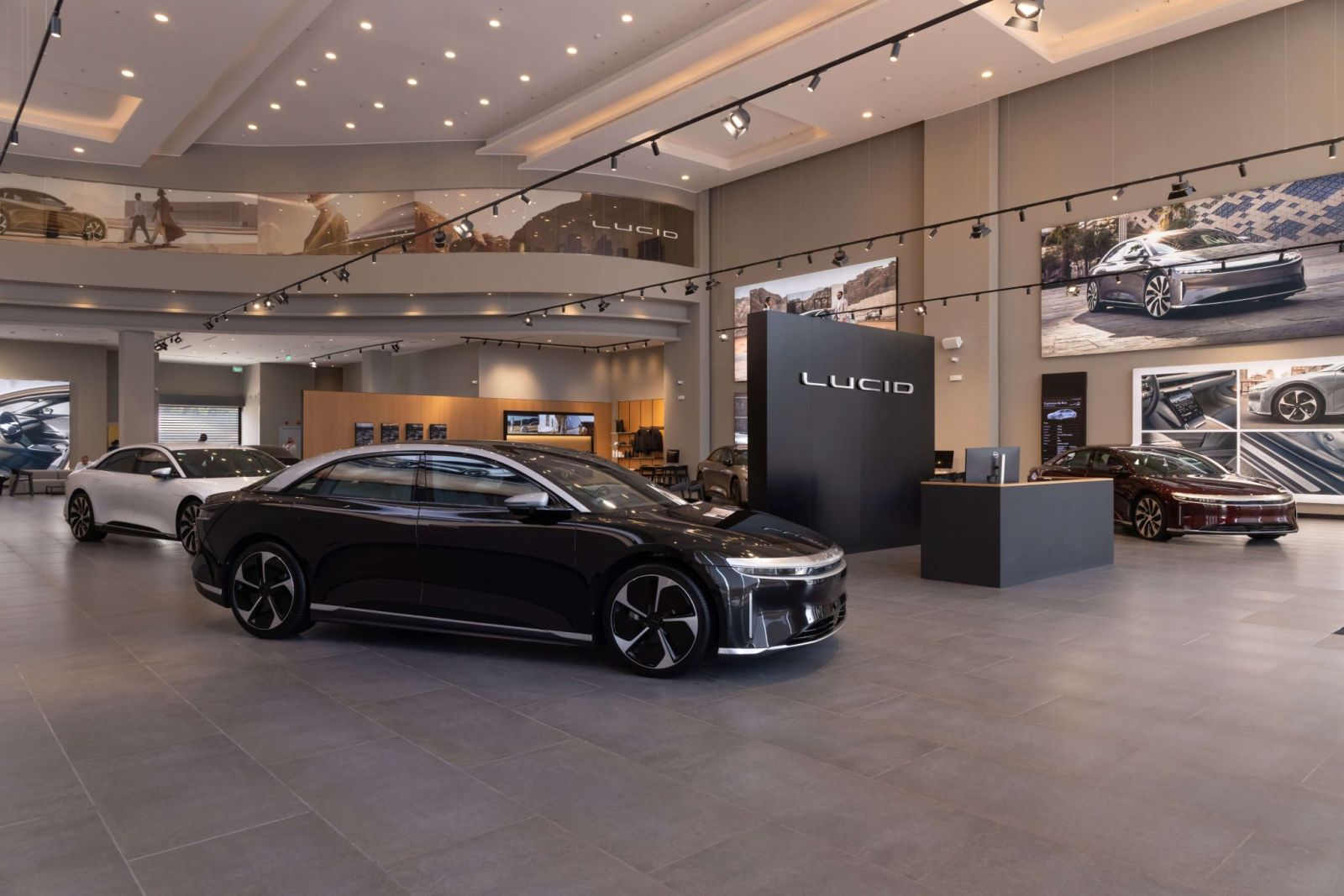
For Lucid, the August launch lands directly on top of the most aggressive incentive quarter in its US history.
The state rebate becomes stackable, in principle, with the $10,000 Lucid Credit and zero-percent financing for 72 months running on 2026 Gravity stock through the program’s August 31 delivery deadline — in the state that is the company’s largest single market, during the month its clearance program expires.
A first-time EV buyer in California could, on the arithmetic, take $13,500 of combined support into a Gravity purchase at any price.
The scale of the state program is also proportionally largest for Lucid.
Under the even per-manufacturer split the governor’s office described — corroborated by Rivian‘s chief financial officer, who told analysts “there are caps by OEM” — each brand’s combined pool runs near $20.8 million, or roughly 5,900 new-vehicle rebates.
Against Lucid‘s US retail pace of about 900 vehicles a month on Motor Intelligence estimates, that allocation could support more than two full quarters of the brand’s entire volume.
Lucid sent an email on Tuesday promoting the incentive.
“This month, lease a MY26 Lucid Air Pure from $699/mo. for 36 months with $6,749 due at signing,” the brand said. “California residents purchasing or leasing their first EV qualify for an instant MyFirstEV discount of $3,500 for new Lucid vehicles and $1,750 for preowned Lucid vehicles, applied directly at time of purchase.”
Rivian Not Yet Live
Rivian‘s participation lands in a half-year in which the company’s deliveries have repeatedly beaten its own outlooks, and CFO Claire McDonough, asked directly on the second-quarter earnings call, said the company is “really happy with the California EV incentive program.”
Additionally, McDonough said last week that the brand is eager to “attract new first-time EV owners into the Rivian community,” while cautioning that per-manufacturer caps and the first-time-buyer restriction impose “limitations in terms of the full population set.”
Governor Newsom signed the bill itself at a Rivian facility, on the hood of an R2 — the vehicle the carve-out most conspicuously rescues, since the $57,990 R2 sits above the general capand would be excluded at any other brand.
The rebate would be the first purchase incentive in the R2’s existence — the model has sold since June with none, while Rivian’s R1 lease sheet moved almost monthly — and R2 buyers must now watch Lucid and Tesla customers claim state money first.
The Market the Program Is Trying to Rescue
California zero-emission vehicles reached a record 29.1% of new registrations in the third quarter of 2025 as buyers rushed the expiring federal credit, fell to 18.9% once it lapsed, and battery-electrics dropped to 13.7% of registrations in the first quarter of 2026 from 21.0% a year earlier — the state’s EV share nearly halved.
The $3,500 arrives below the $5,000 automakers including Tesla, Rivian and Volkswagen had urged, and less than half the federal credit it replaces, but it is the first direct state purchase subsidy since the Clean Vehicle Rebate Project closed to applications in 2023.