
The European Union is preparing to impose countervailing duties on plug-in hybrid vehicles (PHEV) imported from China, the Handelsblatt reported on Thursday evening, citing high-ranking EU officials and industry sources.
Three people involved in the process told the German newspaper that an anti-subsidy investigation has already been prepared, allowing the European Commission to move quickly once a majority of EU member states give their approval.
The move would target vehicles from Chinese manufacturers including BYD, Chery, and SAIC, the parent company of MG.
The planned action aims to close a loophole that Chinese automakers have exploited since the EU imposed definitive countervailing duties on battery electric vehicles imported from China in October 2024.
Those duties, which apply on top of the bloc’s standard 10% car import tariff, range from 7.8% for Tesla vehicles produced at its Shanghai factory to 35.3% for SAIC and non-cooperating manufacturers.
BYD faces a 17.0% countervailing duty, Geely Holding Group 18.8%, and other cooperating companies — including Nio and XPeng — are subject to a 20.7% rate.
The duties apply exclusively to battery electric (BEV) passenger cars and extended-range electric vehicles (EREV).
Plug-in hybrids, conventional hybrids, and internal combustion engine vehicles fall outside their scope.
Chinese manufacturers moved to take advantage of that gap, pivoting toward hybrid exports to maintain access to the European market without incurring additional costs.
The Handelsblatt quoted an unnamed industry manager, who stated that “the Chinese were very quick to identify and take advantage of the loophole. This is an exposed weakness, and the EU needs to close it.”
Chinese Automakers in Europe
Data from multiple sources illustrates the scale of the resulting shift.
According to Procurement Magazine, citing customs data, Chinese plug-in hybrid exports to the EU surged 892% in the first two months of 2025, reaching 25,900 units.
A separate analysis from IndustryIdx found that Chinese-made PHEV sales in Europe rose nearly sixfold, from approximately 27,000 vehicles in 2024 to around 160,000 in 2025.
The Rhodium Group noted in an April report that, while the BEV tariffs briefly slowed EV exports in late 2024, shipments rebounded to pre-duty levels, and exports of plug-in hybrids and internal combustion engine vehicles that were not subject to additional duties rose rapidly in parallel.
The European Commission itself acknowledged the pattern.
In briefings ahead of the European Council summit, and according to Reuters, officials said Chinese EV imports had fallen following the 2024 tariffs, and that these producers had responded by shipping more hybrid vehicles instead.
Trade Deficit Pressure
The Handelsblatt report arrived on the same day that EU leaders gathered in Brussels to debate new and tougher measures to address the bloc’s widening trade imbalance with China.
The EU’s trade deficit with China reached approximately €360 billion ($413 billion) in 2025, or roughly €1 billion per day, according to figures cited at the summit.
EU Trade Commissioner Maros Sefcovic told a meeting of EU foreign ministers earlier in the week that the trading relationship had reached a point requiring a reset, while emphasizing the goal was rebalancing rather than confrontation.
The summit discussion reflected a growing consensus among member states that existing trade defense instruments have not been sufficient to slow the competitive pressure from Chinese manufacturers.
European auto industry group CLEPA warned earlier this year that approximately 350,000 jobs across the European automotive supply chain are at immediate risk from Chinese competition, urging EU lawmakers to act.
Not the First Hybrid Tariff Signal
The Handelsblatt report marks the most concrete indication yet that the Commission is prepared to extend its trade defense measures to plug-in hybrids, but it is not the first time the possibility has surfaced.
In January, media outlet Euractiv had reported that the European Commission was considering extending tariffs on Chinese imported vehicles to include hybrid models.
Days later, however, the Commission denied those reports, stating at the time that no such expansion was under consideration.
The shift from denial to active preparation in less than six months reflects the speed at which Chinese hybrid exports have grown and the increasing political pressure on Brussels to respond.
S&P Global Mobility had warned as early as late 2024 that Chinese brands would compensate for decreased BEV imports to the EU with more imports of internal combustion engine vehicles, hybrids, and plug-in hybrids — a prediction that has since materialized.
Chinese Plug-in Hybrids
The potential duties arrive at a moment when Chinese automakers are flooding European showrooms with plug-in hybrid models across nearly every segment.
BYD has been the most aggressive.
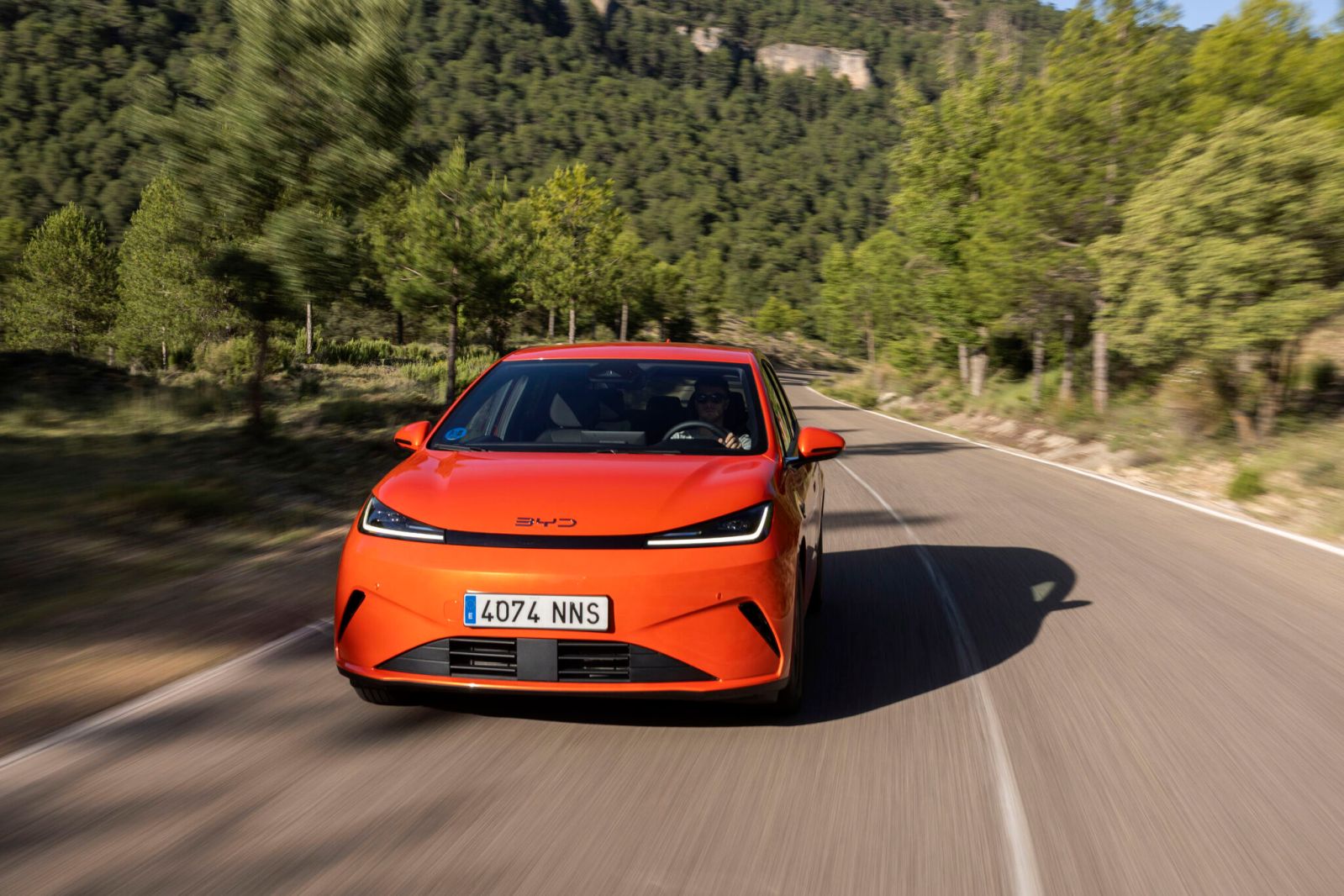
The Shenzhen-based automaker already sells the Seal U DM-i compact SUV, the Sealion 5 DM-i, and the Seal 6 DM-i sedan and Touring estate across European markets, all powered by variants of its DM-i Super Hybrid system.
The Atto 2 DM-i debuted with an entry price of €18,190 in Spain and became BYD‘s best-selling plug-in vehicle in the country, with 3,491 units registered through the first quarter of 2026.
By May, the model and the Seal U DM-i claimed the top two positions in Spain’s entire PHEV market, with 1,388 and 1,360 registrations respectively — well ahead of the third-placed Ford Kuga at 714 units.
In the Netherlands, the Seal U DM-i was BYD‘s best-selling model during the first quarter, accounting for 889 of the brand’s 1,464 registrations.
Late last month, BYD added the Dolphin G DM-i, a compact plug-in hybrid hatchback that represents the first vehicle the company developed specifically for overseas markets, including Europe.
Powered by BYD‘s fifth-generation DM 5.0 Super Hybrid technology, the Dolphin G DM-i offers a combined range of more than 1,000 kilometers and approximately 65 miles of pure electric driving range.
The vehicle targets the B-segment directly, competing against established models such as the Volkswagen Polo, Renault Clio, and Toyota Yaris.
BYD confirmed the Dolphin G DM-i will go on sale across European markets in June, with first customer deliveries expected by autumn 2026.
Chery has brought two plug-in hybrid SUVs to European and UK markets under its international-focused brands Jaecoo & Omoda, which feature models across all powertrains.
Several Chinese manufacturers have simultaneously moved to establish local European production to reduce exposure to tariffs.
BYD is building a factory in Hungary set to begin production next year.
XPeng has signed an agreement with Magna Steyr to assemble vehicles in Graz, Austria.
Stellantis and Leapmotor are planning to build the Leapmotor B10 electric SUV at a plant in Zaragoza, Spain.
These local manufacturing efforts could eventually insulate some Chinese-made vehicles from import duties, though none have yet reached full production scale.
Auto Industry Reacts
The scale of the Chinese auto push has drawn increasingly blunt responses from major automakers operating in Europe.
Kia‘s CEO Song Ho-sung told investors at the company’s Investor Day in April that the Korean automaker had been forced to close the pricing gap.
The company “narrowed its vehicle price gap with Chinese models in Europe to 15–20% from 20–25% previously depending on markets,” the chief executive noted.
Song acknowledged that “Chinese companies launched an aggressive push with low-priced EV models, and in some European countries their market share has been rising much faster than we had anticipated.”
Volkswagen Group‘s CEO Oliver Blume said in late April that the company was evaluating which of its China-developed models could be adapted for the European market and would “look into sharing capacity in European factories with Chinese partners.”
Seat/Cupra CEO Markus Haupt, also part of the VW Group, argued the competitive landscape would only be fair “if they start producing here with a similar infrastructure, with a similar labour cost, with similar material cost.”
Stellantis CEO Antonio Filosa took a different approach, framing his company’s deepening joint venture with Leapmotor as a template, saying he views the partnership “as an example of what we can do with, for instance, another Chinese automaker.”
What Comes Next
The Handelsblatt report indicates that an investigation has been prepared but that formal imposition of duties requires the approval of a qualified majority of EU member states.
The Commission is expected to present a broad review of its trade defense instruments in the third quarter of 2026, which could provide the procedural framework for action on hybrid imports.
BYD, Geely, and SAIC have already filed legal challenges against the existing BEV tariffs at the General Court of the Court of Justice of the European Union.
Those cases may take approximately 18 months to resolve. Any new investigation into plug-in hybrids would likely face similar legal scrutiny from affected manufacturers.
Beijing and Brussels have been engaged in parallel negotiations over minimum price commitments that could replace the existing BEV duties, with the European Commission publishing formal guidance on those arrangements in January.
Whether any hybrid tariff investigation would follow the same countervailing duty model or pursue a different legal mechanism remains to be seen.
The existing BEV duties are set to remain in place for five years from their October 2024 implementation, unless replaced by minimum price agreements or overturned by legal challenge.